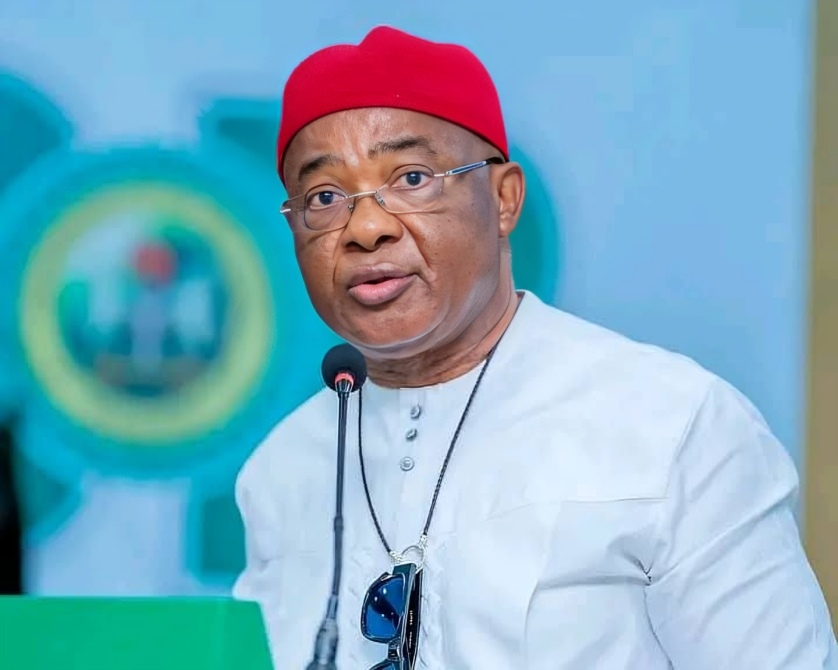
Governor Hope Uzodimma’s likely choice of a successor in 2027 may upend conventional political expectations in Imo State.
Analysts who spoke to INNONEWS say, judging from his history of surprise appointments and his “technocrat-over-politician” preference, the next Imo APC governorship flagbearer may be someone least expected — possibly even outside the core political class or his camp of loyalists.
This growing belief stems from Uzodimma’s consistent pattern of unconventional selections.
In 2019, for instance, he picked Prof. Placid Njoku — an academic with no visible political profile — as his running mate. When the Supreme Court installed him as Governor in 2020, Njoku became the Deputy Governor.
Again, in the run-up to the 2023 Imo off-cycle governorship election, when many loyalists and political allies jostled for the deputy governorship slot, Uzodimma shocked his base by choosing Mrs. Chinyere Ekomaru, a lecturer at Alvan Ikoku Federal College of Education, Owerri. Her only link to politics was her husband, Chukwuma Ekomaru (SAN), known in legal and political circles.
His ministerial nomination followed the same logic. Against expectations that he would nominate a loyalist from his CampHope structure or an APC stalwart like he did when he choose Goodluck Opiah as his nominee in his first term, he instead picked Doris Uzoka-Anite, a banker and technocrat with no political background, but who served as Finance Commissioner in his government.
“This is a Governor who plays chess while others are playing checkers,” said Mr.Bernard Anyanwu, a political analyst and former House of Assembly aspirant in Aboh Mbaise.
“A close study of his style shows he’s not driven by sentiments or political appeasement. He’s strategic, calm, and deliberate — a master of the game, who talks less to keep everyone in suspense, to keep guessing,” he told INNONEWS.
Uzodimma’s leadership style is rooted in measured decisions, not loud rhetoric.
Analysts say that they observed that he leans toward technocrats who align with his long-term governance vision rather than politicians with crowd-pulling credentials. His choices have so far leaned heavily on merit, competence, and loyalty, rather than popularity.
A critical look at Uzodimma’s cabinet, especially in his second tenure reveals a predominance of less-known political figures.
Aside from Hon. Declan Emelumba, Commissioner for Information, Strategy and Public Orientation, Barr. Enyinna Onuegbu, Commissioner for Lands and Physical Planning, Barr Ernest Ibejiako, a former member of House of Representatives, now Commissioner for Mines, and Barr. Nnamdi Anyaehie, his Chief of Staff, many others in key positions lack strong name recognition across the State.
Only a few or a handful of core political loyalists are in his government. Majority of those serving in his administration are not well-known or popular politicians.
“Most of his Commissioners and aides are not big-name politicians. That tells you something — he’s deliberately reshaping governance away from political heavyweights to silent achievers,” noted Sylvanus Ekezie, a political commentator based in Owerri.
“I want you (referring to INNONEWS) to do a background check on the appointments. Most of the big-name politicians who are aligned to him do not hold appointments,” he said.
However, through strategic engagement, he has maintained close political friends and allies across the three zones in the State.
“And this gives them the impression that he will choose one of them as his successor. This may not be so. Mark my words,” he added.
The Governor is believed to have used his first term to settle most of his political followers, even though some of them such as Cyprian Akaolisa and Lady Love Ineh were sacked from office for one reason or the other.
This approach has led to the belief that Uzodimma may apply the same logic in selecting his successor — not necessarily someone with a strong political base, but a competent figure who can consolidate on his achievements and maintain policy continuity.
He had given a clue when he told a congregation at Government House chapel that he is interested in someone who will sustain his achievements no matter the zone the person comes from.
Furthermore, while the Imo Charter of Equity — an unwritten rotation agreement among the three senatorial zones — remains relevant, it is not expected to override his criteria of competence and capacity.
Mr. Anyanwu however predicts that he may still balance the equity principle with performance, thereby narrowing his options to a select few.
“The Charter of Equity is important, but knowing Uzodimma, he won’t be boxed into a corner,”
“He may find someone who ticks both boxes — zoning and capacity — but that person might not be one of the usual suspects,” he said.
“I can foresee his game plan. He will tell both Owerri and Okigwe zone leaders to nominate someone they think can succeed him from their respective zones. Certainly, they will fail in this task because it is impossible for both zones to nominate. When they fail, he will choose by himself,” Anyanwu said.*
So far, names circulating within the political grapevine largely reflect the usual power contenders, yet those close to the Governor hint that his actual choice may not even be on the public radar yet.
“Uzodimma’s style is not to show his hand too early. He’s a strategist, a master in measured political execution,”
“He’ll keep everyone guessing until the last moment because he knows that the opposition are keenly watching him to slip, for them to strategize ahead of time,” Mr. Ekezie told INNONEWS.
Insiders say his focus remains on ensuring continuity and preserving his legacy.
That may mean choosing someone who shares his governance ethos — not necessarily a popular politician, but someone with the capacity to keep the engine of the state running.
Interestingly, Uzodimma has also groomed a new crop of young politicians such as Dr. MacDonald Ebere, a long-time ally and current Imo APC Chairman, and some members of the Imo State House of Assembly, including Deputy Speaker Amara Iwuanyanwu.
While this set of new upcoming politicians are his loyalists, it is unclear what their chances may be
As the countdown to 2027 begins, Uzodimma’s eventual decision may define his legacy as much as his infrastructural strides.
And if history is any guide, Imolites should expect a surprising — even game-changing — choice.