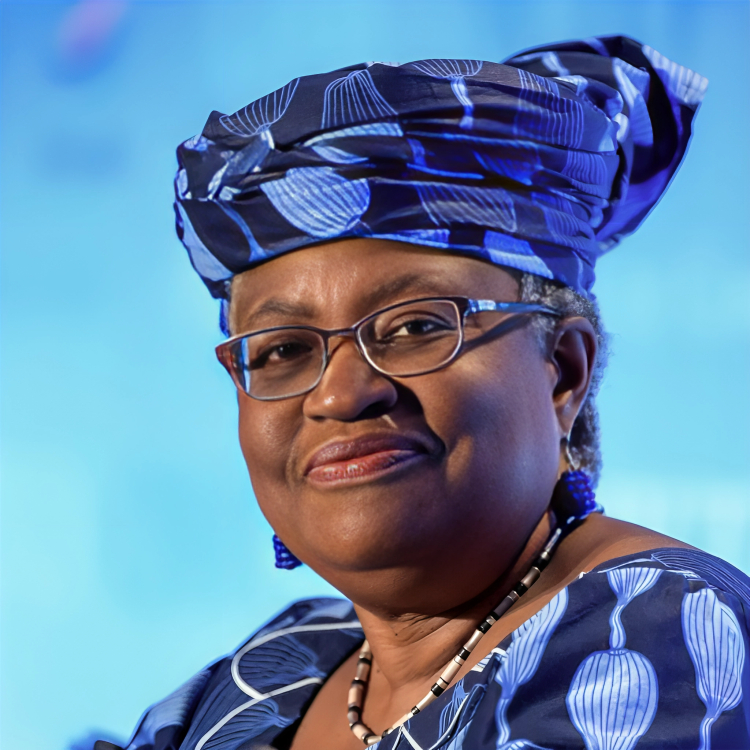
Dr. Ngozi Okonjo-Iweala’s recent statement hailing President Bola Tinubu for “stabilising the economy” through his so-called reforms is not only misguided, it is a slap in the face of millions of Nigerians battling unprecedented hunger, poverty, and insecurity.
This praise, coming from the Director-General of the World Trade Organization, reeks of elite detachment from the daily horrors that ordinary citizens endure.
What exactly is “stabilised” in an economy where food prices double every few months, the naira wobbles daily against the dollar, and millions cannot afford one decent meal a day? Is it the stabilisation of suffering? Is it the entrenchment of a two-tier society where the rich get richer while the poor are pushed into destitution?
Mrs. Okonjo-Iweala’s glowing endorsement ignores a brutal reality: Tinubu’s reforms have been a goldmine for the wealthy, foreign investors, and political cronies, while leaving the average Nigerian poorer, hungrier, and more hopeless than ever. The subsidy removal, floating of the naira, and hikes in electricity tariffs have not “stabilised” anything — they have destabilised households, businesses, and lives.
Today, inflation is at record highs. The cost of living has spiraled beyond the reach of even the struggling middle class.
Insecurity is at its worst in decades, with kidnappings, banditry, and terrorism forcing farmers off their lands and disrupting food supply chains. Yet, from the comfort of elite boardrooms and presidential villas, Mrs. Okonjo-Iweala tells Nigerians that we should be thankful for “stability.”
Let’s be clear: economic stability is not a technocratic metric in a World Bank report; it is felt when the average Nigerian can afford garri and beans without selling personal belongings. It is when mothers no longer watch their children go to bed hungry. It is when people can walk to work without fear of being kidnapped. Stability is not measured in glossy GDP projections but in the dignity and security of citizens.
The irony here is that Mrs. Okonjo-Iweala once spoke passionately about inclusive growth and protecting the vulnerable. Yet in this instance, she conveniently forgot that Tinubu’s so-called reforms have gutted the poor and shielded the rich. The promised “social safety nets” remain largely theoretical, while the people they are supposed to protect are drowning in hardship.
Worse still, her statement hands Tinubu’s administration an undeserved propaganda victory at a time when Nigerians need fearless truth-telling, not diplomatic flattery.
It signals to the ruling elite that they can continue their anti-people policies while international figures applaud from the sidelines.
If this is “stabilisation,” then Nigerians have every right to reject it. A stable economy should not be one where beggars multiply on every street corner, graduates roam without jobs, and rural communities are cut off from markets due to insecurity. Stability that only benefits stock market indices and billionaire portfolios is not stability — it is organised cruelty.
We must stop normalising economic policies that create instant millionaires at the top while condemning millions at the bottom to intergenerational poverty. We must stop applauding leaders for achieving “stability” on paper while families are buried under the rubble of austerity.
Mrs. Okonjo-Iweala may argue that growth is the next step after stability, but the Nigerian reality is this: without urgent reversal of these anti-poor reforms, growth will remain a mirage, and stability will mean nothing but the sustained suffering of the people. You cannot build growth on the corpses of a starving population.
Instead of applause, what Tinubu’s reforms deserve is a thorough public interrogation — why, after all this pain, there is still no visible relief? Why are the promised safety nets missing in action? Why is the purchasing power of Nigerians shrinking daily despite all the “bold” moves?
History will remember those who, in the face of mass hardship, chose to comfort the powerful instead of standing with the powerless.
Mrs. Okonjo-Iweala’s words place her squarely in the former category. Nigerians deserve more than stabilised suffering; they deserve leaders and international figures who will demand economic justice, not just balance sheets.