It was a grand occasion in Owerri, the Imo State capital, on September 30, 2025, when President Bola Ahmed Tinubu visited Imo State for the launch of a book chronicling the impactful years of the APC, written by Governor Hope Uzodimma.
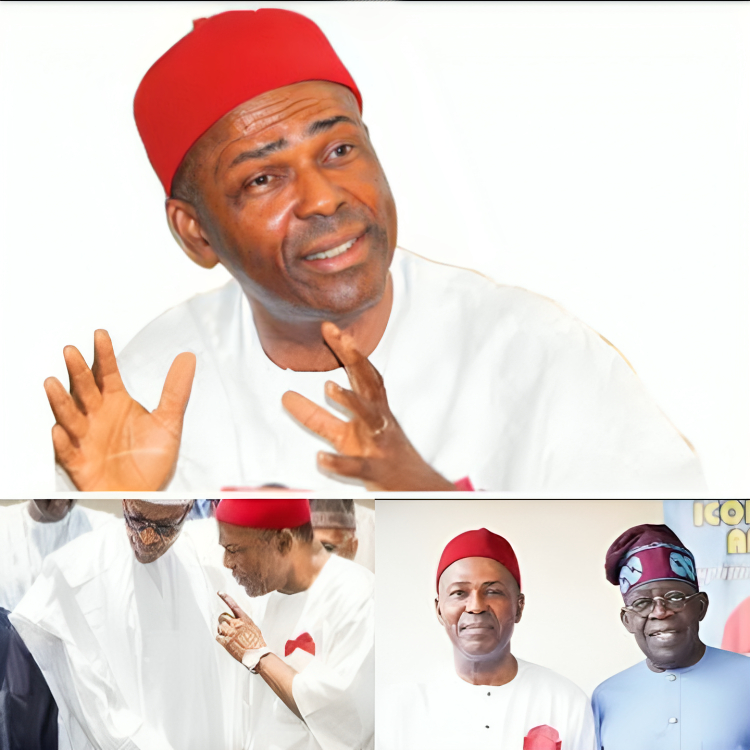
The gathering, held at the newly commissioned Emmanuel Iwuanyanwu International Conference Centre, was filled with dignitaries, party stalwarts, and seasoned politicians. Yet, one thing stood out like a sore thumb. The deafening silence over the name of Late Dr. Ogbonnaya Onu, one of the indisputable pillars of the All Progressives Congress (APC).
From the author of the book to the reviewer and virtually every speaker at the event, none remembered to acknowledge Onu’s enormous contributions. It was as though history was being rewritten in real time, with the role of a founding father carefully erased from the narrative.
Even late Muhammadu Buhari, whose political fortunes changed forever through the APC merger, had in his lifetime acknowledged Onu’s courage in steering the All Nigeria Peoples Party (ANPP) into the merger.
The history of APC cannot be complete without Onu’s name boldly inscribed on its foundation.
During the delicate formative years of the party, the merger stood firmly on a tripod: Tinubu led the Action Congress of Nigeria (ACN), Buhari brought in the Congress for Progressive Change (CPC), while Onu, with characteristic calmness and conviction, delivered the ANPP into the merger. Without this balance, the idea of a truly national party capable of unseating the PDP would have remained a dream.
It is, therefore, strange — and indeed troubling — that at such a momentous gathering, his name was conveniently forgotten.
Dr. Onu did not just play a ceremonial role; he was the bridge between North and South, East and West, Christian and Muslim blocs in the fragile negotiations that birthed the APC. His moral authority and untainted political career gave credibility to a merger many doubted could survive.
Other actors in the APC story were equally significant. Rochas Okorocha delivered a faction of APGA, while the “New PDP,” led by former Vice President Atiku Abubakar, brought defectors from the then-ruling party. Yet, it was the initial tripod — Tinubu’s ACN, Buhari’s CPC, and Onu’s ANPP — that held the vision together. To gloss over Onu’s role today is to distort history and deny the truth of how Nigeria’s ruling party came to be.
Onu, the first civilian governor of old Abia State and later Minister of Science and Technology, always carried himself with uncommon humility. He was never loud nor desperate for power. In fact, his soft-spoken nature often made him underrated in the power game. But behind the scenes, he stood firm when it mattered, ensuring that the ANPP did not falter in joining the merger talks that produced the APC in 2013.
Even Buhari, in several speeches, openly acknowledged the courage of Ogbonnaya Onu in rallying the ANPP to trust the merger process. Without that commitment, the APC experiment would have crumbled under suspicion and rivalry. That is why the silence at Uzodimma’s book launch was not only strange but also a disservice to truth. History, if it must be honest, cannot ignore Onu’s footprints.
Dr. Onu remains one of the true unsung heroes of Nigeria’s political evolution. The APC he helped midwife has gone on to dominate the political space for a decade. To forget him is to rob future generations of the knowledge that nation-building is often borne not only by the loud and flamboyant but also by the quiet and principled.
History has a way of vindicating its neglected heroes. Late Onu may not have been mentioned in Owerri, but in the larger story of APC and Nigeria’s democracy, his name will remain indelible.
Dr. Onu remains one of the true unsung heroes of Nigeria’s political evolution. The APC he helped midwife has gone on to dominate the political space for a decade. To forget him is to rob future generations of the knowledge that nation-building is often borne not only by the loud and flamboyant but also by the quiet and principled