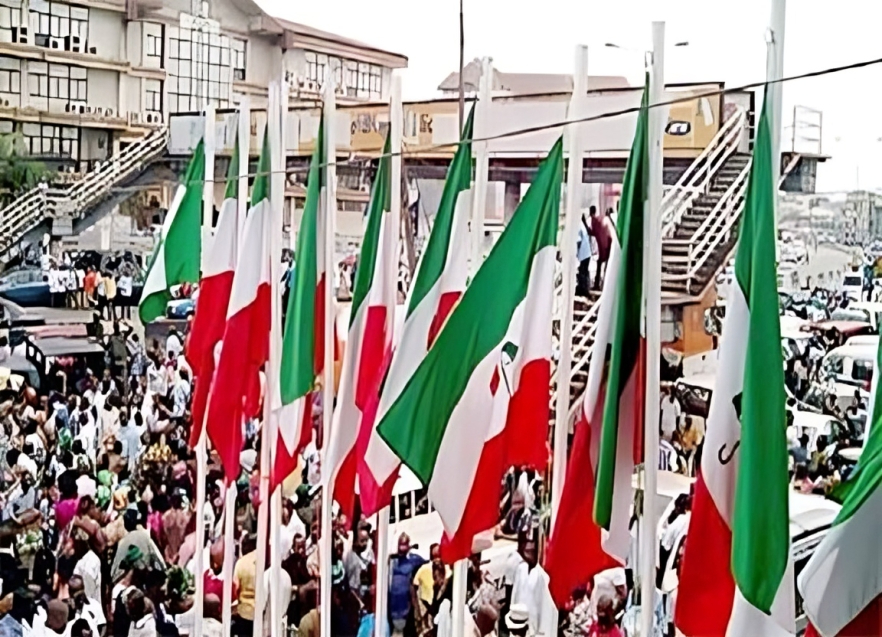
For over two decades, the People’s Democratic Party (PDP) reigned unchallenged in the South East. It was not just a political organization — it was a movement, a religion, the heartbeat of politics in Igbo land.
From 1999, the party dominated the region, winning all five states — Abia, Anambra, Enugu, Imo, and Ebonyi — in what became an era of total control.
But today, that once formidable political fortress lies in ruins. The recent defection of Enugu State Governor, Peter Mbah, to the All Progressives Congress (APC) has sealed what many now describe as the final burial of PDP in the South East.
In its glory days, the PDP was a political colossus. It produced governors across the zone— Dr. Orji Uzor Kalu (Abia), Dr. Chinwoke Mbadinuju (Anambra), Dr. Chimaroke Nnamani (Enugu), Dr. Sam Egwu (Ebonyi), and Chief Achike Udenwa (Imo).
These leaders controlled a united bloc that gave the South East tremendous influence at the national level. For years, the party delivered appointments, projects, and a sense of belonging to the region. The PDP was the rallying point for Igbo politicians seeking relevance in Abuja.
However, internal strife, arrogance, and lack of strategic direction slowly began to unravel the party’s dominance.Candidate imposition, disregard for due process, and corruption scandals turned the PDP from a symbol of hope into a shadow of chaos. By the late 2000s, the foundation of the party’s South East control had begun to shake.
Anambra was the first to fall. The emergence of the All Progressives Grand Alliance (APGA), championed by Dim Chukwuemeka Odumegwu Ojukwu and anchored by Peter Obi, dealt PDP its first serious blow. Obi’s victory in 2003 not only ended PDP’s grip on the state but also inspired a new political awakening across the region. From that point, the PDP’s aura of invincibility began to fade.
In Imo, the decline was even more dramatic. After producing three governors — Achike Udenwa (1999–2007), Ikedi Ohakim (2007–2011), and Emeka Ihedioha (2019–2020) — the PDP lost its once impregnable base.
Ohakim’s loss to Rochas Okorocha under APGA fractured the party, and Ihedioha’s removal by the Supreme Court in 2020 further demoralized its loyalists. Each loss was a blow that the PDP never truly recovered from.
Ebonyi followed next, with Governor David Umahi defecting to the APC in 2020, taking the party’s entire structure with him.
Abia became politically unstable, torn between loyalty to the PDP and personal ambitions of its former leaders. Enugu remained the party’s last stronghold, but Peter Mbah’s defection to the APC last week extinguished even that flicker of hope. The PDP is now without a single governor in the South East — a region it once dominated completely.
One of the most destructive battles that hastened the party’s decline in the region was the unending crisis between Senator Samuel Anyanwu (SamDaddy) and Sunday Udeh-Okoye over the National Secretaryship of the party.
Both men, strong political figures from Imo and Enugu respectively, became symbols of the infighting that crippled the PDP’s organizational cohesion. While Anyanwu insisted on his legitimate tenure as National Secretary, Udeh-Okoye, backed by South East Caucus, laid claim to the same position, deepening the internal discord.
The legal and political tussles that followed further divided the party’s South East bloc and made reconciliation almost impossible.
The crisis worsened the already fractured relationship between Sam Anyanwu and Emeka Ihedioha in Imo. Their feud over control of the party’s structure in the state turned the PDP into a warzone of personal ambitions. Instead of building a united front, the party imploded from within, losing credibility and membership in the process.
The 2022 defection of Peter Obi to the Labour Party was another turning point. Obi’s presidential run not only drew the sympathy of millions of South Easterners but also drained what was left of PDP’s relevance in the region. The “Obidient Movement” became a political earthquake that swept through the South East, leaving the PDP with empty offices and dwindling followers.
The final nail came with Peter Mbah’s move to the APC. His defection was more than symbolic — it was the last collapse of the PDP’s wall of influence in the region. From being the uncontested party of power to a hollow structure riddled with infighting and betrayal, the PDP’s fall in the South East is a tragic story of how complacency, ego, and internal sabotage can destroy even the most dominant political empire.
Today, the once-mighty PDP stands as a cautionary tale. Its story in the South East — from total dominance to total collapse — is a grim reminder that political arrogance and disunity are the surest paths to irrelevance.
The party that once held the entire region in its palm now struggles to fill a town hall meeting. The fall of PDP in the South East is complete — and its ghost now lingers only in the memories of what could have been.
However, internal strife, arrogance, and lack of strategic direction slowly began to unravel the party’s dominance.Candidate imposition, disregard for due process, and corruption scandals turned the PDP from a symbol of hope into a shadow of chaos. By the late 2000s, the foundation of the party’s South East control had begun to shake.