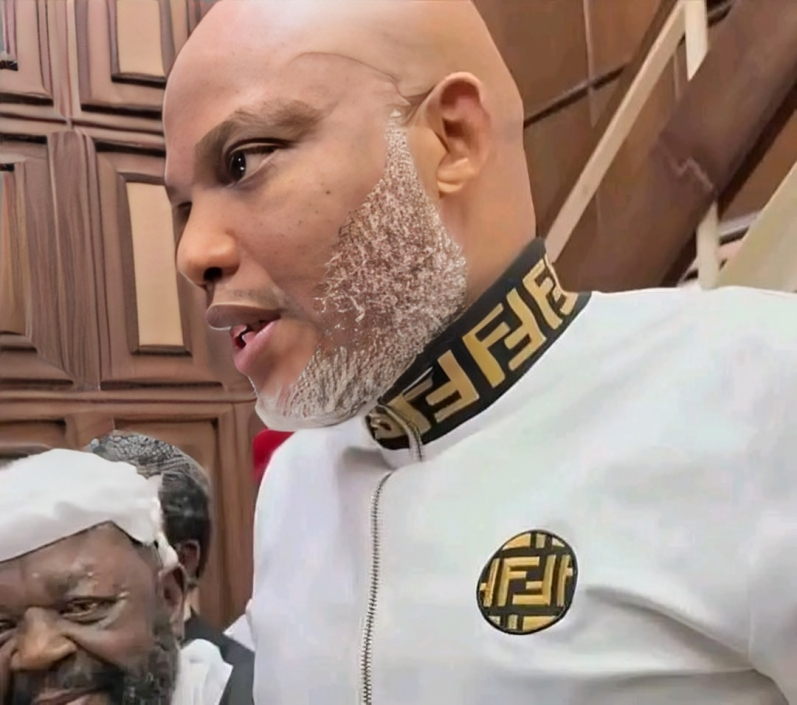
Detained leader of the Indigenous People of Biafra (IPOB), Nnamdi Kanu, has filed a fresh motion before the Federal High Court in Abuja, urging the court to strike out all charges brought against him by the Federal Government.
In the new motion, dated October 30, 2025, and titled “Motion on Notice and Written Address in Support,” Kanu argued that there is no valid legal basis for his continued prosecution, describing the charges as “a nullity ab initio” for lacking any lawful foundation.
Representing himself in the matter, Kanu filed the application under Sections 1(3), 6(6)(b), and 36(12) of the 1999 Constitution (as amended), alongside provisions of the Evidence Act 2011 and the Terrorism (Prevention and Prohibition) Act 2022. He said the prosecution’s case was rooted in repealed laws that have no legal force in Nigeria.
According to him, the government relied on obsolete statutes such as the Customs and Excise Management Act (CEMA), which was replaced by the Nigeria Customs Service Act 2023, and the Terrorism Prevention (Amendment) Act 2013, repealed by the 2022 Terrorism Prevention and Prohibition Act.
Kanu maintained that using repealed laws contravenes Section 36(12) of the Constitution, which forbids the trial of any person for an offence not clearly defined by an existing law. On this basis, he urged the court to strike out all counts against him, insisting they do not disclose any offence known to Nigerian law.
Relying on the Supreme Court’s ruling in FRN v. Kanu (SC/CR/1361/2022), the IPOB leader argued that lower courts are bound to take judicial notice of repealed laws under Section 122 of the Evidence Act 2011. He added that any failure to do so renders the proceedings void from inception.
Kanu further contended that the alleged offences were said to have been committed in Kenya, a situation which, he said, violates Section 76(1)(d)(iii) of the TPPA 2022. The law, he noted, requires such acts to be validated by the courts of the country where they were allegedly committed before a Nigerian court can assume jurisdiction.
He also argued that trying him in Nigeria without such validation breaches Article 7(2) of the African Charter on Human and Peoples’ Rights, which guarantees fair hearing and due process. Citing Sections 1(3) and 36(12) of the Constitution, he maintained that any judicial act inconsistent with the Constitution is automatically void.
Kanu concluded by asking the court to compel the prosecution to reply to his motion strictly on points of law within three days and deliver its ruling on or before November 4, 2025. He added that his motion raises only legal and constitutional issues, and therefore does not require any supporting affidavit.