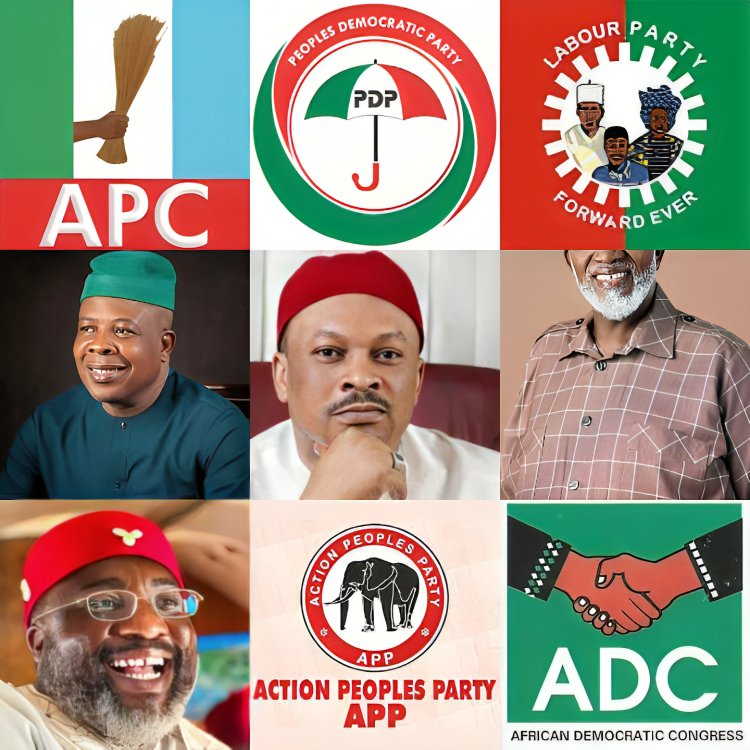
As Imo State inches toward the November 2027 governorship election, political watchers are bracing for what promises to be the most unpredictable race in the state’s modern history — a five-horse contest that could redraw the political map and rewrite power equations across the three senatorial zones.
The 2023 governorship poll was a three-way fight among the All Progressives Congress (APC), Peoples Democratic Party (PDP), and Labour Party (LP). That race ended in a landslide victory for Governor Hope Uzodimma of the APC, who cruised to re-election after sweeping all 27 local government areas. His triumph underscored APC’s dominance in the state, but 2027 is shaping up differently — the field is expanding, the stakes are higher, and the certainties fewer.
This time, the African Democratic Congress (ADC) and the Action People’s Party (APP) are expected to join the fray, swelling the number of serious contenders to five. With Uzodimma constitutionally barred from seeking another term, the race is wide open — and for the first time in years, Imo’s governorship election could be genuinely competitive.
Political analyst, Mr. Nnamdi Eke believes the 2027 election will “be a brutal contest for legitimacy rather than mere party supremacy.”. He argues that the outgoing governor’s attempt to install a successor will test the unity and resilience of the APC.
“The APC remains strong,” Eke says, “but its public approval may be dented by the economic hardship under the Tinubu administration. The party’s success will depend on who carries its governorship flag and whether Uzodimma’s political machine holds together after he exits.”
While the APC will be banking on its much-trumpeted achievements to sell its next governorship candidate, the worsening hardship in the land may compel many Imolites to seek new political alternatives. The party’s fate will also depend on how Uzodimma’s chosen successor can appeal across zones.
Indeed, the APC’s likely candidate — whether from Owerri or Okigwe Zone — will face a formidable field. The ADC’s anticipated flagbearer, Emeka Ihedioha, is reportedly plotting a dramatic comeback after the Supreme Court sacked him from office in 2020. His entry, according to observers, could reawaken political sentiments in Owerri Zone, which still feels cheated out of its tenure.
However, the ADC remains an emerging structure. While Ihedioha’s defection to the party from the PDP could inject life and credibility into the platform, the challenge lies in converting personal loyalty into a mass movement.
“The ADC is still embryonic in Imo,” notes political commentator, Fred Osuagwu. “It’s basically Ihedioha’s political shell. The real question is whether he can rally enough grassroots support outside his traditional base to stand toe-to-toe with the APC,” he told INNONEWS in Owerri.
The PDP, once the natural ruling party in Imo, faces its own existential crisis. After a dismal outing in 2023, the party’s machinery appears fractured and fatigued. Senator Samuel Anyanwu, who flew the party’s flag last time, continues to allege electoral manipulation by the APC as major reason why his party crumbled in the 2023 polls. Yet, the PDP’s internal disunity and declining appeal among voters make its 2027 prospects uncertain.
The Labour Party, which rode on the “Obidient” wave in 2023, seems to have lost momentum. While Peter Obi’s presidential performance was historic — he defeated Tinubu in Imo despite having an APC governor — the party has struggled to sustain that momentum at the state level. Senator Athan Achonu, LP’s governorship candidate in 2023, failed to replicate Obi’s feat. Should he attempt a second run, analysts predict an even steeper uphill battle. “If Obi leaves the party before 2027, LP might simply evaporate in Imo politics,” warns Ifeanyi Uzosike, a veteran political observer.
The Action People’s Party (APP), led by Chima Amadi, represents the newest force in Imo’s political chessboard. Amadi’s energy, youth appeal, and unorthodox mobilization strategy have stirred curiosity across the state. His message of “political renewal” resonates with disenchanted voters across the state. However, Amadi is still being assessed by Imolites — can he be trusted, being a first-timer on the state’s political stage? As Uzosike cautions, “the APP is still largely unknown. Charisma alone won’t win elections — structure does.”
As the race thickens, one underlying question dominates discussions: can Uzodimma break the jinx? Historically, no Imo governor has successfully produced a successor. From Evan Enwerem to Achike Udenwa, Ikedi Ohakim, Rochas Okorocha, and now Hope Uzodimma, all were known faces on the state’s political stage long before they became governors. Yet, none has been able to hand over to a preferred successor. The 2027 election could either extend or end that trend, depending on how skillfully Uzodimma manages intra-party intrigues and the dynamics of succession within the APC.
Observers also point to shifting voter behaviour. The Imo electorate, younger and more politically aware, appears less loyal to traditional party lines. With economic hardship biting harder and no sign for it to abate, voters are expected to be more transactional and pragmatic. “In 2027, performance and credibility will matter more than slogans,” says Eke. “It’s not just about party logos anymore — it’s about who the people believe can rescue Imo from economic despair.”
Yet, for all the speculation, one truth stands out. 2027 will not be business as usual. The alignment of interests across parties, the entrance of new political forces, and the uncertainty of succession make the 2027 guber election in Imo a thrilling, high-stakes contest. Imo is on the cusp of a defining political moment — a battle that could alter not just who governs, but how power itself is perceived and exercised in the state.