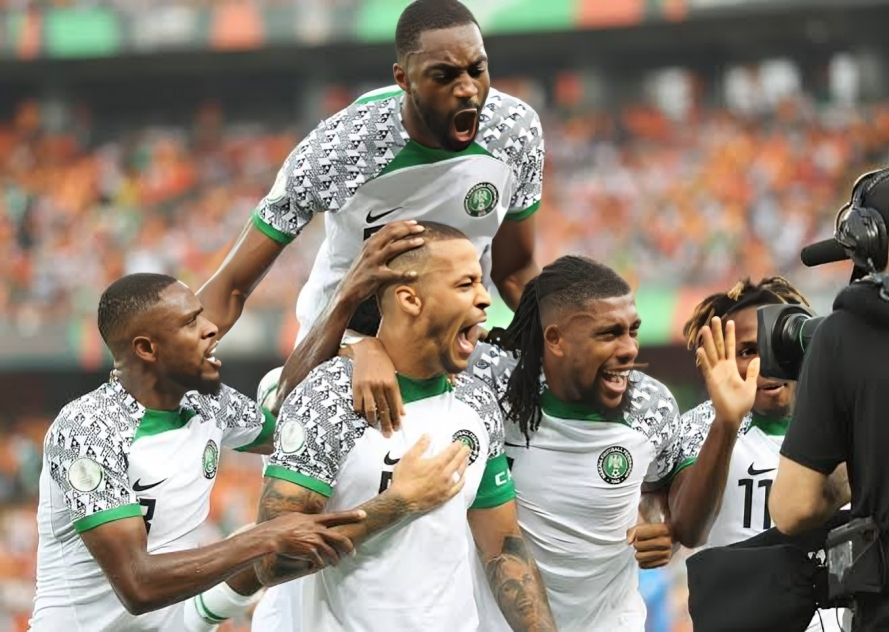
Nigeria’s humiliating crash in the African World Cup qualifying playoffs against Congo DRC was not a surprise, nor was it a stroke of bad luck. It was an unavoidable consequence of years of negligence, mismanagement, and shameless incompetence. What happened on that pitch was simply the latest chapter in a story of decline—a decline engineered and supervised by the Nigeria Football Federation.
The NFF has been run for years by men who lack vision, competence, and even the most basic understanding of football management. They have dragged Nigerian football from its once enviable heights into an era of chaos and mediocrity. Their failures were all on display in Morroco, exposed in front of the entire continent.
This rot is not limited to the Super Eagles. Every national team has suffered—U-17, U-20, U-23—teams that once dominated the world have become shadows of themselves. Global tournaments we once won with ease are now distant dreams because the system that produced those successes has been destroyed.
The scandal of unpaid match bonuses is the clearest proof that the NFF is incapable of running even the simplest administrative tasks. Owing players for two years is not just embarrassing, it is unacceptable. Reports that funds had long been released make the matter criminal. Yet those responsible still cling to office.
A federation that cannot pay players or coaches has no moral right to demand results. The World Cup qualifying campaign collapsed before it even began. How could it succeed when the NFF’s trademark incompetence was already poisoning the foundation?
The refusal to pay national team coaches is another long-standing disgrace. José Peseiro went months without wages. Eric Chelle entered the job already aware of Nigeria’s shameful reputation for breaching contracts. This kind of environment kills motivation and destroys professionalism.
The current leadership of the NFF must go. Nigerian football needs a total overhaul led by credible, knowledgeable figures—football legends like Jay Jay Okocha and others who understand what real football culture looks like. The game must be taken away from career opportunists.
The crisis was worsened by the ill-advised appointment of Finidi George. His selection as Super Eagles coach was a monumental blunder. A good player does not automatically make a good coach, and Nigeria paid heavily for that mistake. Eric Chelle, who succeeded him, was handed a disjointed and confused squad already stripped of identity and confidence.
This team has lacked hunger, purpose, and tactical discipline. The signs were there for years. Nigerians simply chose to ignore the truth because of blind loyalty and nostalgia. The bite that once defined our football is gone, replaced by timid play and disorganization.
Our attack has been painfully reliant on Victor Osimhen. Without him, the Super Eagles are limp, predictable, and utterly ordinary. The statistics speak loudly: without Osimhen, we faltered—four draws and one loss in the world cup qualifiers. With him, we looked like a team; he scored crucial goals, dragged us over the line, and masked systemic weaknesses.
Even in the playoff win over Gabon, it took two Osimhen goals to rescue a performance filled with errors and wastefulness. Remove him, and the team collapses—as we saw brutally in the Congo DRC match.
Against Congo DRC, Nigeria was bullied, outrun, and outplayed. It was glaring from the first whistle that Congo DRC wanted it more. They were sharper, faster, and tactically superior. We, on the other hand, played like a team with no direction. Lookman disappeared. Chukwueze was missing. Iwobi was a disaster. It was a complete collapse.
If we are serious about the next AFCON in December, the first thing the technical team must fix is the midfield. Nigeria desperately needs a creative playmaker—someone who can think, dictate the game, and unlock defenses. Iwobi is not that player and has proven repeatedly that he cannot shoulder that responsibility.
The Super Eagles must not also be built around Osimhen. When he is absent, the team becomes toothless. When he plays, Nigeria is dangerous. This reality must shape future planning.
But beyond immediate technical fixes, Nigeria must admit a painful truth: we have no long-term development plan. No structure. No continuity. No football culture. We operate on vibes, luck, and nostalgia, and that era must end.
We need a proper blueprint for talent development—youth academies, scouting, modern coaching philosophy, and genuine investment in the NPFL. There are countless young Nigerians at home and abroad hungry to represent the country, yet we lack the structure to discover or nurture them.
This is why the Federal Government must convene a National Football Summit. The nation needs its football legends, coaches, administrators, and global experts in one room to reset the system. Football remains Nigeria’s strongest unifying force. We cannot allow a corrupt, clueless few to destroy the one thing that still binds us as a people.
Before we axe the Super Eagles, we must first axe the system that has failed them. Only then can Nigerian football rise again.