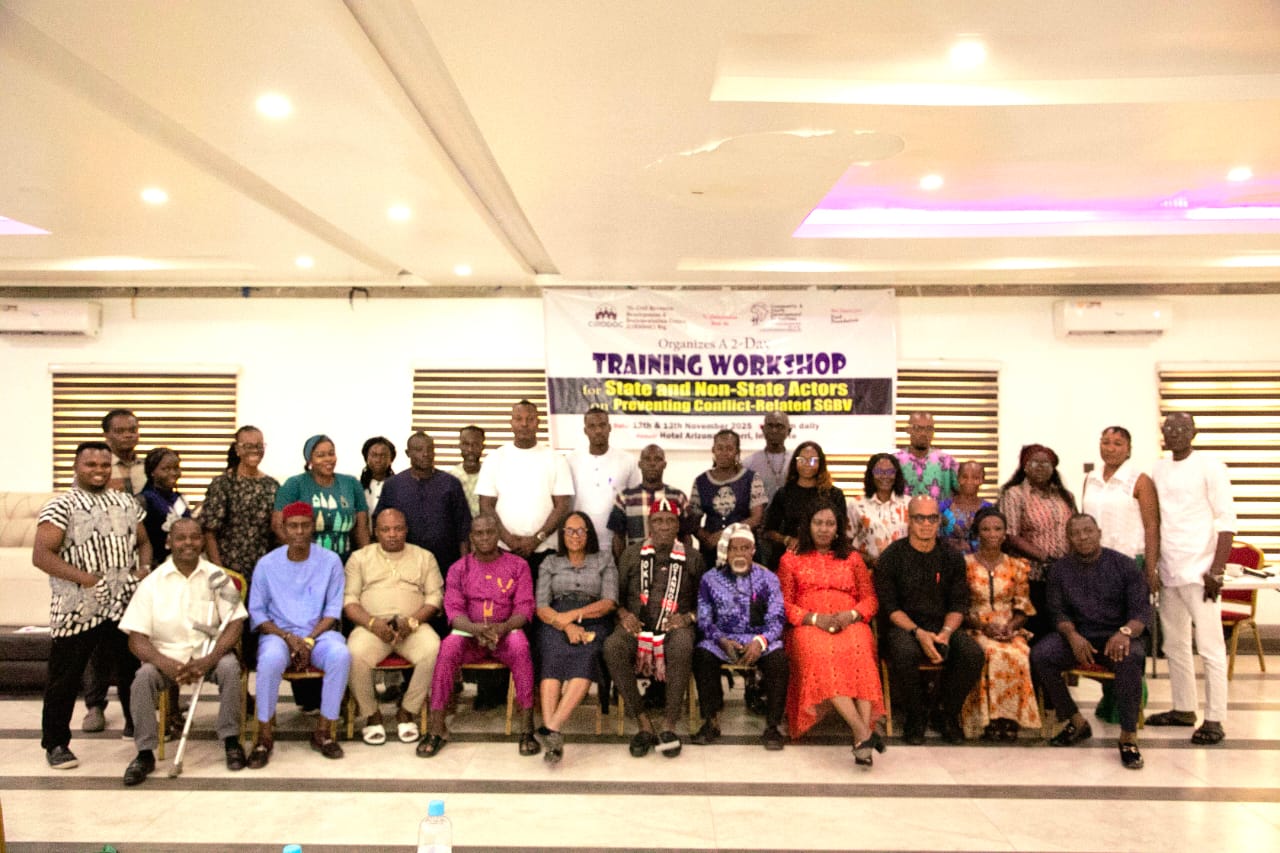
The Civil Resource Development and Documentation Centre (CIRDDOC) Nigeria, in collaboration with the Community and Youth Development Initiatives (CYDI) with support from the Ford Foundation, has intensified advocacy for women’s inclusion in community leadership as a key step toward curbing conflict-related sexual and gender-based violence (SGBV) in crisis-vulnerable areas. The organisations convened a two-day capacity-building workshop for state and non-state actors in Imo State on November 12 and 13, 2025.
The programme assembled security agencies, traditional leaders, health professionals and civil society groups, all converging around one crucial message: the fight against SGBV cannot be won without women occupying decision-making positions. Facilitators drew attention to the World Economic Forum’s 2024 Global Gender Gap Index, which places Nigeria 133rd out of 146 countries, with women holding under 10% of political leadership roles. In many rural communities, women are still absent from key structures overseeing security, land matters and conflict mediation—an exclusion participants agreed fuels silence, vulnerability and impunity.
One of the facilitators, Benjamin Mbakwem, guided attendees through the provisions of the Imo State Violence Against Persons Prohibition (VAPP) Law of 2021, highlighting how leadership that reflects women’s perspectives is integral to preventing and addressing violence. He underscored the links between gender equity, human rights and sociocultural norms, noting that crises often deepen the risks women and girls already face.
CIRDDOC Programme Officer, Paschal Anosie, explained that the initiative is being implemented in two stages: first, broadening community understanding of SGBV and its lifelong effects, and second, enhancing coordination among frontline responders. He stressed that communities must not only identify violations early but also embed women in decision-making bodies tasked with protecting vulnerable groups.
For many participants, the workshop was an eye-opener. Health practitioner Johnson Assumpta said she gained fresh insight into the magnitude of SGBV and the pervasive silence surrounding it. She noted that survivors often avoid hospitals and law-enforcement offices out of fear of stigma or dismissal. The sessions, she said, gave her a clearer grasp of victims’ rights and the need for timely, accurate reporting. She was particularly struck by conversations on women’s leadership.
“Women are the homemakers and peacemakers,” she said. “When women’s voices are part of leadership, communities become safer. We know the realities our children, neighbours and the vulnerable face. When we are included, peacebuilding becomes meaningful.”
CSC Onunwa of the Nigeria Security and Civil Defence Corps (NSCDC) echoed the call for stronger gender-responsive systems, stating that the training reinforced the Corps’ commitment to enforcing the VAPP Law across all 27 local government areas. She noted that the Gender Unit will intensify community engagement and work closely with grassroots leaders—especially women—to strengthen reporting channels and improve survivor support.
At the end of the workshop, participants drafted detailed action plans focused on preventing conflict-related SGBV and embedding inclusive leadership. They warned that sidelining women from community power structures weakens early-warning systems, erodes public trust and leads to decisions that ignore the safety needs of women and girls.
They emphasized that when women sit on traditional councils, village assemblies and local security committees, communities experience improved reporting pathways, more effective mediation, and a shift toward challenging harmful practices rather than reinforcing them.
CYDI Executive Director, Felxfame Enisire, expressed confidence that the commitments made would enhance grassroots peacebuilding and drive fuller implementation of the Imo VAPP Law. He noted that communities are safer when women are recognized not as passive recipients of support, but as active contributors shaping the structures that prevent violence.