Imo State is already entering a decisive political window, even though the 2027 general elections are still months away. While Nigerians will head to the polls in February or March 2027 for presidential and legislative contests, the most consequential election for Imo will be the governorship poll scheduled for November 2027. That contest will mark the end of Governor Hope Uzodimma’s tenure, as he is constitutionally barred from seeking a third term.
Between now and then, 2026 is expected to become the real battleground. It is the year when political actors will surface decisively, alliances will be forged and broken, and ambitions for the House of Assembly, House of Representatives, Senate and, most critically, Government House, will crystallise. For Imo, 2026 will not be a quiet pre-election year; it will be the arena where the future of 2027 elections is negotiated.
At the heart of the unfolding discourse is the governorship, the office that traditionally sets the tone for the entire political ecosystem in the state. Although the guber election itself is slated for late 2027, insiders agree that the effective struggle for control begins much earlier. By 2026, the key players are expected to be fully mobilised, deploying structures, narratives and resources to advance their respective causes.
One dominant theme likely to intensify is zoning, anchored on the Imo Charter of Equity. Since 2025, the governorship conversation has been heavily shaped by arguments around rotation of power, with Owerri zone mounting a sustained campaign for the seat. Groups such as the Owerri Zone Awareness Coalition (OZAC), Owerri Zone Leaders of Thought and the Imo Harmony Project have framed the debate as a moral and political imperative, insisting that equity demands the governorship shift.
Okigwe zone, however, is not retreating from the contest. Political actors from the zone are expected to sharpen their arguments in 2026, positioning themselves as equally deserving and politically viable. The zoning debate, far from being settled, is likely to dominate elite discussions, party calculations and grassroots mobilisation as aspirants seek legitimacy beyond personal ambition.
Governor Hope Uzodimma remains the single most influential figure in this evolving equation. Even as he approaches the end of his tenure, Uzodimma’s choices, silences and signals will shape Imo politics in 2026. Though he has not publicly indicated a preferred successor, his role as a power broker within the ruling party and the broader political space makes him a central factor in determining alignments ahead of 2027.
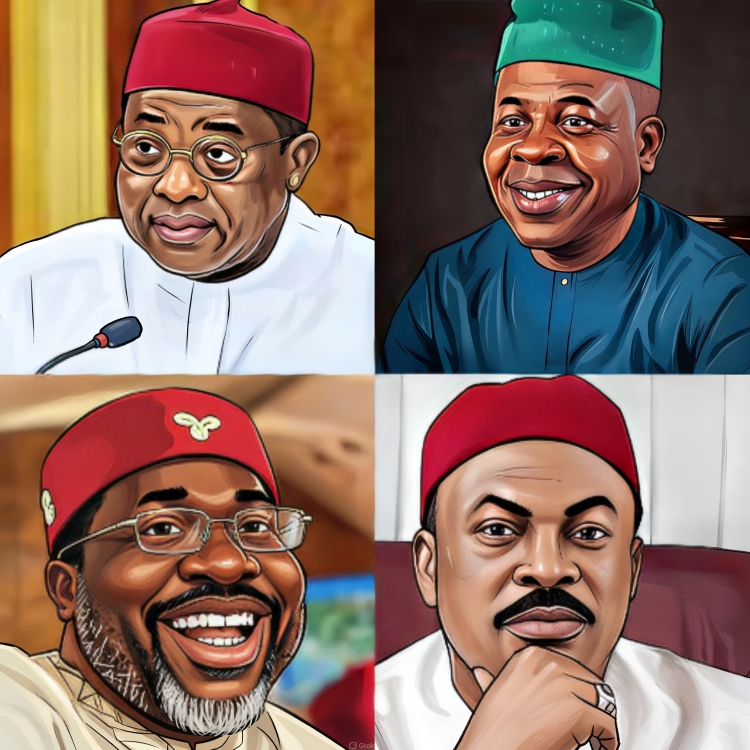
Former governor Emeka Ihedioha is also widely expected to re-enter the arena with renewed intensity. Since his removal from office in 2020 by the Supreme Court, Ihedioha has maintained a low but deliberate profile. His African Democratic Congress (ADC) has been largely dormant in Imo, but 2026 is seen as the year the party must either reorganise or fade from relevance. For Ihedioha, the coming year may determine whether his return bid gains traction or remains aspirational.
Samuel Anyanwu, a polarising figure and key actor in the ongoing crisis within the Peoples Democratic Party (PDP), is another name to watch. Long associated with internal party battles at the national level, Anyanwu is believed to harbour governorship ambitions. Observers expect him to revive and recalibrate his strategy in 2026, especially if the PDP stabilises enough to present a credible platform.
Mazi Chima Amadi, a vocal critic of the Uzodimma administration, is also positioning himself for the 2027 race. His political journey is expected to take a decisive turn in 2026, with indications that he may align with the African Peoples Party (APP). The party itself is facing internal turbulence, including calls for its deregistration led by Frank Ngoforo.
Former governor Ikedi Ohakim remains a persistent presence in Imo’s political calculations. Speculation that he may have been politically “settled” following the appointment of his wife as an ambassador has not extinguished talk of a comeback. Many believe Ohakim is far from done and that 2026 will reveal whether his long-rumoured return bid is tactical positioning or a serious campaign.
Beyond individual ambitions, 2026 will also test the strength and relevance of political parties in Imo. Aspirants for the House of Assembly, House of Representatives and Senate are expected to emerge across party lines, adding layers of competition and complexity to the political landscape. These contests will serve as barometers of party organisation, grassroots reach and public mood.
Ultimately, the politics of 2026 will be about leverage: who controls structures, who commands loyalty and who shapes the dominant narratives. By the time Imo heads into the formal election season in 2027, much of the real work would already have been done. For now, all signs point to a year of intense manoeuvring, high-stakes calculations and a battle to define what comes after Uzodimma in Imo State.