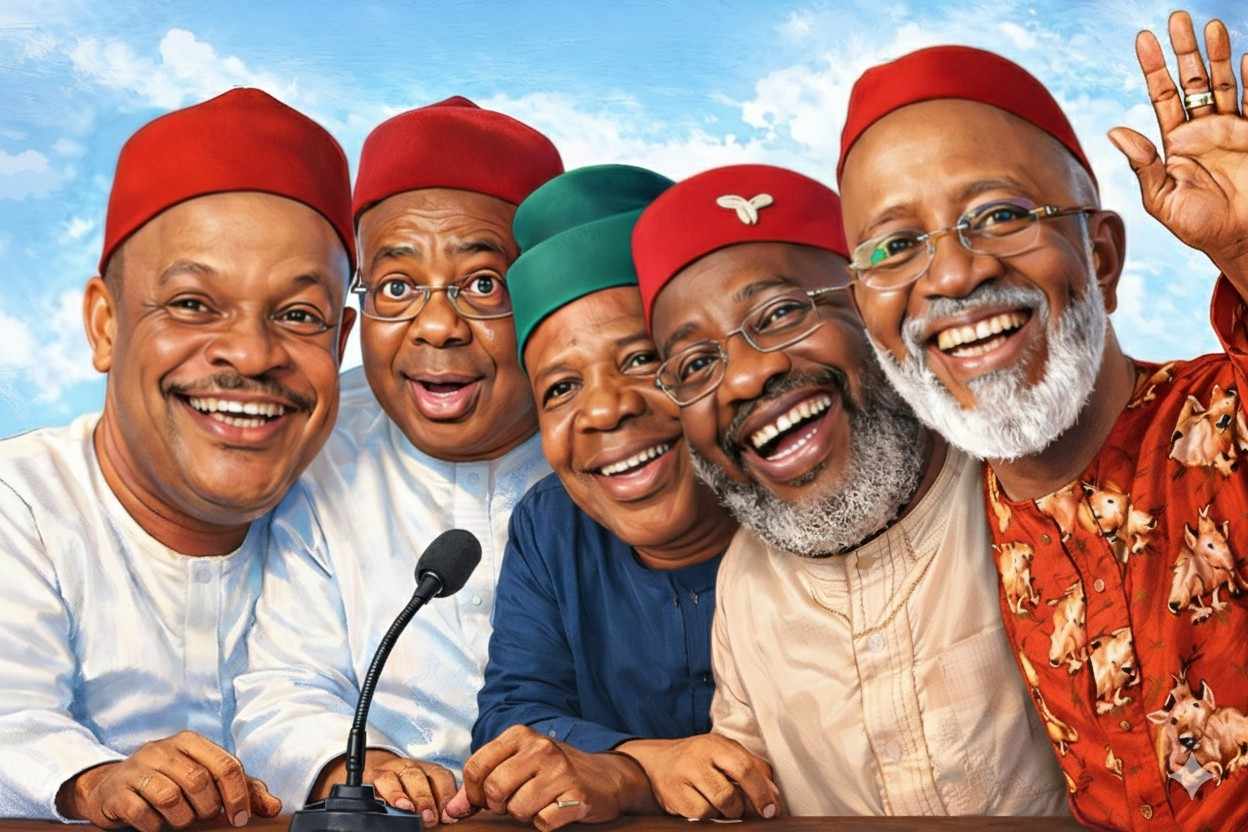
Governance and high-stakes politics are expected to dominate Imo State in 2026 as the state enters a decisive pre-election year ahead of the 2027 general polls, with both performance and political maneuvering set to shape the emerging narratives.
The year is projected to be pivotal for the incumbent administration, as public scrutiny over service delivery, project execution, and policy consolidation intensifies across key sectors of the state economy and governance structure.
Political observers note that the government will be under sustained pressure to not only consolidate gains recorded in 2025 but also significantly improve its performance rating in 2026, a factor seen as critical to weakening opposition arguments and reinforcing claims of continuity ahead of the elections.
Governance outcomes in the year are expected to be closely intertwined with succession politics, as delivery on infrastructure, social programmes, and economic interventions increasingly becomes the benchmark for shaping voter perception and elite political alignment.
Analysts say the Uzodimma administration’s ability to demonstrate measurable progress will likely form the backbone of the ruling APC ‘s defence, particularly as opposition parties intensify efforts to frame governance gaps as evidence of fatigue or underperformance.
On the political front, 2026 is expected to witness a sharp escalation in political activity as preparations intensify for the 2027 elections, scheduled for March or April, with early mobilisation already underway in several parts of the state.
Aspirants for the Imo State House of Assembly, House of Representatives, and Senate are expected to emerge in large numbers, triggering consultations, recalibrations, and grassroots engagement across various constituencies in the State.
Major political parties are projected to fully re-enter the political arena, broadening the field of contenders and deepening competition as internal party structures are rebuilt and strategic positioning for primaries begins in earnest.
The ruling All Progressives Congress (APC), the Peoples Democratic Party (PDP), the African Democratic Congress (ADC), the Action Peoples Party (APP), and the Labour Party (LP) are expected to intensify party activities, with internal negotiations, stakeholder engagements, and alliance-building shaping much of the political calendar.
However, this newspaper anticipate a marked increase in opposition intensity against the present government, particularly from emerging opposition platforms such as the APP and the ADC, which are positioning themselves as key challengers ahead of 2027.
The APP and ADC, described by observers as political newcomers in Imo’s evolving landscape, are expected to be driven respectively by Chima Amadi and former governor Emeka Ihedioha, who is seeking a return to power following his removal by the Supreme Court in January 2020.
The dominant opposition strategy, analysts say, will revolve around demarketing the ruling APC in order to gain political mileage, frame alternative narratives, and capitalise on any perceived governance shortcomings.
In contrast, the PDP is widely regarded as the weakest link in the opposition bloc, except there is a robust and significant change in its political outlook, internal cohesion, and strategic direction before the polls in 2027.
Once the ruling and dominant party in Imo State, the PDP is currently experiencing what observers describe as its most fragile phase, having failed to win a single local government area in the 2023 governorship election, an unprecedented outcome since the return to democracy in 1999.
The Labour Party, which gained momentum in the 2023 election cycle, is also believed to be on a downward curve in the State following the exit of Peter Obi, unless it is able to strongly revive its organisational structures and political relevance in 2026.
The governorship contest is expected to dominate elite and public discourse, with renewed focus on zoning, equity, and power rotation among the state’s three senatorial zones.
While Owerri zone and it’s governorship project is projected to gain organisational clarity and momentum, Okigwe zone is also expected to mount a determined challenge, setting the stage for an intense and closely watched political road to 2027.