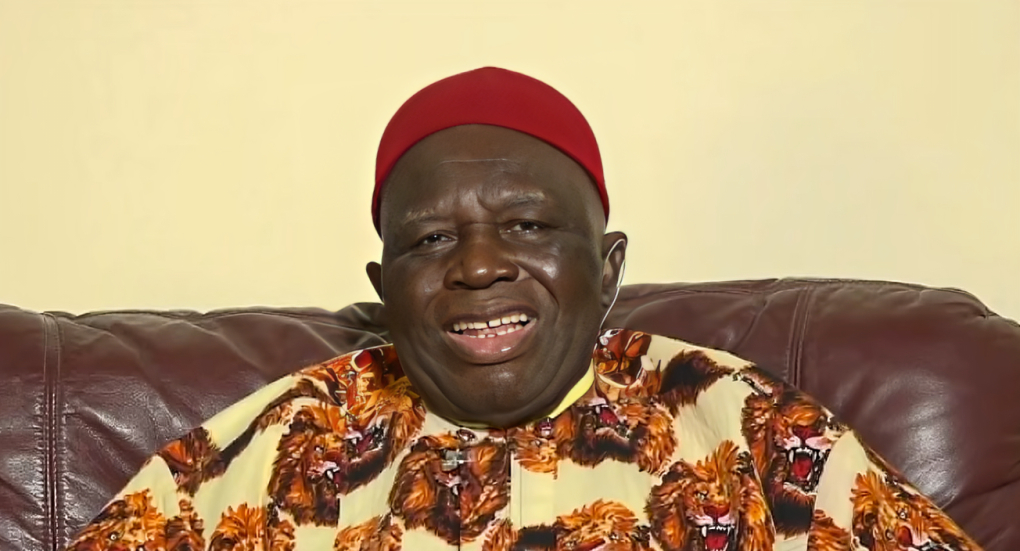
The most remarkable significance of the recent post humous award of honour given to the late Professor George Obiozor by the government and people of Imo state is that it once more underscores the fact that his life was an epitome of a beautiful blend of scholarship and community service. Professor Obiozor was very much at home with his people and still operated at the highest circle of the academia and international diplomacy. How he did it so successfully should be a subject of further inquiry since it is extremely rare to find one single individual so perfectly combine such a level of exposure to the modern world with native originality.
For instance, Professor Obiozor, in spite of his erudition, deliberately developed a diction that was not only peculiar to him but also immediately gave him away as an Igbo; when those who did not get half his level of education struggled to impress their audience with the Queen’s English ascent. Yet, you would never be tired of listening to him in his characteristic lucidity.
Apart from high academic attendance, the late Professor Obiozor worked in the innermost circle of the Nigerian establishment. Whether under the military or civilian dispensation, there was no Think Tank Professor Obiozor was not a member of. As an academic, he had set himself aside as a fellow who had the courage of his own conviction and always expressed his views on national issues with boldness, clarity, candor and a high sense of responsibility. Soon, the military “boys” spotted him and drew him closer, first with an appointment as Special Adviser to one of Nigeria’s most vibrant Foreign Affairs ministers, Ike Nwachukwu and later as Special Adviser to Nigeria’s first military president, Ibrahim Babangida. Not long after, he was appointed to head one of Nigeria’s most strategic institutions, the Nigerian Institute of International Affairs. That was at a time when the rest of the world was keeping a close watch on Nigeria and the military government itself eager to know how it was viewed by the international community. Of course, it is a well-known fact that despite being under a military rule, it was during that era that Nigeria got the most robust diplomatic relations in its history, to the extent that its military leader, General Babangida, was accorded the honor of making an official visit to Britain, a very rare thing.
It was, therefore, not surprising that directly after military rule in 1999, the new civilian administration of Olusegun Obasanjo drafted Professor Obiozor to represent Nigeria in two key most strategic diplomatic missions; initially as an Ambassador to Isreal, (with concurrent accreditation as High Commissioner to the Republic of Cyprus), from 1999 to 2003 and later as the Nigeria’s Ambassador to the United States of America, between 2004 and 2008. Apart from that his tenure as Nigeria’s Ambassador to the US was one of the longest, his earlier involvement in the study of international diplomacy as a scholar but him in a good stead to help shape the relationship between the two countries. His tenure in the US was a challenging period because Nigeria was just beginning to get re-integrated with the rest of the world as a democratic nation. When recently there arose an uneasiness over Nigeria-US relations, not a few remembered with nostalgia that Professor Obiozor would have been handy in getting drafted into the diplomatic turf to engage the Americans.
Professor Obiozor died in office as the 10th President-General of the Oheneze Ndigbo, Igbo nation’s apex socio-cultural organization. Even though he was actually persuaded into accepting to serve in that office, Professor Obiozor put in the same diligence and enthusiasm with which he carried out his earlier national and international assignments. He did not see serving his kinsmen as less challenging than in the earlier assignments. In a sense, the assignment of serving his people rather turned out to be even more challenging than the earlier ones.
That assignment, coming at the height of a separatist agitation by a section of his Igbo kinsmen, nearly put him in a quandary. He was caught in between assuring the other sections of Nigeria that his people are committed to the unity of Nigeria on one hand, and convincing the agitators that Ndigbo are better off in a larger, united and peaceful Nigeria on the other. For a fellow who had served Nigeria at the highest echelon of the Nigerian political establishment, nothing could be more worrisome than being perceived – in some quarters – as an ally to those who were, knowingly and unknowingly, working against the unity of the country.
As is well known, Professor Obiozor navigated that murky turf quite creditably. He neither played the irridentist card nor did he make the agitators believe that the rest of Nigeria was nursing an acrimony against them.He once told a group of journalists who had thought that they could make headlines by cajoling him into renouncing the agitators thus: “The … boys are our children and we cannot deny them” but with a quick remark that the separatists “must listen to good counsel from their leaders”.
In the Second Republic, Professor Obiozor played a leading role in facilitating the return of the late Dim Chukwuemeka Odumegwu -Ojukwu back from exile to Nigeria. He acted as a mediator between Ojukwu and the Nigerian government then headed by President Shehu Shagari, shuttling between Lagos and the then Ivory Coast. In that assignment, he worked closely with some of Igbo land’s finest intellectuals like the late Chuba Okadigbo, Nnia Nwodo and Alphonsus Nwosu.
Professor Obiozor received the Nigerian national honor of Commander of The Order of the Nigerian (CON) Since charity, they say, begins at home, the post humous award by the government and people of Imo state may well be the beginning of more honors that are bound to come even in death.He was honored during the just concluded anniversary for the creation of Imo state in the category of Distinguished Star Of Imo State along with about twenty others.
In the Igbo parlance, a man is worth nothing unless his kinsmen acknowledges his prowess. Therefore, the Imo award is it and it is not surprising that the governor,His Excellency, Senator Hope Uzodimma , has been receiving an avalanche of commendations for initiating the award and implementing it successfully. There are several other erudite scholars in Imo state who did not make the list of honorees but what stood Obiozor out was not just scholarly erudition.
He was a “home boy” – so to speak – who identified with his roots. His people in Awommama were the first to tell the rest of the world that “this is our son in whom we are well pleased” when they conferred him with a chieftaincy title of “UGWUMBA” (The Prestige of A People).
The Distinguished Star of Imo award was given to those who made “sustained impact in economic development, infrastructure, trade and investment” in the state. Obiozor was not a businessman or entrepreneur but he impacted heavily on the development of the state through scholarship and mentoring.
Professor Obiozor was not a politician but those who sought elective and appointive offices sought his counsel and direction. Above all, he was an invisible hand in all efforts to foster good relationship between the state, the federal government and the rest of the country. On Professor George Achulike Obiozor, the good people of Imo state spoke and they spoke well.