PROTOCOLS
It is my profound honour to welcome you to this Strategic Summit. We are here to trigger a process that will reinvent our identity, unify our structures and bring us into one indestructible, strong and united family driven by one unassailable vision and focus.
Let me first express my deepest appreciation to President Bola Ahmed Tinubu, GCFR, for his confidence in the ability of the Progressive Governors to drive this process. I am also personally grateful to you, sir, for finding me worthy to head the Renewed Hope Ambassadors as an instrument for grassroots mobilisation toward an all-around victory for our great party, the All Progressives Congress (APC) in the 2027 elections. Thank you, Mr. President.
I also appreciate His Excellency, the ever-supportive Vice-President of Nigeria, Senator Kashim Shettima, GCON, for his unflinching commitment to the success of the administration. To our energetic and highly cerebral national chairman, we are grateful for your continuous cooperation in synergising with our governors for the progress of this administration and the growth of our great party.
Let me also appreciate the presence of my brother governors who have given me their unqualified support since they chose me to be their chairman. I must say that I have enjoyed your cooperation immensely, and I do not take it for granted.
I equally extend my warm welcome to the leadership and members of the National Assembly, the Federal Executive Council and all dignitaries who are present here today. I must say that anyone privileged to be here has something tangible to contribute to this Strategic Summit. We are all here because of the value we can, and should, add to the Renewed Hope vision of our beloved President. Your presence is truly and immensely appreciated.
We have gathered here today with a singular motive: to bridge the gap between the profound transformative work the administration of President Bola Ahmed Tinubu, GCFR, has done and is still doing for Nigeria, and the lived reality of millions of Nigerians who have not yet felt its full impact.
We have not come for a rally or a celebration. This is a working session for those entrusted with the responsibility of translating policy into public awareness and reform into relief. Your Excellency, Mr. President, permit me to express, on behalf of the Progressive Governors’ Forum and the Renewed Hope Ambassadors structure nationwide, our profound appreciation for your presence and leadership. Your decision to host this Summit here at the State House Conference Hall elevates this engagement from a political meeting to a national strategic convergence. It signals seriousness. It signals direction. It signals continuity between federal reform and subnational mobilisation.
This Summit is historic not because of who is seated in this hall, though the presence of leadership across all tiers of our Party and Government is remarkable, but because of what we are determined to institutionalise. Today, we choose structure over improvisation, discipline over fragmentation, and philosophy over expediency. Above all, we choose Nigeria’s long-term stability over short-term applause.
NIGERIA AT A DEFINING DEMOCRATIC MOMENT
Nigeria is at a defining democratic phase. Across the globe, democratic systems are being tested by economic shocks, digital misinformation, geopolitical uncertainty, and rising citizen expectations. Nigeria is not insulated from these pressures. But Nigeria’s situation is more layered. Mr President is simultaneously reforming our macroeconomic architecture, repositioning our fiscal systems, rebuilding public infrastructure, strengthening our security apparatus, expanding digital inclusion, and managing democratic competition.
In such a season, clarity becomes national security. Citizens today are more informed, but not always more accurately informed. Social media amplifies speed, but not necessarily context. Reform, by its nature, creates discomfort before it creates stability. The central democratic challenge before us is this: How do we ensure that structural reform is understood, defended, internalised, and translated into citizen trust at the grassroots? Because policy success without citizen understanding creates perception gaps. And perception gaps weaken democratic legitimacy. This is why we are here.
NOW TRIBUTE TO PRESIDENTIAL REFORM COURAGE
Your Excellency, Mr President, history often judges leaders more kindly than their contemporaries do. The decisions that secure long-term national stability are rarely the ones that generate immediate applause. When you assumed office on May 29, 2023, you inherited an economy in distress. We all know this. Even our opponents know this. The signs were everywhere: depleted foreign reserves, runaway inflation, crippled oil production, and a subsidy regime that was bleeding the treasury dry whilst enriching a few. Previous administrations had postponed the day of reckoning until it could be postponed no longer; else the nation would collapse. You did what needed to be done: you front-loaded the reforms in the nation’s interest. And for us in the ruling party, the benefits of these reforms have thankfully kicked in just as we approach the end of the political cycle. Some might say this was too great a risk, but it has paid off. And the enemies of Nigeria are not happy.
It is, therefore, not only our partisan duty but our patriotic obligation to propagate these results to every man, woman, and youth until every Nigerian, including our opponents, acknowledges the good work of our great party and our beloved President. I am happy that we have even more zeal than those on the other side. That is what it should be, and we must not extinguish this flame. Fortunately, the facts are on our side. We just need a bit of storytelling to get our message across in the midst of all the malicious noise.
Facts are stubborn. In May 2023, our foreign reserves stood at $32(US) billion in gross terms. As of February 5, 2026, they stand at $49 billion, an eight-year high, representing a 53% increase. When Mr President assumed office, the net usable reserves were approximately $3 billion. Today, they stand firmly in the high thirties. The foreign exchange premium, which once hovered above 30%, is now under 2%. Some people dismiss these wins when they happen under this administration, but celebrate similar or weaker results in other developing economies. However, we must rouse consciousness, and we must do so clearly, patiently, but boldly.
In May 2023, headline inflation was 22.4% and rising. Food inflation was 24.6% and accelerating. By December 2025, after thorough review, headline inflation had declined to 15.15%. Food inflation, which peaked at nearly 40%, now stands at 10.84% and is poised to drop even further. Take a trip to the market and see for yourself. From rice to garri, to beans, yams, potatoes, pepper, and tomatoes – prices keep falling. These are real outcomes, not projections.
Also in May 2023, Nigeria was producing roughly one million barrels of crude oil per day. Today, our output averages 1.5 million barrels per day, with recent peaks reaching 1.6 million when condensates are included. Our OPEC quota remains 1.5 million barrels per day. Whilst we have not yet consistently met it, we have moved from chronic underproduction to the threshold of compliance.
Again in May 2023, Nigeria imported virtually every drop of refined petrol at a cost of approximately $20 billion annually. All four of our refineries were shut down. Today, the Dangote Refinery, with a capacity of 650,000 barrels per day, is operational, and the sector now has the confidence of investors with several other large refineries under construction. Our import dependency has been drastically reduced. This is energy security. We can all attest to the recent gains of the naira, and analysts have predicted that the naira will rise to under N1,000 to the dollar before the year ends. That is the power of Mr President’s reforms. Courage and vision have paid off.
In May 2023, the national minimum wage was N30,000. Today, it is N70,000. In May 2023, power generation averaged 4,200 megawatts. By March 2025, we recorded a peak of 5,801 megawatts, and we now sustain an average between 5,300 and 5,700 megawatts. In 2023, the Federation Account Allocation Committee distributed N10.14 trillion to all tiers of government. This year, the projected allocation is approximately N41 trillion. That is a fourfold increase in resources available to states and local governments.
Before this administration, states were not permitted to regulate their own electricity markets. Today, several states, including my own state of Imo, have taken advantage of the Electricity Act to build their own power infrastructure. This is the federalism we have always talked about. This administration has made it real. Diaspora remittances, which hovered around $200 million per month in 2023, now average $600 million per month. That is a 200% increase.
But perhaps the most far-reaching reform is the tax revolution. In June 2025, President Tinubu signed four Tax Reform Acts into law, consolidating over 60 disparate taxes into fewer than 10 clear statutes. These reforms took effect on January 1, 2026, and they represent the most comprehensive fiscal overhaul Nigeria has seen since 1999.
What does this mean for ordinary Nigerians? Every worker earning N800,000 or less annually now pays zero income tax. If you earn the N70,000 minimum wage, you keep every kobo. Small businesses with turnover below N50 million are exempt from company income tax, capital gains tax, and the development levy. Companies that hire new workers receive a 50% tax deduction on those salaries for three years. Companies that raise wages for their lowest-paid employees receive a further 50% deduction. This administration is using the tax code to reward job creation, not penalise it. Agricultural enterprises enjoy a five-year corporate tax holiday from the commencement of operations. VAT remains at 7.5% – one of the lowest rates in Africa – with basic food, education, healthcare, and transport zero-rated to protect the poorest households.
For the first time, Nigeria has a unified, modern, digitally-administered tax system that protects the vulnerable, incentivises enterprise, and aligns with global standards.
And then there is NELFUND. Before this administration, Nigeria had no functional student loan scheme. As of February 2026, the Nigerian Education Loan Fund has disbursed approximately N184 billion in interest-free loans to nearly one million students across 265 public tertiary institutions. Over 1.5 million students have applied. This is social investment at scale, and it did not exist 30 months ago.
Your Excellency, you have chosen sustainability over sentiment. Beyond macroeconomics, your administration has accelerated infrastructure delivery. Major highway corridors are under construction and rehabilitation across all six geopolitical zones. Rail modernisation projects are also being consolidated. Power sector reform efforts are being intensified equally. Port process digitisation has improved trade facilitation timelines. On social protection, targeted cash transfer systems have been restructured to improve reach and transparency. In security, investment in intelligence coordination and multi-agency collaboration continues to strengthen national response capability. These reforms are not cosmetic. They are foundational. They require courage. And courage in governance is the rarest currency in democracy.
WHY THIS SUMMIT IS NECESSARY
Distinguished leaders, these are the facts. These are the outcomes. Yet, despite these gains, a gap persists. There is a disconnect between the macro-level outcomes I have just outlined and the grassroots reality that millions of Nigerians experience daily. Cynicism remains because the communication of reform outcomes has not matched the pace of the reforms themselves. The opposition has exploited this gap with relentless propaganda. The problem is not policy failure. The problem is a communication failure. And that failure is on us.
We have identified four critical gaps.1, mmunication fragmentation: different voices, different emphases, sometimes different interpretations across states and platforms. In a digital age, fragmentation is magnified.
No.2, weak institutionalised grassroots templates: mobilisation in some places has been personality-driven, rather than system-driven. We need replicable models: ward engagements, listening sessions and sector dialogues.
No.3, inconsistent membership expansion strategy: membership growth must be measurable and intentional, not assumed. A modern political party must know its strength in terms of numbers, demographics, and its growth trajectory.
No.4, role ambiguity between party structures and mobilisation platforms: where roles are unclear, duplication emerges. Where duplication emerges, discipline weakens.
This summit exists to close these gaps through architecture, not rhetoric.
WHAT MUST HAPPEN TODAY
This gathering must produce outcomes, clear outcomes, not impressions. At the end of today, five non-negotiable expectations must be met.
FIRST, ideological consolidation. Every state must reaffirm the APC Manifesto as the guiding compass of governance and mobilisation. We must be clear about what we believe. A party that loses ideological clarity becomes vulnerable to internal contradiction.
SECOND, the adoption of a Unified Messaging Guide. There must be standardised core talking points, reform explanations, data references, and response lines to misinformation. This does not eliminate state uniqueness. It ensures coherence.
THIRD,institutionalisation of grassroots engagement templates. Every state must adopt structured formats for ward town halls, community listening sessions, youth policy dialogues, women empowerment engagements, and sector-specific stakeholder briefings. Mobilisation must move from ad hoc enthusiasm to predictable programming.
FOURTH, an accelerated membership drive. We must move from aspiration to targets. Each state should define membership growth benchmarks, track youth recruitment numbers, track women participation ratios, and establish quarterly growth reporting. Modern politics is data-driven, political rallies alone does not guarantee electoral victories.
FIFTH, adoption of a monitoring and reporting cadence. If we do not measure, we do not improve. If we do not track, we do not correct. This Summit must produce a structured implementation calendar.
THE THREE-PILLAR ARCHITECTURE
This is precisely why we are here. The Renewed Hope Ambassadors exist to bridge the gap. You are the grassroots interface between government performance and citizen awareness. You are the ones who must take these numbers, these outcomes, these reforms, and translate them into stories that resonate in every ward, every market, every town hall. But you cannot do this alone. During the break out sessions, you will be given a work plan and a modus operandi proposing a unified communication architecture built on three pillars operating as one family.
Pillar One: The Renewed Hope Ambassadors at the zonal, state, local government, ward and polling unit levels.
Pillar Two: Government information machinery, led by Commissioners for Information and supported by media units in every ministry.
Pillar Three: Party structures, led by APC state chairmen, secretaries, women and youth leaders, ward and polling unit executives.
To this end, the Progressive Governors’ Forum, working with our great party, will develop a unified communication template to ensure synergy across all three pillars. This template will provide the data, the talking points, and the visual aids needed to make the case for Renewed Hope in every corner of Nigeria.
Now, as we speak of unified messaging, I must address an encouraging development. The APC family, through the Renewed Hope Ambassadors, acknowledges the remarkable enthusiasm amongst many Nigerians in support of Mr President’s re-election bid. This enthusiasm has led to the spontaneous formation of many and diverse support groups across the nation. This groundswell of organic support is both encouraging and energising. It demonstrates that Nigerians recognise and appreciate the transformative work of this administration. However, in achieving unity of messaging, it is essential that the Secretariat screens and approves these groups to ensure that message harmony is achieved and maintained. We must avoid a situation where different structures are singing from different hymn sheets and potentially contradicting one another. Coordination does not stifle enthusiasm; it amplifies effectiveness. Therefore, all support groups must align with the three-pillar architecture I have just outlined.
CLEAR ASSIGNMENTS FOR EVERY STRUCTURE
Institutional clarity prevents conflict. Each pillar has a distinct responsibility, and we must be clear about roles. The APC Leadership must protect ideological coherence, maintain discipline of message, provide strategic mobilisation direction, and ensure internal alignment across organs. Without ideological discipline, electoral strength becomes fragile.
We, as Progressive Governors, must deliver measurable governance outcomes, align state policies with national reform direction, support mobilisation logistics, and ensure that Commissioners and communication teams operate within unified messaging frameworks. Governance must reinforce party philosophy.
State Party Executives – Chairmen, Secretaries, Women Leaders, Youth Leaders – you are the custodians of structure. You must own membership expansion, institutionalise ward-level activity, avoid parallel power centres, and collaborate, not compete, with mobilisation platforms.
The Renewed Hope Ambassadors are amplifiers, not alternatives. They exist to energise citizen engagement, not to bureaucratise political work. Their mandate is engagement, amplification, storytelling, and community activation – always in alignment with party structures.
Commissioners for Information, you are the custodians of narrative discipline. Your responsibilities include ensuring factual accuracy, coordinating state messaging with national reform direction, rapid response to misinformation, and translating policy into relatable language. In today’s Nigeria, information management is governance management.
OPERATIONAL MECHANICS
Here is how this will work operationally. State Information Commissioners will work directly with Renewed Hope Ambassadors at the state and local government levels. There will be regular ward-level briefings involving party officials and Renewed Hope coordinators. The information flow will be two-way: grassroots feedback must reach the centre so that we know what is working and what is not. State by state according to peculiarities.
Social media deployment is non-negotiable. We will establish WhatsApp broadcast networks at the ward, local government, and state levels. We will produce short-form video content in local languages, using the “Then vs Now” format to show the contrast graphically. We will run coordinated weekly social media campaigns. We will provide digital skills training for ward-level officials. And we will establish a rapid-response unit at the headquarters to counter misinformation in real time.
TIMELINES AND ACCOUNTABILITY
Intentions do not build institutions. Timelines do. If this Summit is to rise above symbolism, then our commitments must be time-bound, measurable, and reviewable.
Within fourteen days, we will circulate the Unified Messaging Guide to all the states, disseminate the Summit Communiqué, and activate a central coordination desk within the Secretariat.
Within thirty days, state-level alignment meetings will be convened by each state, integration sessions between party executives, Commissioners for Information, and Renewed Hope Ambassadors coordinators will take place, and state mobilisation dashboards will be established.
Within sixty days, we will roll out ward-level engagement templates across states, launch harmonised Membership Drive Campaigns with measurable targets, and activate digital engagement systems for youth and women mobilisation.
Quarterly thereafter, there will be structured reporting to the Secretariat, performance review of mobilisation growth metrics, communication coherence assessment, and adjustment and recalibration where necessary. We must create rhythm. Institutional rhythm sustains momentum beyond headlines.
CONCRETE DELIVERABLES
This Summit will not end with applause alone. It will end with instruments. The concrete deliverables are as follows:
First, a Formal Communiqué capturing unified commitments, role clarity, institutional direction, and strategic alignment.
Second, a Unified Messaging Guide containing core national reform explanations, state adaptation templates, talking points, dos and don’ts, and a rapid response structure.
Third, a Grassroots Mobilisation Framework including ward engagement templates, listening session models, youth town hall formats, women mobilisation structure, and feedback loop mechanisms.
Fourth, Membership Drive Activation brief detailing state-level targets, demographic focus, reporting frequency, and growth benchmarks.
Fifth, an Implementation Coordination Note specifying 30-day actions, 60-day milestones, quarterly review mechanisms, and Secretariat oversight structure.
I am confident that these targets are achievable
YOUTH AND WOMEN
No political party survives the future without generational inclusion. Nigeria’s demographic reality is clear: over 60% of our population is under the age of 35. Women remain the most consistent voters and the most reliable community mobilisers. Yet inclusion must go beyond attendance. It must become architecture.
Under this Summit framework, youth mobilisation must integrate digital platforms, innovation hubs, policy debates, and entrepreneurship support. Women’s mobilisation must integrate economic empowerment dialogues, leadership pipelines, and community advocacy roles. Data must track participation rates. Leadership development must be intentional. We must not merely invite young people and women to political meetings. We must design pathways for them within the party structure. If the Renewed Hope Agenda is to be sustainable, it must be intergenerational. If mobilisation is to be durable, it must be inclusive.
MEDIA ARCHITECTURE AND NARRATIVE DISCIPLINE
In a digitally saturated age, silence creates distortion. We must therefore institutionalise a unified communication architecture. This includes a shared content pipeline across the states, standardised reform explainer briefs, coordinated media appearances, verified data repositories accessible to state communication teams, and rapid response units for misinformation management.
Narrative discipline does not mean uniformity of tone. It means coherence of substance. When the federal government undertakes reform, states must echo clarity. When states deliver projects, the party must amplify results. When misinformation emerges, the response must be factual and immediate. Governance communication is no longer peripheral. It is central to democratic consolidation.
THE NATIONAL INTEREST ABOVE ALL
This Summit is all about ambitions and institutional continuity. The Nigerian people deserve stability. They deserve reform that works. They deserve a party that speaks with clarity. They deserve leadership that thinks beyond the next election cycle.
As Progressive Governors, we recommit ourselves to strengthening national cohesion, supporting federal reforms, ably led by President Bola Ahmed Tinubu, GCFR, deepening subnational productivity, and institutionalising message discipline.
REAFFIRMATION OF CONFIDENCE IN MR PRESIDENT
Mr President, permit me to reaffirm the unwavering support of Progressive Governors for your reform direction. We understand that transformation requires patience. We understand that restructuring requires courage. We understand that stability requires discipline. Your administration has chosen long-term national interest over short-term applause. History will record that. We, at the subnational level, stand as partners, not spectators. We stand ready to align policy, mobilisation, and communication with your national direction.
CONCLUSION
When we leave this hall today, let it not be said that we merely attended a Summit. Let it be said that we institutionalised a framework. Let it be said that we strengthened ideological clarity. Let it be said that we disciplined our mobilisation. Let it be said that we chose structure over improvisation.
From this moment forward, we operate as one party, with one message, one mobilisation framework, anchored on the APC Manifesto, strengthened by Renewed Hope governance, activated at the grassroots, and measured in outcomes.
The work begins now. From this hall, we go forth with clarity of purpose and unity of action.
May our discipline secure our unity. May our unity secure our strength. May our strength secure Nigeria’s stability. And may we record a resounding victory for all APC candidates in the 2027 elections, beginning with the reelection of President Bola Ahmed Tinubu, GCFR.
God bless our President
God bless the All Progressives Congress.
God bless the Federal Republic of Nigeria.
Thank you all and God bless all of us
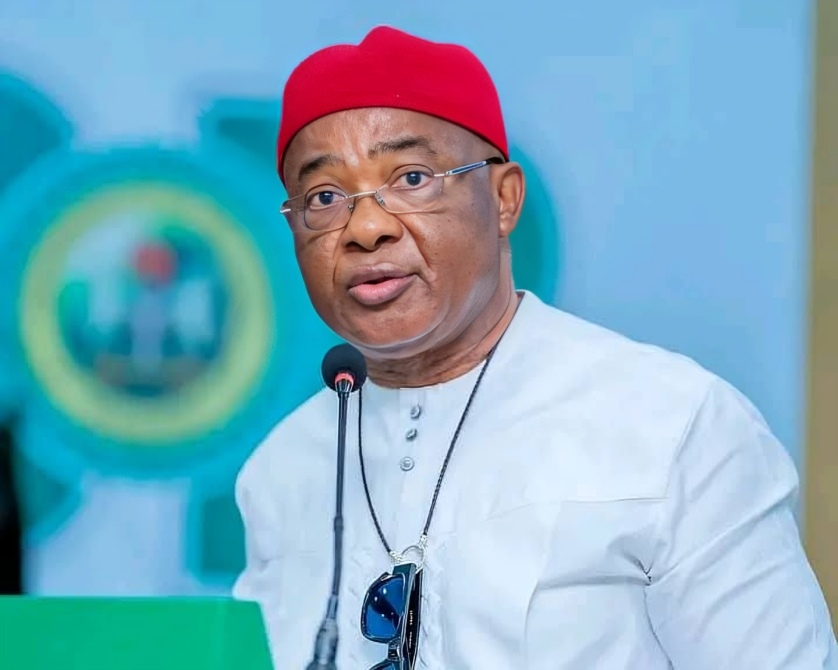
Sen. Hope Uzodimma, CON, GSGI
Governor, Imo State