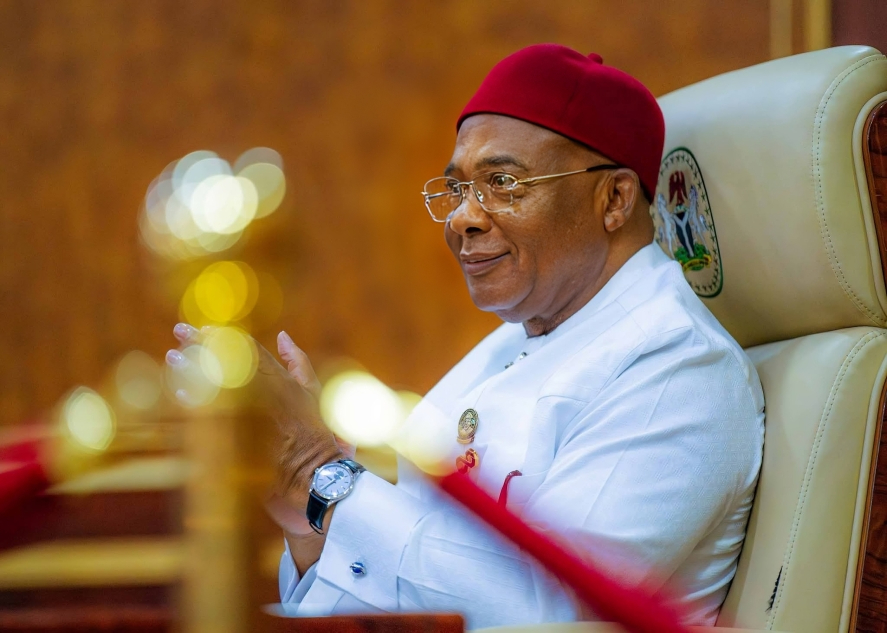
The politics of succession in Imo State has entered a more consequential phase, with Governor Hope Uzodimma’s inevitable exit in January 2028 sharpening elite calculations across the state’s three zones. What began as muted conversations after his re-election has now evolved into a structured contest of narratives—anchored on zoning, equity and control of the ruling All Progressives Congress (APC).
Uzodimma’s commanding victory in the November 2023 governorship election—where he polled over 540,000 votes—did more than secure a second term; it effectively reset the state’s political hierarchy. That margin of dominance has emboldened stakeholders, particularly from Owerri zone, to intensify demands that the next governor should emerge from their axis, citing marginalisation since 1999, with only Emeka Ihedioha’s truncated seven-month tenure as their claim to power.
Okigwe zone has, however, complicated the arithmetic. Its leaders argue that any credible rotation formula must account for their own limited access to the governorship, thereby transforming what might have been a binary Owerri-Orlu succession into a triangular contest of entitlement. This has injected uncertainty into the zoning debate and heightened the stakes of Uzodimma’s eventual decision.
Despite mounting pressure, the governor has remained deliberately opaque. No endorsements, no trial balloons, no symbolic gestures. This calibrated silence is widely interpreted as a governance strategy—designed to avoid the centrifugal pull of succession politics, which in Nigeria often triggers factional realignments, weakens incumbents and distracts from policy execution.
Insiders insist that Uzodimma’s immediate focus is legacy consolidation. His administration has foregrounded infrastructure as its defining metric—reconstructing strategic corridors such as Owerri-Orlu and Owerri-Okigwe roads, expanding urban renewal in the capital city, and pushing investments in healthcare delivery systems and digital infrastructure. The subtext is clear: performance, not politics, should define his remaining years.
There is also a timing calculus. With the governorship election still roughly 20 months away, many within the APC argue that succession talk is premature. The governor’s near-term priority, they contend, is electoral: delivering decisive victories for the party in the January 16, 2027 presidential and National Assembly elections, followed by the March 6, 2027 State Assembly polls—outcomes that will shape the structure of power heading into the governorship race.
Control of party machinery remains central to this strategy. The successful conduct of APC congresses in Imo has further entrenched Uzodimma’s influence within the party. A strong showing in 2027 would not only consolidate that dominance but also provide the political capital required to anoint—or at least decisively back—a successor capable of commanding both party loyalty and voter legitimacy.
Hovering over the debate is the Imo Charter of Equity, a normative framework endorsed by Uzodimma and advanced by the Imo State Council of Elders to institutionalise rotational governorship. While not legally binding, the charter has become a moral compass in elite negotiations, and any deviation from it risks political backlash, particularly from zones that perceive themselves as historically excluded.
Publicly, Uzodimma has sought to deflate the urgency of succession politics. He has repeatedly emphasised that governance must not be derailed by “premature campaigns,” noting that leadership decisions will ultimately reflect “the collective interest of Imo people.” The ambiguity of that position preserves flexibility while keeping aspirants in check.
Privately, however, the governor operates within a dense network of long-standing allies—figures cultivated from his senatorial years through his ascent to Douglas House. Within this circle are individuals with varying combinations of loyalty, administrative competence and political reach. The emerging consensus among insiders is that the eventual choice will hinge less on sentiment and more on governability—capacity to manage a complex state apparatus.
Yet, the structural challenge remains formidable. Imo’s political history offers no precedent of a sitting governor successfully installing a successor since 1999. The volatility of the state’s electoral politics, combined with entrenched local rivalries, makes any succession project inherently risky.
What may tilt the balance in Uzodimma’s favour is his alignment with the federal centre and his role as Chairman of the APC Governors’ Forum. Unlike some predecessors who operated from weaker national positions, he commands a level of institutional leverage that could prove decisive in managing both party consensus and electoral outcomes.
Still, the opposition is recalibrating. Former governor Emeka Ihedioha is widely projected to re-enter the arena, potentially under the African Democratic Congress (ADC), alongside other aspirants across party lines. Their participation ensures that the 2028 contest will not be a coronation but a competitive, high-stakes election.
In the final analysis, Uzodimma’s succession plan sits at the intersection of zoning morality, party supremacy, federal alignment and personal calculation. His silence, far from passive, is strategic—an attempt to sequence power, manage ambition and preserve authority. Whether that strategy culminates in the rare feat of producing a successor—or unravels under the weight of competing claims—will define not just his legacy, but the next chapter of Imo’s political trajectory.