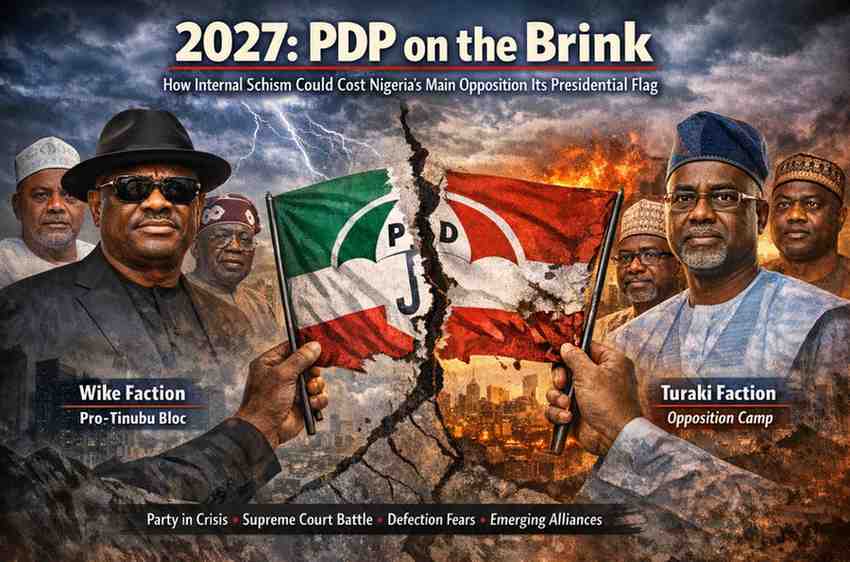
Nigeria’s main opposition party, the Peoples Democratic Party (PDP), is sliding into what may become its most defining existential crisis since losing power in 2015, with emerging indicators suggesting it could fail to field a presidential candidate in the 2027 general election. At the heart of this looming political rupture is a deepening factional war that has effectively split the party into two rival power blocs, each laying claim to legitimacy while pursuing sharply divergent political interests.
One faction, widely associated with Federal Capital Territory Minister, Nyesom Wike, has consolidated control through a controversial national convention that produced Abdulrahman Mohammed as National Chairman and Samuel Anyanwu as National Secretary. This bloc, though operating under the PDP umbrella, has shown little hesitation in aligning politically with President Bola Tinubu and the ruling All Progressives Congress (APC), blurring the ideological boundaries that typically define opposition politics.
Wike himself has been unapologetically direct. Serving as a key figure within the APC-led federal administration, he has repeatedly affirmed his support for Tinubu’s re-election bid in 2027. His political posture has effectively redefined his faction’s role within the PDP—from opposition actors to what critics describe as embedded allies of the ruling party. This has fueled concerns that the faction’s ultimate objective may not be electoral victory for the PDP, but strategic collaboration with the incumbent government.
On the other side of the divide is a rival PDP leadership structure led by Saminu Turaki, which insists it represents the authentic national leadership of the party. This camp draws its strength from the backing of two of the party’s remaining governors—Bala Mohammed of Bauchi State and Seyi Makinde of Oyo State—both of whom have maintained a more traditional opposition stance against the APC.
The Turaki-led faction has not only rejected the outcome of the Wike-backed national convention but has escalated the dispute to the Supreme Court, seeking judicial invalidation of the exercise. While the final verdict remains pending, the legal battle underscores the depth of institutional breakdown within the PDP, where parallel leadership claims now threaten to render the party structurally incoherent ahead of a critical election cycle.
Complicating the equation further are recent political movements that hint at a broader realignment of opposition forces. Governor Seyi Makinde’s recent visit to Kano, where he met with Rabiu Musa Kwankwaso alongside Labour Party’s Peter Obi, has intensified speculation about a possible coalition outside the PDP framework. Such engagements suggest that key actors within the Turaki faction may already be exploring alternative political platforms in anticipation of an unfavorable Supreme Court ruling.
Should the apex court validate the Wike-aligned convention, the implications would be far-reaching. The Turaki faction, effectively stripped of institutional control, could be forced into a political migration—most plausibly to the African Democratic Congress (ADC), which is increasingly positioning itself as a coalition platform for displaced opposition heavyweights. This would leave the PDP, at least in its legally recognized form, firmly under the control of a faction sympathetic to the APC.
In that scenario, the PDP’s capacity to function as a credible opposition party would be fundamentally compromised. With its recognized leadership aligned with or openly supportive of Tinubu’s re-election, the likelihood of the party presenting a serious presidential candidate diminishes significantly. Rather than contesting power, the PDP could inadvertently become a passive enabler of the ruling party’s dominance.
The broader implication for Nigeria’s democracy is profound. The absence of a viable PDP presidential candidate would mark a historic low point for opposition politics, effectively collapsing the traditional two-party competitive structure that has shaped electoral contests since 1999. It would also shift the burden of opposition almost entirely to emerging or reconfigured coalitions, whose coherence and electoral viability remain uncertain.
As 2027 approaches, the PDP stands at a crossroads that will determine not just its future, but the balance of political competition in Nigeria. Whether through judicial intervention, internal reconciliation, or strategic realignment, the choices made in the coming months will decide if the party remains a national political force—or fades into irrelevance at the very moment it is most needed.
Onwuka , a political analyst writes from Abuja