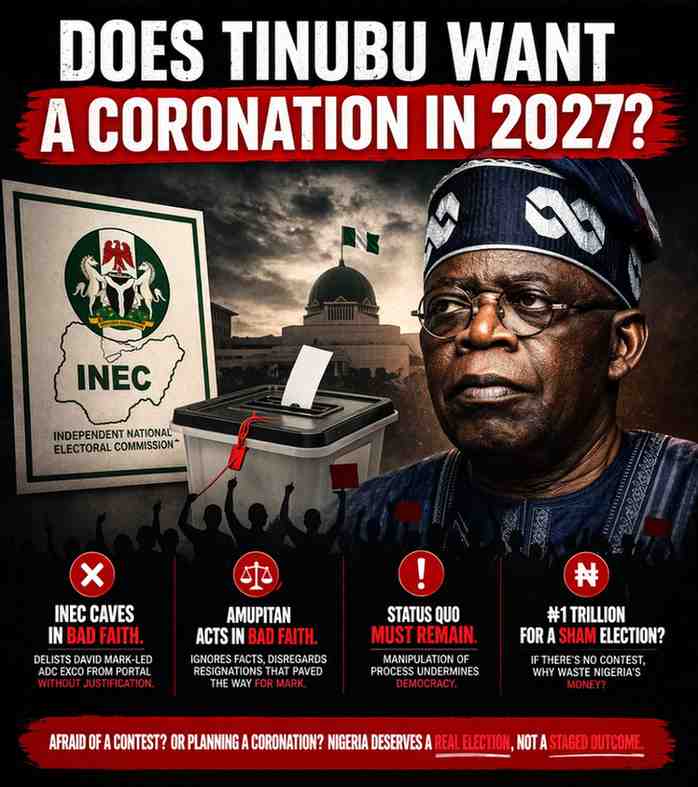
There is something deeply troubling about the latest developments around Nigeria’s electoral process, and it compels an urgent question: is President Bola Ahmed Tinubu preparing for a democratic contest in 2027, or scripting a coronation? Because the signals emerging are not those of a government confident in its popularity, but of one increasingly wary of open competition.
The Independent National Electoral Commission (INEC) has, once again, stepped into controversy—this time by delisting the David Mark-led National Executive Committee of the African Democratic Congress (ADC) from its official portal. That decision is not just questionable; it reeks of bad faith. It suggests an electoral umpire that is no longer content with neutrality but is edging dangerously close to political partisanship.
This is not a minor bureaucratic adjustment. It is a consequential political act that interferes with the internal stability of an opposition party at a critical time of coalition-building. By removing a leadership structure without transparent grounding, INEC has invited legitimate suspicion about whose interests it is truly serving.
Even more indefensible is the position attributed to Prof Josh Amupitan, the INEC Chairman and a Professor of law who ought to understand the legal and ethical implications of such a situation. It is disingenuous to challenge the legitimacy of the David Mark-led executive when the very individual who went to court against that leadership had already resigned alongside then National Chairman of ADC, Ralph Nwosu, effectively paving the way for a transition. That context cannot be conveniently ignored.
In matters like this, the principle of maintaining the status quo is fundamental. It exists precisely to prevent manipulation and preserve institutional integrity while disputes are resolved. By deviating from that principle, both INEC and its defenders have exposed themselves to accusations of complicity in undermining democratic norms.
But the larger question remains: why is the ruling establishment so invested in the internal affairs of an opposition party? The APC controls over 30 states and commands enormous political machinery. A party with such dominance should not be this visibly unsettled—unless there is something deeper fueling the anxiety.
The defection of Rabiu Musa Kwankwaso into the ADC orbit appears to have triggered that anxiety. The reaction from the ruling camp suggests a growing fear of a credible opposition coalition. For all its outward bravado, the APC is beginning to look like a party that is losing sleep over 2027.
And that fear is beginning to manifest in troubling ways—through institutional interference, strained legal arguments, and actions that suggest a desire to shape the contest before it even begins. It raises a pointed question: should a Jagaban be afraid of a contest, or is he now more comfortable with a controlled outcome?
The irony is stark. INEC is projecting a budget of nearly one trillion naira for the 2027 elections. But if the playing field is to be tilted and the process subtly manipulated, then the entire exercise risks becoming an expensive charade. Nigerians cannot be asked to fund a democracy that exists only in form, not in substance.
What we are witnessing is not strength, but panic. The APC’s moves betray a ruling party that may already be reading the handwriting on the wall. And instead of preparing for a fair fight, it appears to be reaching for institutional levers to secure advantage. If Tinubu seeks legitimacy in 2027, it must come through a genuine contest—not the quiet engineering of a coronation.
Mr Ibeama Writes From Abuja