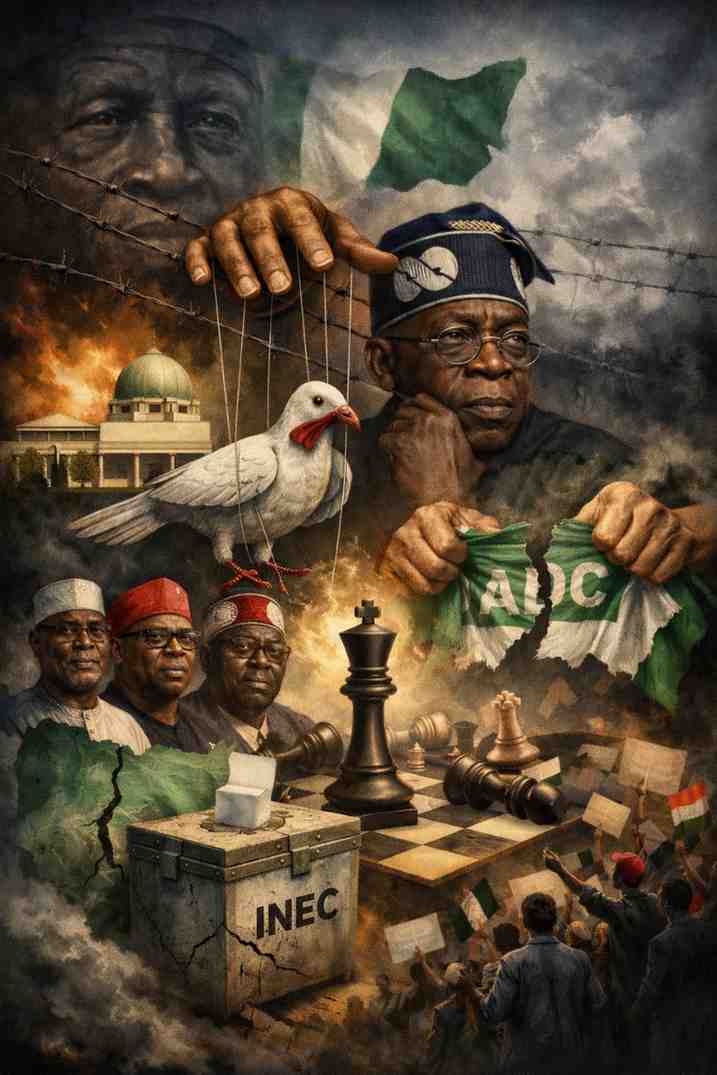
The derecognition of the African Democratic Congress (ADC) by the Independent National Electoral Commission (INEC) has blown open a political Pandora’s box—one that exposes not just legal ambiguities, but the deeper anxieties of Nigeria’s power elite about competition, dissent, and the unpredictable chemistry of opposition politics.
INEC’s action, in its barest form, involved withdrawing recognition from factions within the ADC leadership structure, citing internal disputes and procedural inconsistencies. The ADC, unsurprisingly, pushed back, accusing the electoral umpire of overreach and political partisanship. But beyond the legalese and bureaucratic justifications lies a more consequential question: why now, and to whose benefit?
Before its current troubles, the ADC had begun to assume the contours of a viable opposition platform. Not because it was ideologically coherent or morally superior, but because it had become a convenient rallying point for politically displaced actors seeking relevance outside the gravitational pull of the ruling party.
Let’s be clear: there is nothing inherently wrong with this. Political realignments are the lifeblood of democratic systems. The ADC’s evolution mirrors, in striking ways, the events leading up to 2014 when the All Progressives Congress (APC) emerged from the ashes of discontent within the then-dominant Peoples Democratic Party (PDP).
The APC was not born out of ideological purity. It was, fundamentally, a coalition of convenience—an assemblage of politicians who either felt excluded from the PDP’s power calculus or were simply impatient with its internal contradictions. What distinguished the APC, however, was its methodical approach and strategic clarity.
The alliance between Bola Tinubu and Muhammadu Buhari was not accidental; it was the product of deliberate political engineering. Buhari brought to the table a solid bloc of about 12 million loyal voters—votes he had cultivated over years of electoral losses. Tinubu, on the other hand, provided organizational muscle and elite consensus-building. It was a near-perfect synthesis.
The ADC, in its current iteration, appears to be groping toward a similar configuration, albeit with less coherence. It lacks Buhari’s ready-made electoral base, but it compensates with a troika of heavyweights—Atiku Abubakar, Peter Obi, and Rabiu Kwankwaso—who collectively commanded over 14 million votes in the 2023 presidential election.
That arithmetic alone is enough to unsettle any incumbent power structure. So when murmurs began about Kwankwaso’s possible alignment with the ADC, it triggered predictable tremors within the ruling establishment. Power, anywhere in the world, is instinctively allergic to credible threats.
It is within this context that the ADC and many of its sympathizers interpret INEC’s intervention—not as a neutral regulatory act, but as a politically motivated maneuver. In their telling, INEC is merely executing a script: the hand of Esau, guided by the voice of Jacob.
Whether or not one subscribes to this conspiratorial framing, the effect is undeniable. The ADC has been thrown into a state of political paralysis, its momentum stalled, its internal contradictions amplified. And in the ruthless arithmetic of Nigerian politics, timing is everything.
If, indeed, there is a grand design behind this, it only reinforces a long-standing perception: that President Bola Tinubu remains a consummate political strategist, one who has learned from the mistakes of his predecessors. Unlike Goodluck Jonathan, who allowed a relatively open competitive space that the APC expertly exploited, Tinubu appears unwilling to take similar chances.
But this is where the conversation must shift from personalities to principles. A democracy without credible opposition is not a democracy; it is a managed political theatre. The drift toward a de facto one-party state, whether deliberate or incidental, should alarm anyone invested in the health of Nigeria’s republic.
The more troubling question is why competition should inspire fear in the first place. If the ruling party is confident in its performance and popularity, it should welcome, not suppress, robust contestation. After all, legitimacy in a democracy is strengthened—not weakened—by credible opposition.
What is unfolding before our eyes is not just a dispute over party recognition; it is a stress test for Nigeria’s democratic institutions. And the early signs are not reassuring. Even the politically indifferent can read the handwriting on the wall.
Ultimately, the responsibility does not lie with the ADC alone. It rests with Nigerians—especially those who still believe in pluralism—to resist any subtle or overt moves toward political monopolization. History has shown, repeatedly, that when competition is stifled, mediocrity thrives.
Nigeria cannot afford that regression. Not now. Not ever.