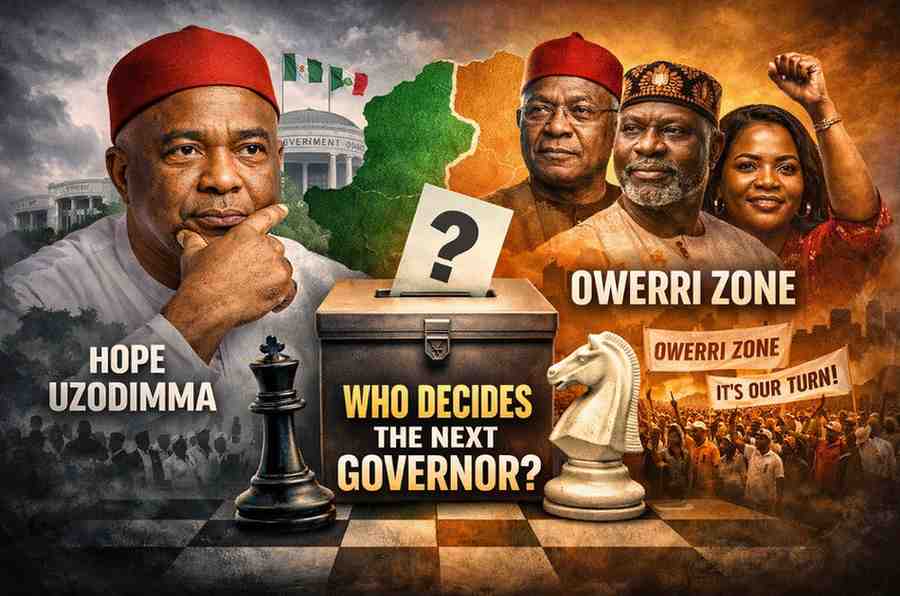
The agitation for the emergence of a governor from Owerri Zone is not only legitimate; it is long overdue. For years, the zone has watched from the political sidelines as power rotated in patterns that seemed to exclude it from the apex seat of Imo politics. In a state where equity is often preached, sometimes loudly, the Owerri Zone argument resonates with a moral clarity that is difficult to dismiss. It is, by every reasonable measure, a justified demand rooted in history, balance, and a quest for inclusion.
Yet, as with many righteous causes in Nigerian politics, the method of pursuit often determines the outcome more than the merit of the demand itself. What is emerging now from sections of the Owerri political elite suggests a subtle but consequential misreading of how power actually works. There is a growing tendency to conflate agitation with entitlement, and worse, to assume that the logic of zoning automatically confers the power of selection. It does not.
Politics, especially at the level of gubernatorial succession, is not a communal assembly where zones gather to nominate successors. It is a carefully choreographed process driven by incumbency, influence, alliances, and calculation. Governor Hope Uzodimma, like every sitting governor before him, holds the decisive lever in determining who succeeds him. This is not conjecture; it is the lived reality of Nigerian subnational politics.
To assume that Owerri Zone leaders can unilaterally “produce” or “present” a successor to the governor is to indulge in political romanticism. It ignores the asymmetry of power between those who currently wield state authority and those who merely aspire to influence it. In truth, any attempt to impose a candidate on an incumbent governor is not just unrealistic—it is strategically flawed.
There is a difference between advocating for equity and staging what could be perceived as a political ambush. Governors, by instinct and by necessity, resist attempts to box them into corners. Succession politics is deeply personal, often opaque, and always calculated. No governor wants to be strong-armed into a decision that could define his legacy, secure his post-office relevance, and protect his political structure.
This is where the Owerri Zone agitation must evolve. It must transition from a moral appeal to a strategic engagement. The language of “it is our turn” must be complemented by the politics of persuasion, coalition-building, and alignment with the governor’s interests. Anything short of that risks turning a compelling argument into a counterproductive confrontation.
There is also the danger of internal overreach. When multiple voices within the zone begin to speak in tones that suggest finality—naming candidates, drawing battle lines, and projecting inevitability—they inadvertently weaken the collective cause. Such posturing can trigger resistance, not just from the governor, but from other zones that may feel threatened or sidelined.
It is important to state clearly: supporting Owerri Zone’s aspiration does not mean endorsing every tactic deployed in its pursuit. Agitation must be intelligent, not impulsive; strategic, not sentimental. The history of Nigerian politics is replete with examples where well-founded demands collapsed under the weight of poor execution.
Governor Uzodimma, by virtue of his position, reserves the right to shape his succession. And if precedent holds, he will exercise that right with precision. Those who understand the dynamics of power know that succession is less about where a candidate comes from and more about who controls the process that produces the candidate.
Ultimately, Owerri Zone stands at a critical crossroads. It can either refine its approach and align its legitimate demand with political reality, or it can persist in a path that risks alienating the very power structure it needs to engage. The choice is stark. Agitation is necessary, yes—but it must not morph into an illusion of control. In the end, power concedes nothing to assumption; it responds only to strategy.
“Governor Uzodimma, by virtue of his position, reserves the right to shape his succession. And if precedent holds, he will exercise that right with precision”