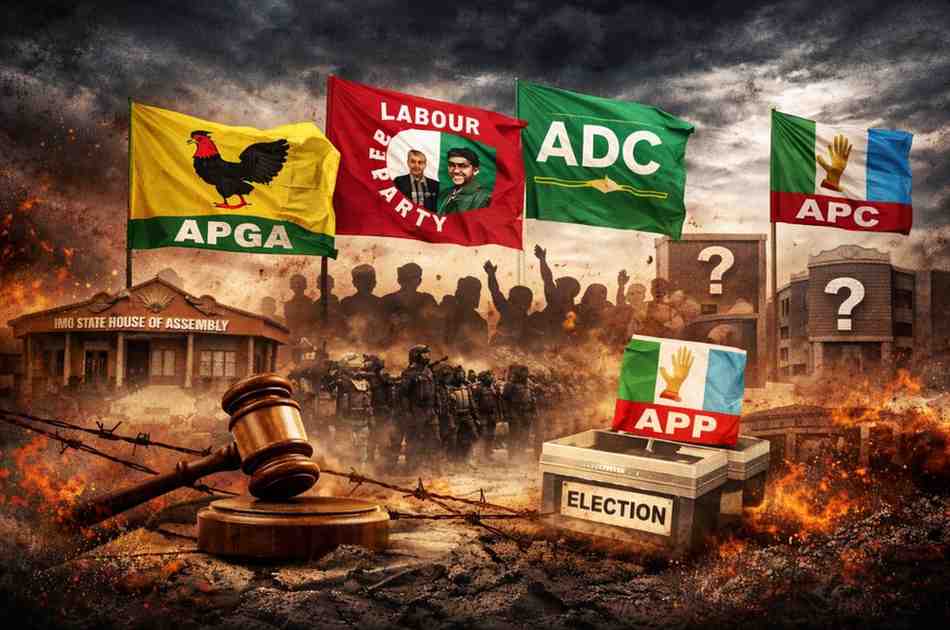
The configuration of opposition politics in Imo State has shifted significantly in recent years, leaving a fragmented field struggling to define a credible alternative to the ruling APC. An assessment based on electoral outcomes, legislative presence and organisational coherence shows a weakened opposition space marked more by decline and realignment than by any clear emergence of a dominant challenger.
Historically, the PDP was the dominant political force in the state. It produced two governors—Achike Udenwa and Emeka Ihedioha—both elected on its platform, while Ikedi Ohakim also governed the state after defecting from the PPA. At its peak, the PDP controlled all 27 local government areas, held a majority in the State Assembly, and maintained a strong presence in the National Assembly.
That dominance has, however, eroded sharply. The party’s performance in the 2023 governorship election marked a historic low, failing to secure victory in any local government area. Its absence at the councillorship level and reduced grassroots visibility highlight a broader organisational decline, raising concerns about its ability to function as a viable opposition force.
APGA, once a preferred platform among Imo’s political elite, has also faded considerably. The party currently holds no elective positions in the state and has struggled to maintain relevance in an increasingly competitive and fluid political environment.
The African Democratic Congress (ADC) is gradually establishing a presence in the state, though its influence remains limited. While the party enjoys a stronger profile at the national level, that strength has yet to translate into significant electoral impact in Imo. Its relatively recent emergence on the state’s political scene partly explains its still-evolving structure.
The Labour Party experienced a surge in 2023, driven largely by the popularity of its presidential candidate, Peter Obi. That wave of support translated into notable victories in both federal and state legislative elections within Imo.
However, the party’s momentum has since declined. The post-election period has seen a weakening of its support base, with shifting political alignments—including Mr Obi’s association with the ADC—contributing to a gradual dissipation of its earlier gains.
Amid this landscape, the APP has recorded modest visibility, particularly through its representation in the House of Representatives. This gives it a degree of institutional presence that distinguishes it from several other opposition parties currently lacking elective positions at the grassroots level.
Nevertheless, the APP’s position remains constrained. Questions have been raised about its registration status—issues the party has dismissed—while its overall structure and statewide reach are still developing, limiting its immediate capacity to mount a broad-based challenge.
Across the opposition spectrum, many parties continue to point to the existence of ward and local government executives as indicators of strength. However, such claims have not consistently translated into electoral success, making them an unreliable measure of political viability in the state.
Overall, the opposition in Imo remains fragmented and in transition. The decline of established parties, the uneven growth of newer platforms, and shifting political loyalties underscore a landscape still searching for cohesion, with no single party yet demonstrating the strength, structure, or consistency required to effectively challenge the dominance of the APC.