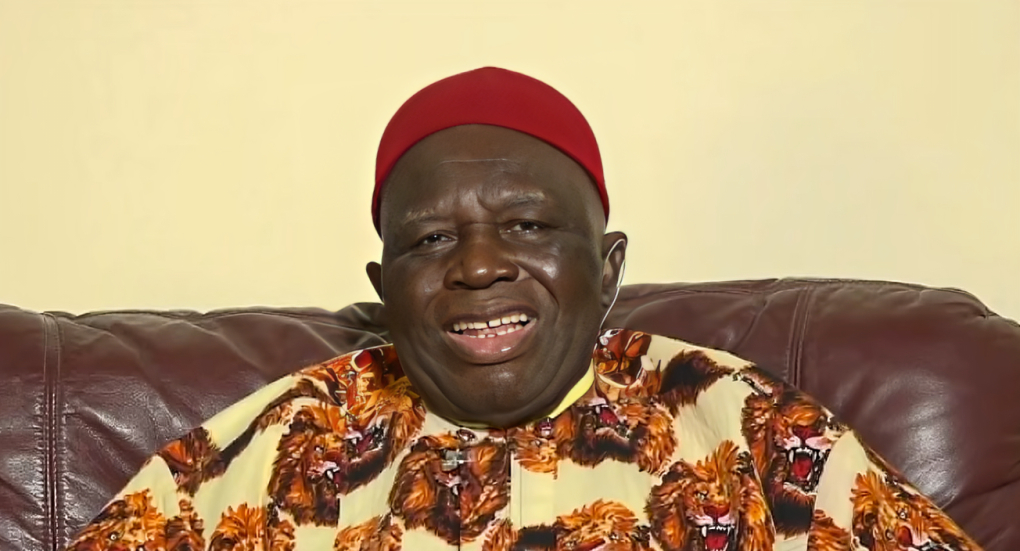
A couple of weeks ago, I had cause to ruminate over the life and times of my late uncle, Professor George Obiozor, through an article entitled: “TRUMP: IF AMBASSADOR GEORGE OBIOZOR WERE STILL ALIVE”. As the title suggests, I was moved to do the write-up in the wake of the diplomatic uneasiness between our dear country, Nigeria, and the United States of America, following the recertification of Nigeria as a “Country of Particular Concern” by the Donald Trump administration; and the latter’s threat to invade our country to tackle terrorists and insurgents. As expected, several well-meaning Nigerians came up with the argument that what Nigeria needs now are deft diplomatic moves and naturally, Professor George Obiozor, easily one of the most experienced diplomats Nigeria has ever produced, came to mind. After the article, I came across several comments in the social media reaffirming the fact that the late Professor Obiozor would have been quite handy in engaging the US government concerning the matter under discuss.
Today, however, is his death anniversary and even though the matter for which Nigerians recently talked and wrote about him is still lingering, Professor Obiozor is missed in more ways than one. Professor George Achulike Obiozor towered in academics, public service and diplomacy but his last duty post was as the president-general of Ohaneze Ndi Igbo, the apex socio-cultural organization of the Igbo nation. In other words, Professor Obiozor had, after several years of serving Nigeria and indeed the international community quite meritoriously, returned home to serve his own people, the Igbo. Even though he was more or less persuaded into accepting to serve in that office, Professor Obiozor put in the same verve, diligence and enthusiasm with what he carried out his national and international assignments earlier. He did not see serving his own kinsmen less challenging than in capacities that made him a recurring decimal in every administration since the Second Republic, whether military or civilian.
As a matter of fact, there was no THINK TANK in the country Professor Obiozor was not part of. He was not a politician but he was a master strategist and was consulted by even the most astute politicians. Of course, his definition of politics as a concentric circle of conspiracies wherein the last set of conspirators would always emerges victorious remains a classical reference in almost every political discussion in Nigeria. Still, the period he served his people as president-general of Ohaneze Ndigbo could be said to be one of the most tasking in his career. Although his ascendance into that office marked a water shed in the existence of the body, it was at a most difficult time in the relationship between the Igbo and their fellow compatriot across the country. He took up the job of leading the Igbo at the height of the separatist mantra of some younger elements in Igbo land. And even though the movement was initially non-violent, criminally-minded elements soon infiltrated the struggle and began to unleash mayhem on the people.
Thus, throughout his tenure as president-general of Ohaneze Ndigbo, Professor Obiozor was caught in between assuring a skeptical Nigerian nation that his people are committed to the unity of Nigeria on one hand, and convincing the agitators that Ndigbo are better off in a larger, united and peaceful Nigeria on the other. For a fellow who had been taken into confidence by the highest echelon of the national political establishment, nothing could be more worrisome than being perceived as condoning tendencies that challenged the unity of the country. But contrary to insinuations in some quarters that he would play the ethnic irredentist, he took the new assignment from a robust patriotic ambience.
Because he believed that injustice was at the root of the separatist agitations that were, in any case, not limited to his people, that apparent dilemma was for him easy to handle. He once told a panel of journalists who thought they could blackmail him on the issue of the Indigenous People of Biafra (IPOB) thus: “the IPOB boys are our children and we cannot deny then” but he quickly cautioned that his kinsmen in Igboland must try and “listen to good counsel from their leaders”.
Further prodded by one of the panelists whether the Ohaneze which he was leading believes in Biafra, he said “There is Biafra in anyone looking for justice”, adding that “so long as injustice is meted to people in any part of the country, sentiments like Biafra are bound to arise irrespective of tribe, religion or geography”. For the one and half years he served as Ohaneze president-general, Professor Obiozor kept saying, “Igbo are not at war with Nigeria”.
Apart from the challenge posed by the separatist movement and the consequential mounting of suspicion of his Igbo kinsmen by other sections of the country, it was during the same period that agitations for a Nigerian president of Igbo extraction got to a crescendo. Professor Obiozor, both as an individual and as leader of the Igbo nation, threw his weight behind it. He once said, “finally, it is our turn. It is right, reasonable and timely. Igbo president is our agenda”. Unfortunately, death came a few months before the 2023 presidential election but even though the outcome was not as he would have wished, Nigerians missed his own perspective on how the entire thing ended up.
Of course, that was not the first time he was playing a leading role in the pursuit of the interest of his people. Professor Obiozor played a key role in facilitating the return of the late Dim Chukwuemeka Odumegwu-Ojukwu to Nigeria in the Second Republic. He acted as a mediator between Ojukwu and the Nigerian government then headed by President Shehu Shagari, shuttling between Lagos and the then Ivory Coast, now Cote d’ Ivoire. In that assignment, he worked closely with some of Igboland’s finest intellectuals like the late Chuba Okadigbo, who was a Special Adviser to President Shagari, Nnia Nwodo, who was a minister in that republic and ABC Nwosu.
My last article on Professor Obiozor referenced earlier and in which I sought to explore what would have been his position on President Trump’s current posturing on Nigeria, was published a few days just before the sentencing of Mazi Nnamdi Kanu to life imprisonment by a federal high court. Now that we are marking his death anniversary amid a heated debate over that judgment, a good question would be, what would have been Professor Obiozor’s position on the matter. But the answer is not difficult to fathom. Professor Obiozor would have aligned with several other well-meaning Nigerian to tell his Igbo kinsmen to remain calm as a “political solution” is in the offing.
Professor Obiozor was a statesman, a renowned academic, public servant and diplomat, but he was first and foremost a community leader and successful family man. He was born and raised in Awo-Ommama, an ancient community in the Oru-East local government area of Imo state. Even though he rose to the apogee of his academic and public service career, he was very much in touch with his roots. He served his immediate community meritoriously and was honoured with a chieftaincy title of Ugwumba I of Orlu in 1991. Professor George Obiozor was blessed with a beautiful family.
On March 21, 2023, Prof’s country home in Awo-Ommama was razed down by unknown hoodlums using Improvised Explosive Devices (IED). Naturally, the incident was greeted with outrage but till date, the mystery over it is yet to be unraveled. Even though he knew that there was bound to be a price to be paid for providing leadership at such a precarious period, that was clearly a heartless show of ingratitude to an 80-year old man who had used his active days in service of both the entire Nigerian nation and his kinsmen in Igboland. Prof. was to latter confide in some of his close associates that what pained him most in that incident was the loss of a manuscript of a book he had hoped would be his last, along with his world-class library that took him several years to build.
Following the formal announcement of his death by Governor Hope Uzodimma, on December 26, 2022, a deluge of tributes flooded the media from across the world. This was how Governor Uzodimma, himself a longtime ally and kinsman of Professor Obiozor, described him: “A renowned academic, an exceptional diplomat, a statesman, and a tenacious patriot”. Former Nigeria’s Foreign Affairs Minister, Major General Ike Nwachukwu (rtd), whom Professor Obiozor served as Special Adviser, had this to say: “I can attest to the fact that Georgy was made of impeccable qualities. He was a scholar, an exquite diplomat and a man of vast public knowledge. Notwithstanding his depth of knowledge and interest in writing, he remained an unassuming intellectual who was beholding to a life of pleasant expositories laced with humour”. Professor Chido Nwangwu, a US-based academic wrote of him thus: “Only as few scholars had the skills of interpreting and speaking rather clearly on a multitude of global issues and situating the most practical implications and connections”.
A former governor of Imo state, Ikedi Ohakim, wrote of him thus: “Professor Obiozor was not just a brilliant academic, he was a philosopher, a great thinker, a trait he embellished with a down-to-earth and unassuming mein that set him aside from most of his colleagues”. Former Minister of Aviation, Osita Chidoka, says of him: “He was deep, humorous and Intellectually rigorous”.
In a tribute on behalf of the Nigerian Institute of International Affairs (NIIA), which Professor Obiozor once headed as Director-General, Professor Eghosa E. Osaghae, the head of the institute at the time of Prof’s passing wrote, among other things: “Professor Obiozr demonstrated unalloyed zest for strengthening our capacity to actualize Nigeria’s manifest destiny as African and global leader”.
President Muhammadu Buhari in his own tribute wrote that Professor Obiozor’s “contributions to a peaceful and stable polity … will never be forgotten”. President Olusegun Obasanjo, in whose administration he served as Ambassador to Israel and the United States, noted that Professor Obiozor’s tenure was “a fitting complement to my administration’s efforts to re-make the international profile of Nigeria”. Similarly, President Gooluck Jonathan in a tribute asserted that “Professor Obiozor was a great patriot whose love for the nation and his people knew no bounds in his selfless service towards the unity and development of our country”. We can go on and on but space constraint would not permit going beyond a few of the many acknowledgements by eminent personalities of his contributions not only to the building of the Nigerian nation but also to international scholarship and diplomacy.
Professor Obiozor had his early education at Awo-Omamma Comprehensive Secondary School from 1959 to 1963. For his higher education, he attended the Institute of African studies, Geneva, Switzerland in 1967 for a Diploma programme. He later proceeded to the University of South Tacoma, Washington, USA where he obtained a B.A (Hons) in Political Science in 1968.
He obtained a Master’s degree from Columbia University, New York, in International Law and Organization, M. Phil in International Affairs in 1974 and finally a doctorate in International Affairs in 1976. Professor Obiozor was a lecturer at the Pratt Institute, New York, from 1971 to 1975. He went on to become an assistant Professor of Political Science in City University of New York, Medgar Evers College between 1975 and 1979 and Rlaph Bunche Fellow at the City University of New York Graduate Center, from 1977 to 1978.
He was the Ambassador of the Federal Republic of Nigeria to the state of Israel and High Commissioner to the Republic of Cyprus between 1999 and 2003 and later Nigeria’s Ambassador to the United States from 2004 to 2008. Before his engagements with foreign missions, he had been Special Adviser to the Nigerian Minister of Foreign Affairs and Special Assistant to the President on International Affair in 1990. He also served as Director-General of the Nigerian Institute of International Affairs, Africa’s foremost foreign policy think tank. Professor Obiozor authored several books and other seminal works including highly regarded journal articles. Sleep on Ugwumba
Hon. Obiozor writes from UbaChima, Awo-Ommama Imo State