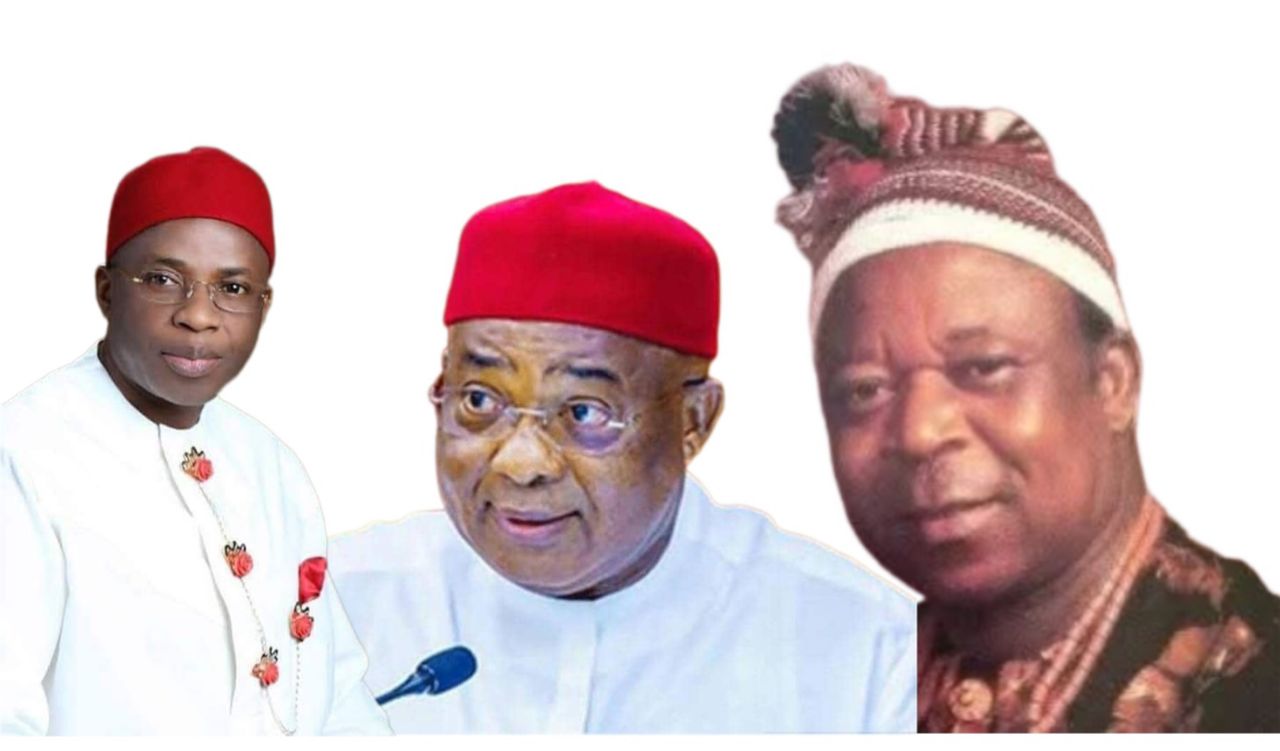
Any honest account of Imo State’s foundation—its infrastructure, institutions, and enduring development philosophy – can be traced unmistakably to Okigwe zone.
From the pioneering leadership of Dr. Sam Onunaka Mbakwe, popularly known as “Dee Sam” to the reform-driven governance of Dr. Ikedi Godson Ohakim, Okigwe has repeatedly gifted Imo State leaders whose visions transcended politics and prioritized posterity.
Dee Sam Mbakwe Phenomenon
Late Dr. Sam Onunaka Mbakwe, governor of old Imo State from 1979 to 1983, remains one of the most visionary, selfless, and development-oriented leaders the South-East has ever produced. A lawyer by training and a statesman by instinct, Mbakwe governed with rare integrity, humility, and an unyielding passion for progress.
At a time when many states in the late 1970s to 80s were still grappling with identity and direction, Mbakwe laid a solid developmental foundation for the old Imo State,which consists parts of present day Abia and Ebonyi States. His administration embarked on massive road construction, opening up rural communities and integrating them into the state’s economic life. He invested boldly in agriculture, industry, tourism, aviation, and education—sectors that defined Imo’s early promise.
Remarkable projects such as the Sam Mbakwe International Cargo Airport, Concorde Hotel Owerri, and extensive road networks across the state stand today as enduring monuments to his foresight. Decades after his tenure, these projects continue to serve the people – an exemplification of leadership driven not by personal gain but by collective advancement. Unsurprisingly, Mbakwe remains celebrated as an unforgotten hero whose legacy helped shape not only Imo State but the broader South-East region.
Ohakim’s Vision and Mission
Decades later, Dr. Ikedi Godson Ohakim emerged from the same Okigwe zone to rekindle that spirit of purposeful governance. Though his tenure as governor (2009–2011) was brief, it was impactful, reform-driven, and distinguished by clarity of vision and courage of execution.
Ohakim governed with intellect, discipline, and compassion—qualities often scarce in the political space. His administration reintroduced structure, order, and accountability into governance at a time when public institutions had weakened and civic responsibility had eroded.
Perhaps his most defining legacy was the Clean and Green Revolution, a bold environmental policy that transformed Imo State into one of the cleanest states in Nigeria at the time. Beyond aesthetics, the initiative restored environmental sanity, improved public health, created jobs, and repositioned Imo as a model of urban and environmental management.
Ohakim also emphasized the rule of law and public service discipline, insisting on due process, professionalism, and respect for institutions. Civil servants were reoriented toward service delivery, while governance became more data-driven and policy-focused. His administration invested in road infrastructure, education, healthcare, and urban renewal, with projects designed to be sustainable rather than cosmetic.
Importantly, Ohakim governed with the future in mind. He sought to rebuild citizens’ confidence in government, promote civic responsibility, and restore the dignity of public life. His leadership demonstrated that governance could be firm yet humane, visionary yet practical.
Between Mbakwe and Ohakim lies a shared philosophy: leadership as service, development as duty, and legacy as the true measure of power. Both men, in different eras and under different circumstances, governed with courage and conviction, leaving behind tangible achievements rather than empty rhetoric.
Okigwe’s gift to Imo State, therefore, is not accidental. It is a tradition of leaders who think beyond their tenure, who prioritize institutions over personalities, and who believe that government exists to improve lives. Regrettably, both former governors suffered similar fate as their tenure were truncated and their vision ruined .
History will continue to judge leaders not by how long they ruled but by what they built and what endured. By that measure, Sam Mbakwe and Ikedi Ohakim stand tall—two sons of Okigwe whose contributions remain engraved in Imo State’s past, present, and future.
Then Comes Uzodimma’s Midas Touch
Governor Hope Uzodimma’s emergence in 2019 remains the soothing balm that has kept the socioeconomic,
infrastructural,and political fabrics of Imo State intact to date. The resilience and panache his administration has brought to bear in the governance of the State is evident in the eye-popping developments across all spheres or sectors of Imo’s economy.
After the conspiracy of the 2011 Imo governorship, which plunged Imo State into political and economic recession occasioned by gross maladministration, lack of altruism in governance and repugnant obsession for grabbing of anything grabable by an administration that came in through deceit and falsehood, it took Governor Uzodimma’s political maestroism,spartan spirit and midas touch to “truly rescue Imo State.” But for Governor Uzodimma’s intervention when he did, perhaps Imo State today, would have nose-dived into the abyss or valley of governance – socioeconomically,
infrastructurally and politically.
Like Ohakim, Governor Uzodimma has proven to be an ardent student of Dee Sam Mbakwe’s leadership thought and philosophy. This is incontestably correct and evident in the massive transformations Imo State has continued to witness under his leadership. In fact, Governor Uzodimma, as former Governor Ohakim once said, has demystified the erroneous notion that second tenures for governors in Nigeria is for jamborees, and a wasteful venture.
Records confirm that Governor Uzodimma has done more works in his second tenure than he did in his first tenure. A friend of mine told me recently that he is appalled by the way Governor Uzodimma is working in his second tenure. “Are you he is not eyeing a third term? I have not seen any governor work like this in his second tenure,” my bewildered friend stated.
Need For Stability and Continuity
A major problem facing governance in Nigeria today, is lack of stability and continuity in governance. Any new administration struggles to obliterate the achievements and legacies of its predecessors. Former Governor Rochas Okorocha did it before Governor Uzodimma intervened.
Uzodimma himself has,however,kept faith with the demands of stability and continuity in governance. He never abandoned any projects by his processors despite political differences; rather he improved upon them – that is visionary leadership.
As 2027 beckons, Imo needs an experienced leader who is broadminded and has the capacity to sustain Governor Uzodimma’s laudable legacies. If Ohakim is the man – so be it. Political experimentation should be avoided at all costs – zoning or no zoning.
Indeed, Governor Uzodimma, Ohakim and Dee Sam Mbakwe are three of a kind. The message now should be Imo first above other mundane considerations.Imo must win.
Ochiagha Nnanna Okere is from Umuowa Ngor-Okpala and writers from Finland.