President Bola Tinubu came into office in May 2023 with a reputation as a bold reformer, a man willing to take tough decisions others avoided. Nearly three years into his administration, one thing is clear: he has indeed taken hard decisions. But another truth is even clearer — ordinary Nigerians are paying the price, and they are paying it brutally.
To be fair, this government is not without achievements. The removal of fuel subsidy, unification of the exchange rate, improved government revenue, and relative macroeconomic stability have all been cited as policy wins. Inflation, by official figures, has shown signs of moderation, easing to about 15 percent in early 2026. Economic growth has also held steady, and investor confidence has somewhat improved. These are not trivial outcomes.
But governance is not measured by economic theory or investor applause. It is measured by the lived reality of the people. And across Nigeria — from Kano to Owerri, from Uyo to Ilorin — the verdict is harsh and unforgiving: life has become harder, not better.
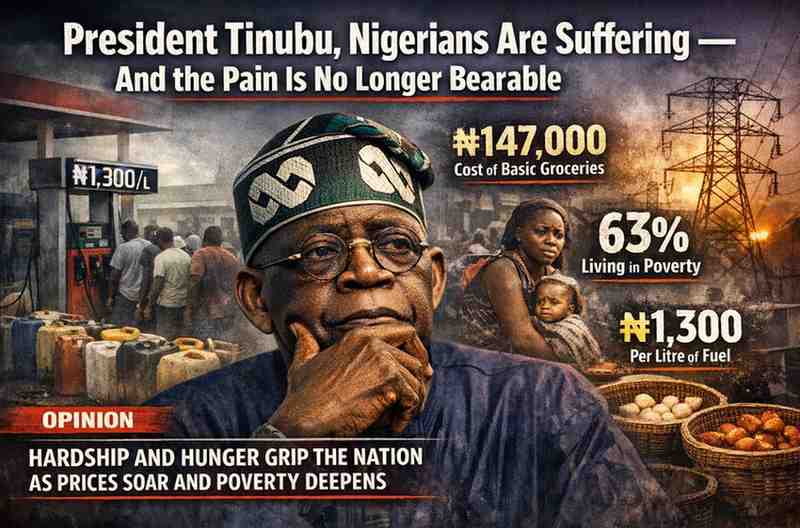
Fuel, the lifeblood of Nigeria’s informal economy, now sells for as high as ₦1,300 per litre in many parts of the country. This is not just a statistic; it is a death sentence for small businesses, transporters, and households. Transportation costs have surged by as much as 50 percent, cascading into higher food prices and general inflation. Every sector is choking under the weight of energy costs.
Food prices tell an even more devastating story. A basic basket of groceries that cost about ₦25,000 in 2020 now gulps over ₦147,000 — a staggering 582 percent increase. For millions of families, feeding has become a daily struggle, not a routine obligation. In some homes, food now consumes up to 70 percent of income.
Electricity, which should cushion the impact of expensive fuel, has failed spectacularly. Power supply remains erratic, forcing citizens to rely on generators — ironically powered by the same costly fuel. Nigerians are trapped in a vicious cycle: no power, high fuel cost, and rising cost of living.
The most damning indictment lies in poverty figures. A recent study indicates that about 63 percent of Nigerians now live below the poverty line, largely worsened by the removal of fuel subsidy and associated reforms. Let that sink in: nearly two-thirds of the population is struggling to survive. This is not reform. This is social distress on a massive scale.
Yes, economists argue that these reforms were necessary. Yes, they insist the pain is temporary. But Nigerians are not living in economic textbooks. They are living in a country where salaries have remained stagnant while prices have tripled. Where survival, not prosperity, is now the national ambition.
The Tinubu administration’s pattern of governance is becoming predictable — bold reforms, harsh consequences, and insufficient cushioning for the people. Social protection measures remain weak, inconsistent, and largely ineffective. The gap between policy and compassion is glaring.
There is also a dangerous disconnect between government messaging and public reality. Officials speak of “stability” and “recovery,” yet the streets tell a different story — one of hunger, frustration, and quiet anger. Markets are no longer just places of trade; they are theatres of hardship.
This is the paradox of the Tinubu presidency: strong on reform, weak on relief. A government that understands macroeconomics but appears disconnected from micro suffering. A leadership that celebrates indicators while citizens battle inflation in real time.
Mr President, Nigerians are not asking for miracles. They are asking for relief. They are asking for policies that do not crush them in the name of reform. They are asking for electricity that works, fuel they can afford, and food within reach.
Your administration may yet be judged kindly by history for its economic restructuring. But history is not written in boardrooms or policy papers. It is written in the daily experiences of the people.
And today, across Nigeria, that experience is one of pain.
Relentless, suffocating pain.