If politics is ultimately a contest over power, succession politics is a contest over the future. And in Imo State today, nothing animates conversations in government circles, political gatherings, more than the question of who succeeds Governor Hope Uzodimma in 2027. With barely 17 months to the governorship election, a quiet political war is already buzzing among powerful interests in Owerri Zone. It is a cold war prosecuted through discreet meetings, strategic endorsements, subtle lobbying, and relentless positioning. Beneath the surface calm of the ruling APC lies an intense struggle among competing blocs in the zone, each convinced that history, equity, and political logic favour its claim to Douglas House.
What has given oxygen to this silent contest is the widespread belief that Uzodimma is inclined to hand over power to Owerri Zone in line with the Charter of Equity. Whether the governor has privately settled on that position is beside the point. In politics, perception often becomes reality long before reality arrives. And the prevailing perception among political actors in Owerri zone is that the governor’s successor will emerge from the Zone. Consequently, the debate has shifted from whether Owerri should produce the next governor to which segment or bloc of Owerri deserves the office. That distinction is crucial because Owerri Zone is not a monolithic political entity. It is a collection of competing blocs with different histories, ambitions, and arguments.
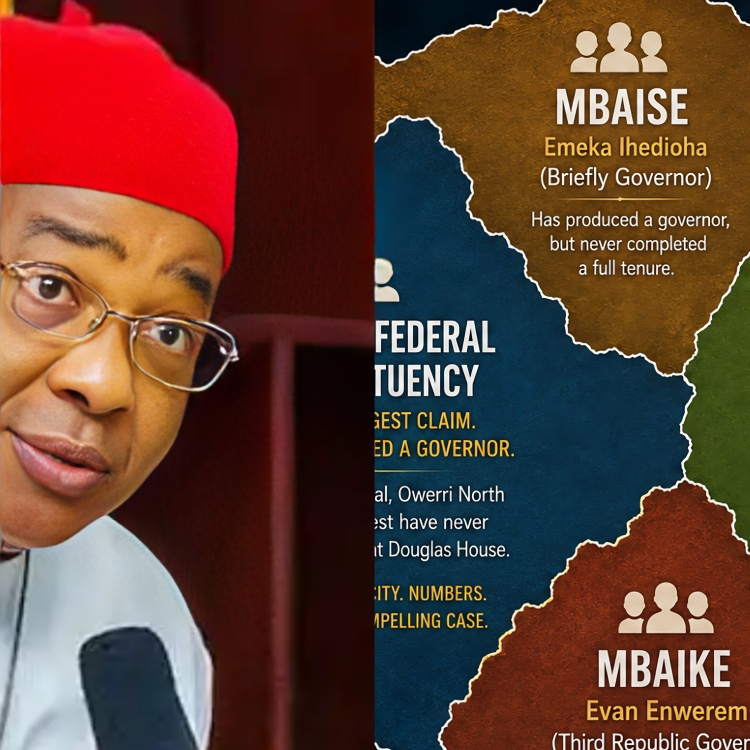
Traditionally, the zone is divided into three major blocs—Mbaise, Mbaike, and Owerri Federal Constituency. But recent developments have complicated that arrangement. Ngor Okpala, historically grouped with Mbaise because both share the Aboh Mbaise/Ngor Okpala Federal Constituency, has increasingly asserted a distinct political identity. Its leaders argue that geographical convenience should not permanently subordinate their political aspirations. Thus, what was once a three-way equation is gradually evolving into a four-cornered contest. Every bloc now seeks to construct a persuasive narrative capable of attracting Uzodimma’s attention and endorsement.
The fascinating aspect of the succession debate is that every bloc possesses an argument, but not every argument carries equal weight. Mbaike can proudly point to the late Evan Enwerem, who governed Imo State during the aborted Third Republic. Mbaise can point to Emeka Ihedioha, who briefly occupied Douglas House during the Fourth Republic. Ngor Okpala can invoke demographic significance and strategic location. Yet, among all the blocs, Owerri Federal Constituency possesses the most potent political weapon: it has never produced a governor. Not one. Since Imo State was created in 1976, Owerri Municipal, Owerri North, and Owerri West have watched other blocs take turns at the state’s highest office while they remained spectators.
That reality is politically consequential. In a state where the Charter of Equity has become both a moral compass and a political instrument, the inability of Owerri Federal Constituency to produce a governor stands out like an unfinished chapter in the state’s political history. It gives the bloc a compelling argument that is difficult to dismiss. Equity, after all, derives its legitimacy from correcting imbalance. And there is hardly a stronger case for imbalance within Owerri Zone than the exclusion of Owerri Federal Constituency from the governorship equation.
Ironically, even the blocs that have produced governors carry political scars. The stories of Evan Enwerem and Emeka Ihedioha are linked by an extraordinary coincidence. Both ascended to power with enormous expectations. Both left office prematurely. Enwerem’s tenure was terminated by military intervention after barely 22 months. Ihedioha’s administration lasted only seven months. Neither completed a full tenure. Neither enjoyed the opportunity to consolidate power. Consequently, supporters of both blocs argue that justice remains incomplete. Their governors occupied office, but never long enough to leave enduring legacies.
Yet succession politics is rarely an exercise in historical compensation. Governors do not choose successors merely to settle old scores or reward emotional arguments. They choose successors to protect interests, preserve legacies, sustain political structures, and maintain influence after leaving office. That is why the succession conversation must be viewed through a broader lens. The decisive question is not who deserves the office most. The decisive question is who best serves Uzodimma’s long-term political calculations. And that is where Owerri Federal Constituency appears to gain another advantage.
A remarkable number of political figures currently angling for the governorship come from Owerri Federal Constituency. More significantly, many of the administration’s visible power players and strategic actors are rooted in that axis. The bloc is rich in political experience, administrative exposure and elite networks. In other words, it is not merely demanding power on the basis of equity; it also possesses a deep bench of potential contenders. This combination of moral argument and political capacity makes it particularly formidable. In succession politics, a bloc becomes dangerous when it can combine entitlement with competence.
This is why the argument that Owerri zone APC Senatorial candidate who emerged from the constituency has weakened its governorship prospects misses the complexity of political succession. Governorship succession operates under a different logic altogether. The factors that determine who becomes the APC senatorial candidate are often non existent when choosing a successor. An outgoing governor weighs considerations far more delicate and strategic: loyalty, trust, competence, electability, political temperament, ability to manage competing interests, and commitment to preserving existing political arrangements. These considerations frequently override simplistic zoning calculations.
Indeed, history shows that succession battles are won not by those who shout the loudest but by those who best align with the outgoing governor’s vision of the future. That is why the identity of Uzodimma’s preferred successor remains one of the best-kept secrets in Imo politics, at least for now. He understands that the choice will define not only the future of the APC in Imo but also the fate of his own political legacy. For now, all the blocs remain in the race. Mbaise is calculating. Mbaike is hopeful. Ngor Okpala is asserting itself. But Owerri Federal Constituency appears uniquely positioned, armed with the strongest equity claim, the deepest reservoir of aspirants, and perhaps the most persuasive political narrative. Whether those advantages ultimately translate into Uzodimma’s endorsement remains uncertain. What is certain, however, is that the battle for Douglas House has begun. And in the intricate chessboard of Imo politics, the most decisive moves are usually made when spectators still think the game has not started.