Power is a dangerous intoxicant. It seduces men into believing that the throne belongs to them by divine inheritance. It whispers that yesterday’s privilege should become tomorrow’s birthright. But power, like the seasons, was never designed to be permanent. Every civilisation that mistook dominance for destiny eventually collided with history’s unforgiving verdict. Imo State now stands before such cross roads. The Constitution grants every qualified citizens the right to contest the governorship. That right is unquestionable. But politics is not sustained by legality alone. It is equally anchored on morality, restraint and justice. A right exercised against equity soon becomes an abuse of that right.
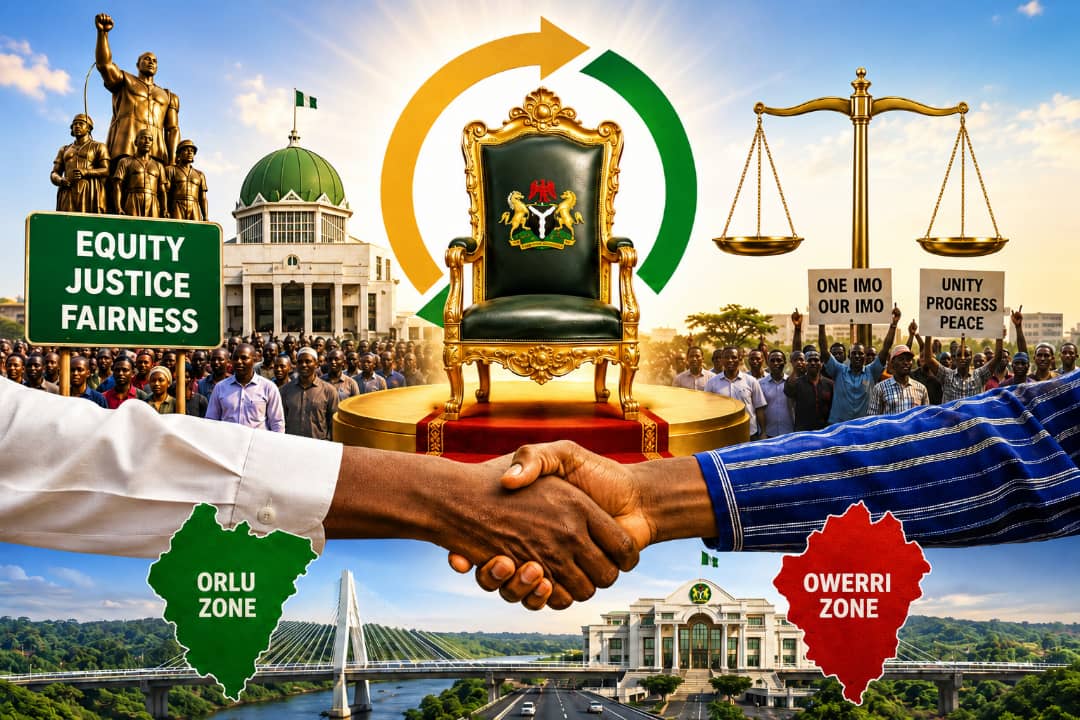
The arithmetic is too plain to be disputed. Since 1999, Orlu zone has occupied the commanding heights of Imo politics. From Achike Udenwa to Rochas Okorocha and now Hope Uzodimma, the governorship has remained substantially in Orlu’s custody. By 2027, the zone would have held power for well over two decades in the Fourth Republic. No rhetorical gymnastics can erase that record. Facts are stubborn tenants. They refuse eviction by propaganda.
Standing opposite this long occupation is Owerri zone, the perpetual bride left at the altar of power. Its fleeting encounter with Government House disappeared almost before it began. It has waited while others ruled. It has watched while others harvested the fruits of democracy. That is why the Charter of Equity was born—not as a decorative slogan or a political lullaby—but as an attempt to rescue justice from the jaws of permanent exclusion. It was conceived as a covenant of balance, not a favour bestowed on the weak.
Those who dismiss the Charter as a gentleman’s agreement betray a poor understanding of political civilisation. The strongest democracies are held together not merely by constitutions but by conventions, honour and mutual trust. Justice cannot always be legislated. Equity cannot always be enforced. They survive because responsible leaders recognise that there are moments when morality must triumph over ambition. Once agreements become disposable whenever they inconvenience the powerful, politics degenerates into organised deceit.
That is why any politician from Orlu zone nursing a governorship ambition in 2027 commits a grave moral error. Such an ambition may satisfy personal vanity, but it will stand condemned before the court of public conscience. More profoundly, any aspirant from Orlu seeking to succeed Governor Hope Uzodimma would amount to the political antichrist of the Charter of Equity—a direct repudiation of the spirit of fairness, an assault on justice, and a rebellion against the very covenant that has kept hope alive among the excluded. Such a person would not merely contest an election; it would seek to crucify equity on the altar of insatiable ambition.
Thankfully, many respected voices from Orlu understand this truth. They know that greatness is not measured by endless occupation of Douglas House but by the grace to relinquish it when justice demands. They recognise that Orlu loses nothing by supporting Owerri. On the contrary, it gains the moral authority that only sacrifice can produce. History is kinder to those who voluntarily surrender privilege than to those who cling to it with desperate fingers.
History also remembers alliances. Owerri never declared political war on Orlu when Orlu sought power. Across successive elections, bridges were built, hands were joined and votes were exchanged. No governor from Orlu ascended Douglas House solely on Orlu votes. Other zones invested their trust in that project. Political gratitude may have no constitutional provision, but it remains one of the noblest currencies in public life. A people who continually receive support but refuse reciprocity eventually mortgage their moral capital.
No one disputes Orlu’s electoral weight. It remains the largest voting bloc in Imo politics. But numerical strength is not a licence for perpetual domination. True leadership is demonstrated not by monopolising power but by guaranteeing peaceful succession. The strongest brother in the family proves his strength by protecting the weaker, not by confiscating every inheritance. Influence survives office. Respect outlives power.
The 2027 governorship election is therefore bigger than individual aspiration. It is a referendum on whether Imo genuinely believes in fairness or merely invokes it when politically convenient. Every politician from Orlu should answer one question before declaring ambition: after producing governors for over two decades, what compelling moral argument remains for insisting on another turn? The silence that follows is louder than a thousand campaign speeches.
History has opened a rare window for justice. To shut it deliberately would be to invite needless division into the future. Orlu’s greatest contribution to Imo in 2027 is not another governor but another legacy—the legacy of honouring equity. Power retained at all costs breeds bitterness. Power surrendered in obedience to justice breeds enduring peace. And peace, unlike office, outlives those who wield authority. That is the difference between statesmanship and political idolatry.
“That is why any politician from Orlu zone nursing a governorship ambition in 2027 commits a grave moral error. Such an ambition may satisfy personal vanity, but it will stand condemned before the court of public conscience. More profoundly, any aspirant from Orlu seeking to succeed Governor Hope Uzodimma would amount to the political antichrist of the Charter of Equity—a direct repudiation of the spirit of fairness, an assault on justice, and a rebellion against the very covenant that has kept hope alive among the excluded. Such a person would not merely contest an election; it would seek to crucify equity on the altar of insatiable ambition”