There is a point at which political ambition ceases to be merely an exercise of constitutional freedom and begins to reveal something more troubling: an inability to read the political temperature of the society one hopes to govern. This is the uncomfortable question confronting politicians from Orlu Zone who are warming up for the 2027 governorship of Imo State. Nobody disputes their constitutional right to contest. But constitutional eligibility is not the same thing as political equity. After 24 years of Orlu domination of the governorship since 1999, another bid from the same zone inevitably raises a more fundamental question: when is enough enough?
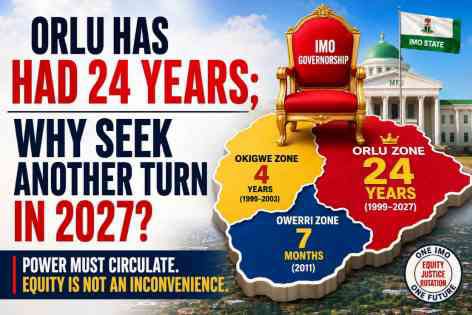
The arithmetic is brutally straightforward. Since the return to democracy in 1999, Orlu Zone has produced Achike Udenwa, who governed for eight years; Rochas Okorocha, who governed for another eight years; and Hope Uzodimma, whose tenure, if completed as constitutionally permitted, will bring Orlu’s cumulative occupation of the Government House to 24 years. Okigwe Zone has produced one governor, Ikedi Ohakim, for four years. Owerri Zone produced Emeka Ihedioha, whose tenure lasted approximately seven months before the Supreme Court removed him from office. These are not matters of interpretation. They are the political history of Imo State since 1999.
Yet, against this overwhelming imbalance, politicians from Orlu are again positioning themselves for the 2027 contest. Former ISOPADEC chairman Charles Ugwu, for instance, has declared his interest and argued that he has the right to contest. On the narrow constitutional question, he is correct. But politics is not a courtroom where the only question is whether an action is legally permissible. It is also a negotiation among communities with competing interests, expectations and claims to fairness. The more important question, therefore, is not whether an Orlu politician can contest, but whether, after three Orlu governors and 24 years in power, another Orlu bid represents a proposition that the rest of Imo should reasonably regard as equitable.
There is also an inconvenient question some Orlu politicians must answer. The governors produced by Orlu did not govern an Orlu republic. They governed Imo State and depended on votes, goodwill and political cooperation from Owerri and Okigwe. Citizens from those zones helped elect and sustain Orlu administrations. Why, then, should the political support that Orlu received from other zones suddenly become irrelevant when those same zones ask for their own opportunity? If political solidarity is desirable when Orlu seeks power, why should equitable rotation become unacceptable when power is expected to move elsewhere?
The deeper problem is the conception of political power as an entitlement rather than a responsibility. A politician can possess every constitutional qualification for an office and still demonstrate poor political judgment in pursuing it at a particular time. The distinction matters. Democracy gives citizens the freedom to compete; political wisdom determines how that freedom is exercised within a diverse society. If every zone approaches the governorship with the mentality that it must seize the office whenever it has the numerical or political capacity to do so, then zoning, rotation and consensus become meaningless words deployed only when convenient.
The present moment offers Orlu an opportunity for something more consequential than another governorship bid. It offers the zone an opportunity to demonstrate statesmanship. After producing three governors and occupying the Government House for 24 years, Orlu could say that its political class understands the need for balance and is prepared to support another zone. Such a decision would not diminish Orlu’s political importance. On the contrary, it would demonstrate confidence, generosity and an understanding that political influence becomes more enduring when it is used to build accommodation rather than perpetual dominance.
What, then, should the people of Imo make of another Orlu claim in 2027? They should ask the obvious questions. Why should Owerri continue waiting after barely seven months in office? Why should Okigwe regard four years as an adequate share of the governorship? What exactly is the political logic that makes 24 years insufficient for Orlu while seven months is apparently sufficient for Owerri? And if the answer is simply that every aspirant has a constitutional right to contest, then what becomes of the equally legitimate political expectation that power should circulate among the three zones?
Nobody is asking Orlu politicians to surrender their constitutional rights. Nobody is suggesting that the governorship belongs permanently to Owerri. Imo State is not the property of any senatorial zone. But precisely because it belongs to all three zones, its highest elective office cannot be treated as though political equity were an inconvenience to be overcome. A right to contest is not a guarantee of entitlement to the support of the people.
The real test of political maturity in 2027 will therefore not be how many aspirants Orlu can produce. It will be whether its political class understands that there is a time to pursue power and a time to help distribute it. Orlu has had three governors and, by the end of Uzodimma’s tenure, 24 years of control of the state’s highest political office since 1999. That history gives the zone enormous political weight. It should also give it enough confidence to step back and allow another zone to breathe.
Because there is something fundamentally wrong with a political arrangement in which one zone repeatedly says, “I have the right to contest,” while the other zones are perpetually expected to answer, “Perhaps it is not yet our turn.” That is not the language of equity. It is the language of permanent advantage. And Imo State deserves better.