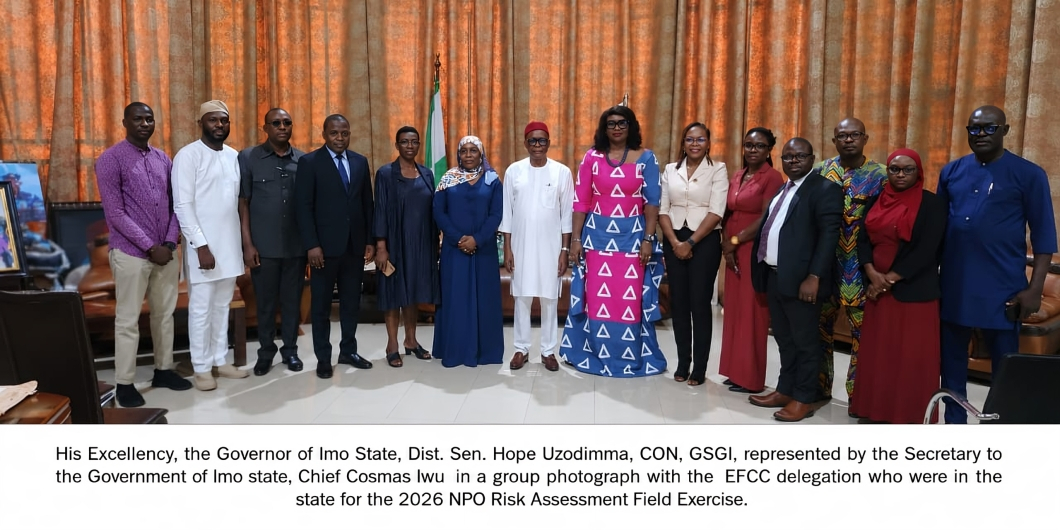
The Secretary to the Government of Imo State, Chief Cosmas Iwu, has pledged the preparedness of his boss and Governor of the state, Senator Hope Uzodimma, to assist the Economic and Financial Crimes Commission (EFCC) to fight money laundering.
Iwu made the pledge on Wednesday in Owerri while receiving, on behalf of Governor Uzodimma, a team of EFCC officials for the 2026 NPO Risk Assessment Field Exercise against money laundering, which was held at the Emmanuel Iwanyanwu International Convention Centre, Owerri.
Chief Cosmas Iwu told the inter-agency delegation, led by Mrs. Korede Abdul-Aziz, on a courtesy visit at the Cabinet Office, Owerri, ahead of the main session, that the state government was prepared to assist all federal agencies to achieve their mandate.
Welcoming the team to Imo State for the commencement of the 2026 Non-Profit Risk Assessment Field Exercise against money laundering, Chief Iwu described crime as a global issue that is “infectious and spreads easily” and commended the Commission for the sustained spirited fight against all sorts of financial crimes in the country.
“Everyone cannot be happy with your method of operation or even existence, but the majority of Nigerians agree that without the intervention of the Commission, financial crimes would have been on the increase in the country,” Chief Iwu noted.
He further commended the leadership of the EFCC on the recent Risk Assessment Field Exercise on the Non-Profit Organisation sector, which aimed at ensuring that Non-Profit Organisations are not being used as conduits for money laundering and funding of terrorism in the country.
“The government of Imo State under the pragmatic leadership of His Excellency, the Governor, Dist. Sen. Hope Uzodimma, CON, GSGI, appreciates this engagement. We believe that transparency and accountability are key to good governance, and we will continue to support efforts that protect our people and institutions,” the SGI stated.
Chief Iwu reiterated the fact that Imo State Government has been at the forefront of fighting corruption, noting that on assumption of duty in 2020 by His Excellency, the Governor, Dist. Sen. Hope Uzodimma, he discovered that previous administrations had outsourced the preparation of workers’ salary vouchers to nebulous contractors. Every month, the state government lost more than five hundred million naira (N500m) through payroll fraud; but Governor Uzodimma put a halt to it. Today, no worker in the state is owed one kobo by this administration.
Chief Iwu further disclosed that with the approval of His Excellency, the Governor, Imo State Government would avail the team the necessary support they require to carry out their duties while in the state, noting that the State Government is ready to collaborate with federal agencies for the overall good of our country.
He enjoined them to find time to move around the state to see the giant strides recorded by Governor Uzodimma’s administration and to enjoy the hospitality of the people of the state.
The inter-agency exercise brought together Chief Executives, Boards of Trustees of NPOs operating in Imo State, top government appointees, and relevant Ministries involved in the regulation of the non-profit organisation sector.
According to the inter-agency delegation, the objective of the field exercise was to identify vulnerabilities by spotlighting the small number of NPOs that could be exploited by terrorism financiers, protect legitimate charities from unnecessary regulatory burdens, and strengthen Nigeria’s framework for anti-money laundering and counter-terrorism financing.
The delegation clarified that Imo State was not under investigation by the Commission, noting that the exercise is part of a nationwide assessment of Non-Profit Organisations.
Addressing participants during the interactive session, the leader of the delegation, Mrs. Korede Abdul-Aziz, said the essence of the exercise is to strengthen transparency and mitigate terrorism financing risks in the non-profit organisation sector.
She explained that the assessment is in line with Financial Action Task Force (FATF) recommendations on Nigeria’s National Terrorism Financing Risk Assessment.
“The goal is not to clamp down on genuine charities. It is to look at the sources of funding of NPOs, to ascertain if they are being used as a conduit for money laundering or terrorism financing, and to ensure that only a few bad actors are targeted while genuine NPOs continue their humanitarian work without hindrance,” Mrs. Abdul-Aziz said.
She further noted that the exercise is an inter-agency collaboration involving EFCC, the Nigerian Financial Intelligence Unit (NFIU), the Corporate Affairs Commission (CAC), and other relevant bodies.
Contributing, the Director of Spaces for Change, a Civil Society Organisation, Barr. Mrs. Victoria Ibezim-Ohaeri, enlightened stakeholders that NPOs could be used unknowingly through health outreach programmes or other services in the course of doing their humanitarian work, and warned them to be cautious.
The interactive session featured technical presentations on compliance requirements, such as Special Control Unit Against Money Laundering (SCUML) registration, record keeping, and donor due diligence.
Representatives of NPOs in Imo State raised concerns on the need for harmonised and digital registration of Non-Profit Organisations and urged the Ministries involved in the registration process to liaise with security agencies for proper security clearance of Chief Executives and Boards of Trustees of NPOs, before registration.
Officials from the Ministries of Women Affairs, Health, Humanitarian Affairs, Justice, Finance and the Ministry of Youths also participated in the discussions alongside a good number of NPOs operating in the state.
The EFCC reiterated that SCUML registration remains free of charge and urged all NPOs in the 27 Local Government Areas of Imo State to complete their registration.
The programme ended with a call for stronger collaboration between government, regulators, and the non-profit sector to protect the integrity of charitable work in the state.