Nigeria’s football establishment should stop pretending that this is a bad patch. The Super Falcons’ quarter-final defeat to Cameroon at the WAFCON is another painful warning from a system that has been failing for years. Nigeria will not contest the semi-finals and must now pursue the difficult qualification route for the 2027 FIFA Women’s World Cup in Brazil. For a country that once expected its national teams to set the standard in Africa, this is an alarming descent.
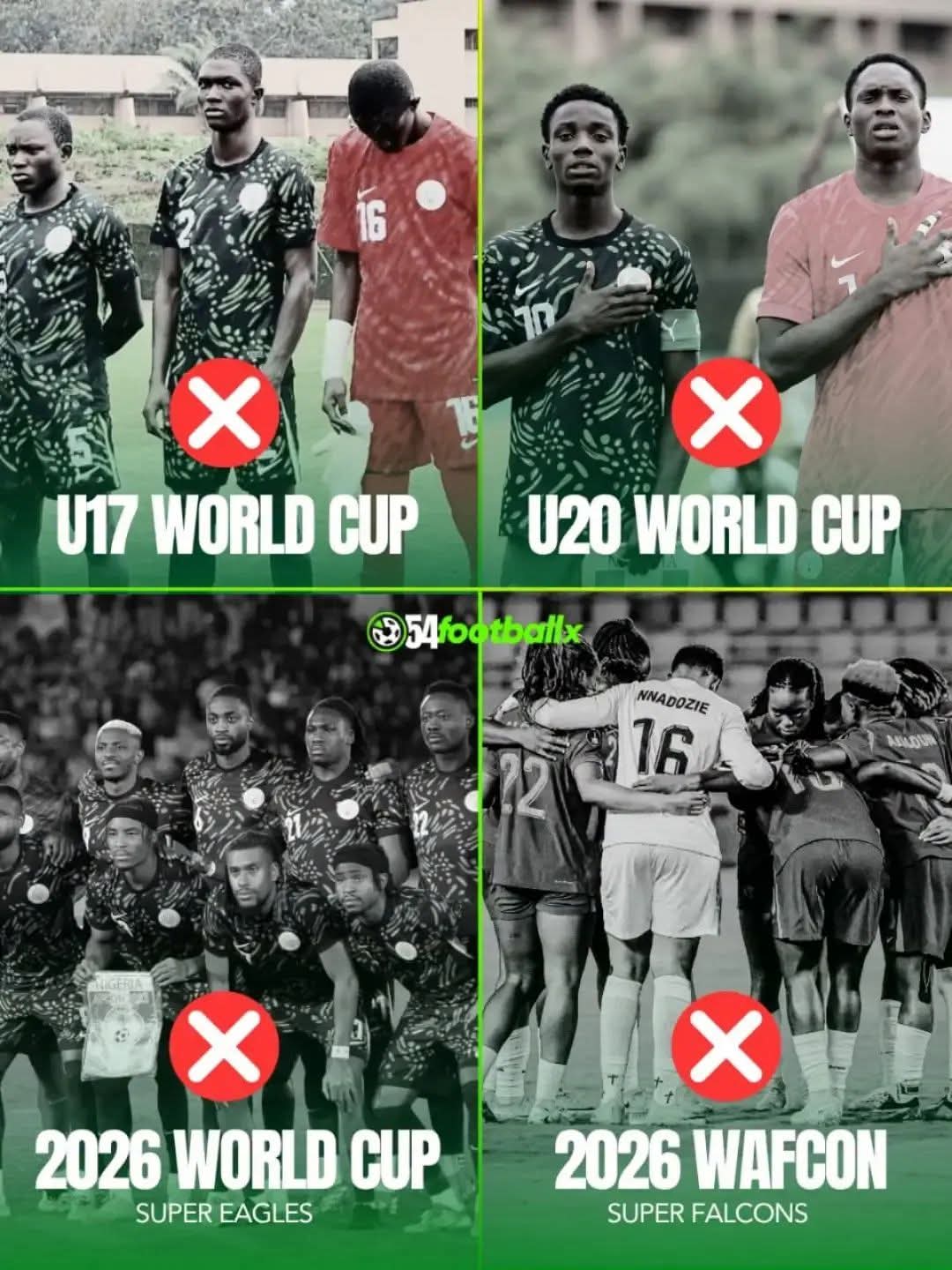
The evidence is now overwhelming. The Super Eagles have missed two consecutive World Cups. The Golden Eaglets are absent from the U-17 World Cup. The Flying Eagles have been battered by Burkina Faso. The Falcons have failed to reach the WAFCON semi-finals and now face a more complicated road to Brazil. These are not four unrelated disappointments. They point to a national football structure that is losing its capacity to develop, prepare and sustain competitive teams.
The uncomfortable truth is that Nigeria has not run out of footballers. Nigerian players continue to thrive in some of the world’s most competitive leagues. The raw material remains exceptional. What is failing is the machinery around them. Administration, youth development, coaching structures, scouting, grassroots football, domestic competitions and technical planning have not produced the coherent system expected of a country with Nigeria’s football resources.
The Nigerian Football Federation and the wider football establishment must therefore accept responsibility instead of searching endlessly for convenient scapegoats. Coaches will come and go. Players will make mistakes. Matches will be lost. But when failure becomes recurrent across senior and youth teams, the issue is no longer tactical. It is institutional. A serious football administration should be able to explain its development strategy, demonstrate measurable progress and account for repeated failure. Nigeria has heard enough promises. It needs evidence of competence.
This is also where Nigeria’s obsession with short-term fixes must end. Changing coaches after every disappointment is not a development policy. Assembling national teams around tournaments is not a development policy. Waiting for another generation of naturally gifted players is certainly not one. Football nations build systems that continuously produce players, coaches and competitive teams. Nigeria has too often relied on talent to compensate for the weaknesses of its institutions.
The country now needs a National Football Summit with one purpose: fundamental reform. It should bring together credible former internationals, coaches, club owners, administrators, technical experts, sports scientists and youth-development professionals to examine the entire football structure without political protection or sentiment. The questions must be blunt. What is Nigeria’s long-term football plan? Who is responsible for youth development? How are coaches selected and assessed? Why are our systems producing fewer elite national teams despite abundant talent? And who answers when agreed targets are missed?
The defeat by Cameroon should therefore not be filed away as another tournament disappointment. It should be a catalyst. The failures of the Super Eagles, Falcons, Flying Eagles and Golden Eaglets have exposed a crisis that no new slogan can solve. Nigeria still has the talent. What it lacks is a football system worthy of that talent. The administrators must now choose between serious reform and continued decline. There is no credible third option.