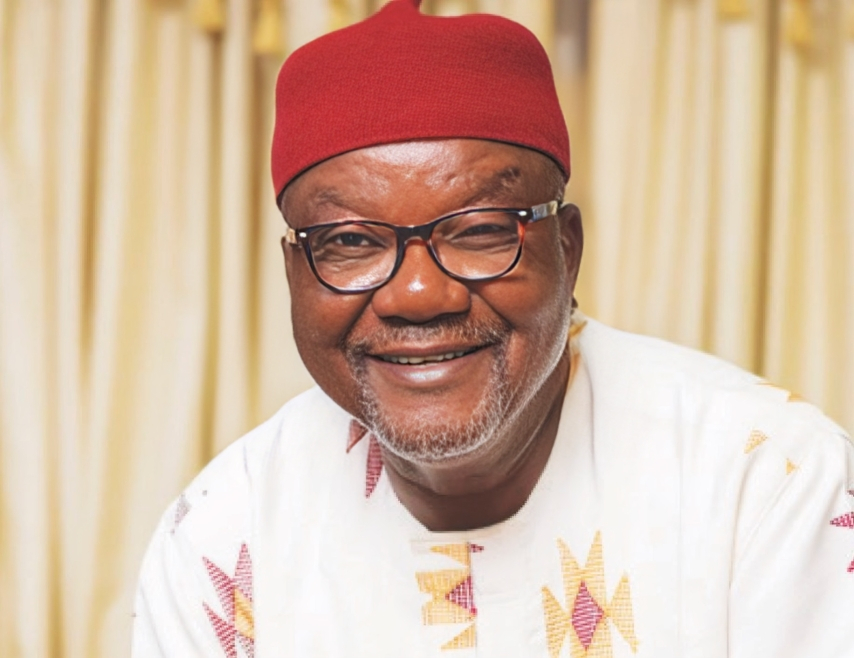
“Strong men do not create opportunities. They seize them, and in the seizing, they remake the world around them.”
In the crowded, noisy arena of Abia politics, few names echo with the weight of inevitability like that of Chief Charles Ogbonnaya. To the people of Ibeku, he is not just a title holder. He is Evule Ogu Ibeku. The bulwark. The wall that does not flinch when the storm comes.
A bulwark is not decorative. It does not beg for attention. It stands, and by standing, it allows everything behind it to breathe. That has been the story of Evule Ogu Ibeku for more than two decades.
He first entered the consciousness of Abia people not with noise, but with service at the base. In his formative years in politics, he was at different times Local Government Chairman and Special Adviser to the Abia State Governor — roles that taught him how government feels at the grassroots before it gets to the state capital. Later, as Commissioner for Local Government and Chieftaincy Affairs, he sat at the intersection where government touches the village square. That is where power is either made real or made a lie. He chose to make it real.
Later, as Commissioner for Trade and Investment, and as Deputy Chief of Staff to the Governor, he learned the cold arithmetic of governance: that budgets mean nothing without will, and that will means nothing without men who can move people.
That is where the title Evule Ogu Ibeku stopped being ceremonial and became operational. In Igbo cosmology, Ogu is war. Evule Ogu is loosely translated as the Ram of War, connotes the one who carries it, who absorbs it, who turns it back. In politics, the war is for relevance, for resources, for representation. And he has fought it, and won it, on the streets, not just in government house.
Look at 2022. When Nigeria was described as being “on life support,” he did not hold a press conference and go home. He donated a magnificent edifice on Azikiwe Road, Umuahia, as the campaign office for Atiku Abubakar. He called it what it was: a collective rescue mission. That single act told you two things about the man. He puts his money where his conviction is, and he understands that politics is about structures you can touch.
He stood then as Abia State Coordinator of the Atiku Campaign Council. The PDP chieftain was betting on reach, on international connections, on political understanding. But the same man would later walk a different road, because bulwarks do not follow parties. Parties follow terrain.
Today he walks under the broom. As an APC chieftain in Abia, he has thrown the full weight of his machinery behind President Bola Ahmed Tinubu’s 2027 project. He commended the digital e-registration drive, not as a ritual, but as a strategic move to count real strength. “Come out en masse,” he told his people. “Let the party deliver more dividends of democracy.”
That is the language of a mobilizer. Not slogans. Instructions. He knows that elections are not won on television. They are won in the 292 wards, at the registration centers, in the quiet conversations under mango trees.
He has said it plainly: the Ikwuano/Umuahia North/Umuahia South Federal Constituency has been under-represented. It is a cry that resonates across the capital territory, where the promise of federal presence has not matched the weight of population and enterprise.
He is aligning strongly with Distinguished Senator Orji Uzor Kalu, a former Governor of Abia State and a towering voice in the National Assembly. And he is much more strongly aligned with the Deputy Speaker of the Federal House of Representatives, Rt. Hon. Benjamin Kalu, who has been vociferous in his mobilization for President Bola Ahmed Tinubu and the All Progressives Congress in Abia State. Together, they form the tripod on which APC’s ambition in the state now rests.
A bulwark does not apologize for choosing strong allies. It finds the load-bearing beams and leans into them.
But strength without voice is just posture. Evule Ogu Ibeku has a voice, and he uses it like a scalpel. When royal fathers waded into partisan criticism of the Deputy Speaker, he called them back to order. “Leave politics to politicians,” he said. “Concentrate on your cultural responsibilities.” Coming from a former commissioner in charge of traditional rulers, that was not an opinion. It was doctrine.
When he turned on his former principal, he did not mince words. He accused Gov. Okezie Ikpeazu of following Wike around while Abia roads died. He said if allocations were lower in his time and council workers were still paid, then where was the money going now? “There’ll be earthquake in Abia if I reveal what I know,” he warned. That is not recklessness. That is the confidence of a man who has seen the books.
And when Gov. Alex Otti’s administration rolled out its first year numbers, he asked the question every citizen was thinking: ₦30 billion every month, and what do we have to show for it? Accountability, to him, is not a party issue. It is a survival issue.
This is why people follow him. Not because he is always right, but because he is always present. He shows up at the registration center. He shows up at the funeral. He shows up when the hospital bill is too high and when the school fees are due. The title Evule Ogu Ibeku carries an expectation of patronage, and he has met it with sports, with health interventions, with education support in Ibeku.
In a state where government is often distant, that kind of proximity becomes political capital. It is not bought. It is earned, one solved problem at a time.
Critics will say he has switched parties. From PDP to APC, from Atiku to Tinubu. But a bulwark does not drown with the ship. It moves to where it can still hold the line. He said it himself in 2022: “This is not time for politicking. The situation calls for collaborative efforts to take back our country.” In 2025, he said the same thing in a different language: Ndigbo must vote massively for Tinubu to have bargaining power.
The consistency is not in the party logo. It is in the calculation: where can Abia get the most leverage?
That is the coldness of a strong man. He does not confuse sentiment with strategy. He does not confuse loyalty to a person with loyalty to a people.
And Abia needs that coldness right now. Because the fight for 2027 has already started. The fight for House of Representatives seats has started. The fight for who speaks for Ndigbo at the center has started.
In that fight, you need men who can do three things: raise money, raise people, and raise the temperature when necessary. Evule Ogu Ibeku has done all three.
He raises money by putting up buildings and funding campaigns. He raises people by organizing, by e-registering, by knocking on doors. And he raises the temperature by speaking truth to governors, to traditional rulers, to anyone who thinks power is a private estate.
That is why the word “bulwark” fits him. A bulwark takes the first hit. It absorbs the pressure so that others behind it can organize. In Ikwuano/Umuahia, in Umuahia, in the APC, he is taking the first hit of opposition, of scrutiny, of expectation.
And still he stands.
The danger, of course, is that bulwarks can become walls that shut people out. The test for Evule Ogu Ibeku in the coming months will be whether he can convert mobilization into delivery. Whether the e-registration numbers translate to federal projects. Whether the alignment with Tinubu, Kalu and Kalu translates to roads, to jobs, to light in Aba.
But if history is any guide, he understands that test. He has been commissioner. He has been deputy chief of staff. He knows that the people do not eat press releases.
So watch him in the next 18 months. Watch how he moves between Umuahia and Abuja. Watch how he speaks to the grassroots and to the presidency in the same week. Watch how he balances the role of critic and insider.
That balancing act is the art of the bulwark. You must be close enough to power to influence it, and far enough to criticize it.
Chief Charles Ogbonnaya, Evule Ogu Ibeku, has chosen that lonely middle. It is not comfortable. It is not safe. But it is where Abia’s future will be decided.
Strong men do not wait for history to be kind to them. They grab it by the collar.
And in Abia, the collar he has grabbed is heavy. It is called representation. It is called dignity. It is called dividends.
Whether he succeeds will be written not in headlines, but in the lived experience of the man in Ikwuano, the trader in Umuahia Main Market, the student in Uturu.
Until then, the wall stands.
Bashorun is a Political Analyst