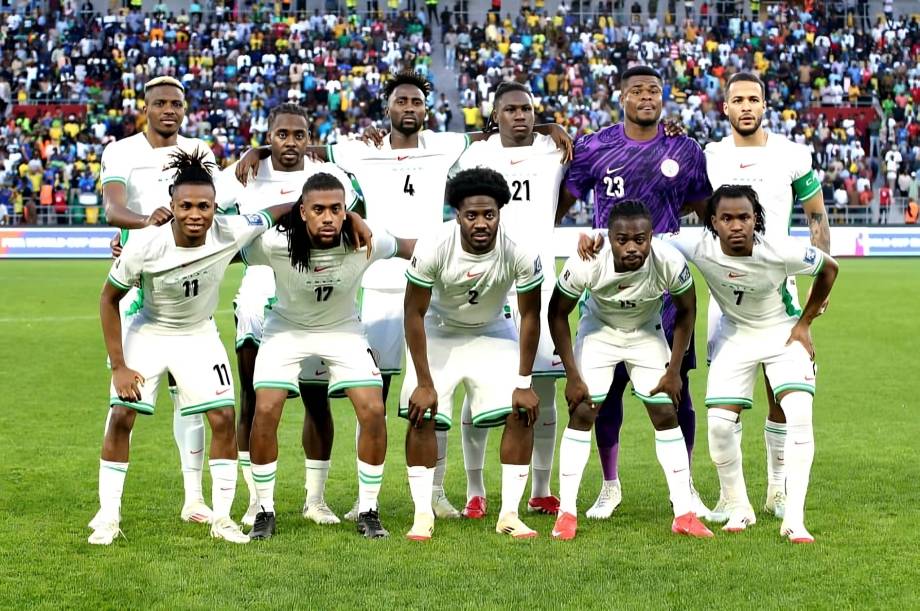
Let us stop deceiving ourselves. The Super Eagles players are overrated. Not necessarily because they lack talent, but because Nigerians have for too long confused talent with excellence, reputation with achievement and playing in Europe with being a great international footballer. The 3-0 humiliation by Guinea-Bissau should have shattered whatever remained of that illusion. Three days earlier, Nigeria had laboured to a 2-1 comeback against Madagascar, rescued by debutants George Ilenikhena and Moses Usor after falling behind. Then came Guinea-Bissau, and the façade collapsed. The hosts were faster, hungrier, more aggressive and more purposeful. Eric Chelle himself admitted that Guinea-Bissau were “more aggressive” and “better” than Nigeria, although he also pointed to the poor pitch and intense heat. But since when did a bad pitch become an exclusively Nigerian disadvantage? Did Guinea-Bissau play on another planet? They played on the same surface, under the same heat, and somehow remembered that football is a contact sport requiring urgency, courage and concentration.

The pitch excuse is therefore too convenient. Of course, a poor surface can affect passing, ball control and tempo. But can it explain a team that looked mentally absent, physically second best and tactically bereft? Can grass explain why Nigerian players repeatedly failed to match the intensity of opponents who, on paper, possess far less individual pedigree? Footballers are paid to adapt. Great teams do not require carpeted pitches before they remember how to compete. What we saw in Bissau was more uncomfortable than a bad pitch: Nigeria were outfought. Guinea-Bissau entered the match with greater hunger and maintained it. Nigeria did not. Chelle said his team “never found a solution” after Guinea-Bissau increased the intensity. That sentence should concern Nigerians more than anything said about the playing surface. The real question is not whether the pitch was bad; it is why a supposedly superior Nigerian team could not impose itself on an opponent playing under exactly the same conditions.
And perhaps that is the hard truth we have avoided for years: we have overrated the Super Eagles because we have overrated individual players. We announce European clubs as though club addresses automatically translate into international greatness. A player signs for a prestigious European club and Nigerians begin speaking about him as if he has already proved himself on the biggest international stage. We celebrate caps, transfers, social-media popularity and occasional spectacular performances, while conveniently ignoring the scoreboard. Alex Iwobi has passed 100 appearances for Nigeria, and Moses Simon recently joined him in the century club. Wonderful achievements. But what exactly are we celebrating if the national team continues to stumble when the stakes rise? Caps are statistics, not trophies. Nigeria have not won the AFCON since 2013, lost the 2023 final to Côte d’Ivoire, failed to qualify for the 2022 World Cup and then failed again to reach the 2026 World Cup after losing the African play-off final to DR Congo on penalties. At some point, Nigerians must stop asking only whether our players are talented and start asking whether they are actually producing at the level their reputations suggest. Talent may get you to Europe; it does not automatically make you great.
Then there is the Victor Osimhen question, which has become almost impossible to avoid. Why does the Super Eagles suddenly look like a different animal when Osimhen is available and like a confused collection of footballers when he is absent? Nigeria beat Madagascar without him, but it took a comeback and two debutant goals to secure the points. Against Guinea-Bissau, the attack offered almost nothing of comparable force. This is not an argument that Osimhen should be worshipped as Nigeria’s football saviour. Quite the opposite: it is an indictment of the collective. A national team that becomes dramatically less threatening whenever one player is unavailable has not built a sufficiently coherent attacking system. Osimhen can provide hunger, movement, aggression and goals, but he cannot supply eleven players with courage. He cannot simultaneously press, create, defend, dominate midfield and finish every chance. If the Super Eagles require one man to rescue their collective identity, then the collective identity does not exist. A great national team may have a great individual; it should never be held hostage by his absence.
Nigeria’s recent history makes this even harder to dismiss as one bad night. The country has changed coaches, changed formations, changed administrators and changed generations of players, yet the same disease keeps returning. The 2026 World Cup failure was not caused by one unlucky moment; Nigeria endured a disjointed qualifying campaign and ultimately lost the play-off to DR Congo. Now, barely into the 2027 AFCON qualifying campaign, Nigeria already have three points from two matches while Guinea-Bissau have six. Tanzania, as a co-host, already has a guaranteed place, leaving Nigeria, Guinea-Bissau and Madagascar competing for the remaining qualifying berth from Group L. Nigeria are not eliminated, and nobody should pretend they are. But neither should anybody pretend that everything is fine. The November matches against Tanzania are now an opportunity to demonstrate whether the Guinea-Bissau debacle was an aberration or another symptom of a deeper malaise. Nigerians have heard the same explanations for too long. At some point, the explanations themselves become part of the problem.
The answer, therefore, cannot simply be another coach, another formation or another collection of familiar names. Nigeria may need to rebuild—and rebuilding means having the courage to question reputations that have become untouchable. The Super Eagles need players who understand that the green shirt is not a ceremonial garment worn between lucrative club assignments; it is supposed to represent the most demanding football responsibility of their careers. The great Nigerian teams were not great because every player was a global superstar. They were great because talent was accompanied by hunger, aggression, collective discipline and an almost offensive refusal to accept defeat. Today, we celebrate the talent before demanding the achievement. We defend the players before interrogating the performance. We blame the coach, the federation, the referee, the weather and now the pitch. Perhaps it is time to look where Nigerians have been reluctant to look: at the players themselves. If they are as good as we keep saying they are, then they must start proving it when the football is ugly, the pitch is bad, the opponent is aggressive and the nation expects them to fight. Until then, “talented” may simply be the most flattering word we have invented for a team that too often fails to deliver.