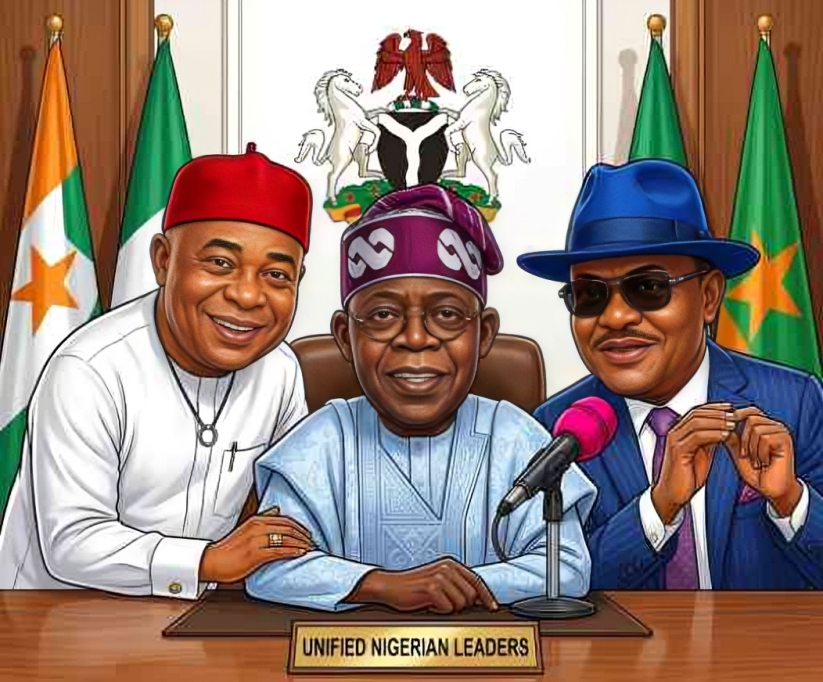
The inclusion of Nyesom Wike, Minister of the Federal Capital Territory (FCT), in the All Progressives Congress (APC) Presidential Campaign Council raises a critical question about the place of the party’s governors in President Bola Tinubu’s re-election calculations. Are they still his most trusted political assets, or is their influence diminishing? For Governor Hope Uzodimma of Imo State, chairman of the Progressive Governors’ Forum and secretary of the campaign council, the question is particularly pertinent. There is an unmistakable irony in a political arrangement that gives a prominent role to a minister who recently disparaged APC governors while placing their forum’s chairman in a subordinate position within the same campaign structure.
The dispute arose from Wike’s proposed Rainbow Coalition, a cross-party arrangement intended to mobilise support for Tinubu in 2027. The APC governors, led by Uzodimma, opposed a coalition they feared could benefit the president while undermining APC candidates in governorship and legislative elections. Their position was not necessarily opposition to Tinubu’s re-election; it was also a defence of the party’s institutional interests. Wike responded by describing the governors as politically lazy and questioning their capacity to deliver electoral victories. He also challenged Uzodimma over APC’s performance in Imo during the 2023 presidential election. Yet Wike has now been entrusted with coordinating the campaign in Rivers State and the FCT. The question is not whether he can contribute to Tinubu’s electoral fortunes, but what his elevation says about the standing of the governors he publicly criticised.
The composition of the campaign council offers another revealing detail. Uzodimma chairs a forum comprising 31 APC governors, yet he occupies the office of secretary of the presidential campaign council. Senate President Godswill Akpabio and Speaker of the House of Representatives Abbas Tajudeen are among the principal legislative figures associated with the council’s vice-chairmanship structure. Why was the chairman of the APC governors’ forum not considered for a comparable position? This is not an argument that Uzodimma deserves elevation simply because of his title. It is about political symbolism: a man expected to mobilise 31 governors should arguably have been accorded greater institutional recognition. While Tinubu has expressed confidence in the governors and appointed them state campaign coordinators, the distinction between presidential assurances and the hierarchy of appointments is difficult to ignore.
Tinubu may simply be playing a pragmatic game, unwilling to stake his re-election entirely on the governors. Wike offers cross-party connections, while figures such as Anambra Governor Charles Soludo and Osun Governor Ademola Adeleke bring their own political networks and constituencies. Broadening the president’s electoral base is a legitimate strategy, but it must not come at the expense of the ruling party’s internal cohesion. The governors must prove their electoral worth, but they cannot be expected to deliver their states while their institutional standing appears diminished. The challenge for Tinubu is to ensure that political alliances complement the APC rather than create competing centres of influence within his re-election machinery.
For Uzodimma, the stakes extend beyond the presidential campaign. His reported ambition to become Senate President in the next National Assembly faces a potentially difficult political landscape. Wike has publicly opposed his emergence, while Akpabio has declared that there is no vacancy in the Senate presidency in the next assembly. Akpabio’s declaration is a pointed reminder that the incumbent has his own political calculations and that the contest for the next leadership of the Senate may be anything but straightforward. These developments do not prove that Uzodimma has lost Tinubu’s confidence, but they suggest that his ambitions could be encountering resistance from influential quarters, including within the ruling party. He must therefore look beyond his proximity to the president, strengthen his alliances and recognise that the campaign council’s hierarchy may not translate into future political rewards.
Ultimately, this is not about shielding APC governors from criticism or questioning Wike’s usefulness to Tinubu. It is about whether the president can expand his political coalition without diminishing the people expected to deliver the party’s electoral machinery. The governors must demonstrate that their offices translate into votes, while the presidency must show that their loyalty and institutional responsibilities are valued. Uzodimma, in particular, faces a monumental task: helping to deliver Tinubu’s re-election while navigating an increasingly complicated contest for political influence. His position as secretary of the campaign council is neither proof of political weakness nor a guarantee of future advancement. But the combination of Wike’s elevation, the governors’ concerns and the resistance confronting his Senate presidency ambition offers enough warning for him to watch his flank. In Nigerian politics, proximity to power is one thing; the ability to command it is another.