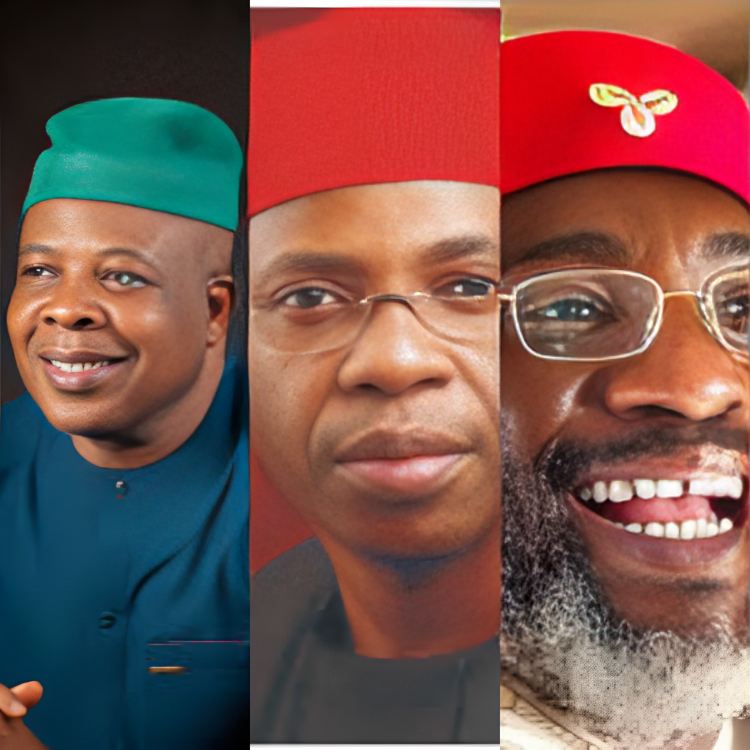
The political temperature in Imo State is already boiling, years ahead of the 2027 governorship election. What should ordinarily be a quiet countdown to the end of Governor Hope Uzodimma’s second term has instead turned into an open battlefield, with zoning, raw ambition, and entrenched political structures shaping the discourse.
At the heart of this storm is the contentious Charter of Equity—an unwritten political understanding that continues to dominate debates.
Owerri and Okigwe zones insist it is their turn to produce the next governor, arguing that equity demands Uzodimma’s successor must emerge from their zones. For them, anything short of that would amount to outright injustice and political suffocation.
But Governor Uzodimma has tried to wave off the succession chatter. Focused on consolidating his political legacy, he has repeatedly warned that discussions about who comes after him are both premature and distracting. Yet, his silence has only deepened speculation. Many are convinced he will eventually play a decisive role in choosing his successor, but for now, he has kept everyone guessing.
What lies ahead is not just another election cycle but a fierce contest that could reshape Imo’s political future. Beyond equity, Uzodimma himself faces a personal test. No outgoing governor in recent memory has succeeded in installing a successor.
Achike Udenwa and Rochas Okorocha all lost the succession battle. For Uzodimma, breaking this long-standing jinx has become as much a political necessity as it is a personal challenge.
Adding fuel to the fire, last week the political atmosphere grew even more heated when Chima Amadi, a vocal critic of Uzodimma, delivered a scathing lecture at a Catholic Men Organization event. The Uzodimma camp quickly fired back, sparking a fresh round of political fireworks that exposed just how tense the state has become—three clear years before ballots are cast.
Amadi has carved a niche as a relentless critic of Uzodimma’s policies, rallying disenchanted voices across the state. His group has almost assumed the role of Imo’s de facto opposition, issuing blistering critiques of government programmes.
But critics and political observers in the state argue strongly that without a political platform, Amadi risks being a noisy outsider—loud but structurally powerless when the real contest begins.
Former governor Ikedi Ohakim has also thrown his hat into the ring, determined to stage a dramatic comeback. His rhetoric has been bold and unapologetic—framing his return bid not just in terms of equity, but as a quest for redemption. For Ohakim, this is about legacy, personal vindication, and unfinished business. Whether Imo people are willing to revisit that chapter remains to be seen.
In a parallel move, another former governor, Emeka Ihedioha, is positioning himself for a comeback under the African Democratic Congress (ADC). Having lost power controversially after just seven months in office, Ihedioha has retained a loyal base that sees him as a victim of political injustice.
But his biggest challenge is structure—ADC is a weak platform in a state dominated by APC,, Labour party and PDP, and convincing voters to rally behind a “forth force” could be his greatest gamble yet.
The unresolved zoning argument adds another layer of complexity. For decades, Orlu zone, Uzodimma’s base, has maintained dominance, holding the governorship for more than 20 years.
Critics warn that any attempt to extend that dominance further would deepen political resentment. Owerri and Okigwe believe they are owed their “turn,” but in Nigerian politics, zoning alone is rarely enough. Money, alliances, and incumbency power often tilt the balance.
Within Uzodimma’s inner circle, calculations are underway, even if quietly. The governor’s refusal to openly indicate a preferred successor is itself a strategy, keeping his allies loyal and his opponents unsettled. When he eventually makes his choice—or chooses not to—the impact could completely reshape the political map of Imo ahead of the 2027 polls.
What is clear is that the 2027/28 governorship race in Imo will be no ordinary contest. It will be a stormy, multi-dimensional fight where the Charter of Equity collides with entrenched ambition, where history confronts future promises, and where political gladiators wrestle for survival in a state notorious for unpredictable shifts.
Ultimately, the election will not just decide who succeeds Uzodimma. It will test whether equity truly has a place in Imo’s politics, whether Uzodimma can defy history by installing a successor, and whether the state’s political future will be shaped by justice—or by the raw force of ambition and power.
What is clear is that the 2027/28 governorship race in Imo will be no ordinary contest. It will be a stormy, multi-dimensional fight where the Charter of Equity collides with entrenched ambition, where history confronts future promises, and where political gladiators wrestle for survival in a state notorious for unpredictable shifts.