The night descends slowly on Owerri, and as the city’s streetlights flicker to life, another economy—silent, shadowy, and deeply human—awakens. Beneath the red lights of brothels, bars, and dimly lit alleys, hundreds of young women step into a trade that many condemn, yet society itself sustains.
Once whispered about in shame and secrecy, prostitution in Imo State has evolved into an open, booming industry—one that mirrors the state’s economic distress and deepening gender inequalities. For many, it is not just a business of the body; it is survival redefined.
A decade ago, the idea of women selling sex in their own communities was unthinkable. Today, it is a normalized enterprise, woven into the daily rhythms of urban life. Brothel owners now advertise openly, while some families quietly endorse the trade as a lifeline against hunger and hopelessness.
This investigation by The Project Truth Journalism Initiative (PTJI), an investigative arm of INNONEWS Media Network, reveals how economic desperation, family complicity, and government neglect have combined to create a thriving underground economy of sex work that now extends far beyond the walls of brothels.
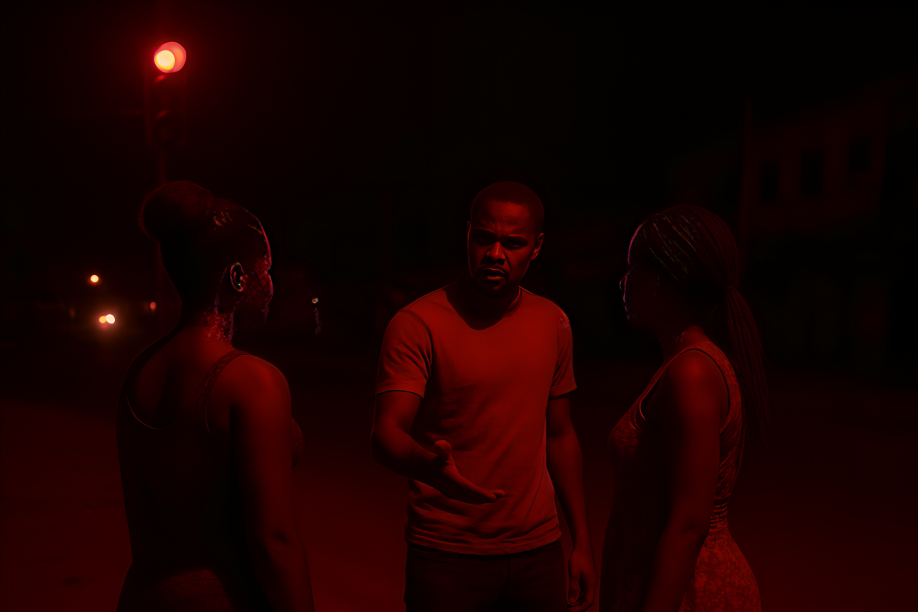
An AI generated image of three people engaged in a tense conversation under the haunting glow of a red traffic light in Owerri — a stark reflection of the struggles, desperation, and harsh realities confronting many in Imo State’s urban nightlife.
In one notorious corner of Owerri, an entire family runs what residents call “a house of sin.” The patriarch, a man in his late 70s, manages the liquor section; his wife keeps records; their sons—married men with children—freely mingle with the women. It is prostitution turned family enterprise, stripped of moral restraint and camouflaged as entrepreneurship.
At the heart of this phenomenon lies a disturbing social truth: prostitution is no longer a moral aberration, but an economic adaptation. Poverty has altered the moral compass of many families, reducing values to the logic of survival.
The PTJI field team uncovered similar patterns in several communities across Owerri. At one brothel in New Owerri, a commercial driver reportedly takes his wife to work at night—dropping her off at a brothel before returning home to care for their three children. The next morning, he picks her up as though she had just completed a normal shift.
When asked why, the man said simply: “We have to survive.” His story echoes across countless households where joblessness and inflation have eroded dignity and forced desperate choices.
From Amaigbo Street to the Control Post axis (before the new flyover was constructed), from World Bank Layout to Okigwe Road, the story repeats itself—streets lined with dimly lit rooms, loud music, and bodies for sale. Brothels coexist with churches, schools, and residential homes, creating a moral paradox that defines modern Owerri’s urban life.
In one striking example, sometime last year a church (which has relocated recently) shared a fence with a brothel on Amaigbo Street. As hymns rose from the sanctuary, seductive music echoed from next door. For children growing up in such neighborhoods, the line between right and wrong blurs early.
Investigations revealed that many of the women come from rural communities in Imo, Abia, Rivers, and Akwa Ibom States—often lured with false promises of jobs or education. Some even deceive their parents, claiming to be university students while trading sex for survival.
At a brothel near Control Post (before the State Government constructed a new flyover at the location), the PTJI team counted over sixty rooms and interviewed dozens of women. Each tenant pays between ₦2,500 and ₦3,500 daily to the management—an informal economy generating millions monthly, untaxed and unregulated.
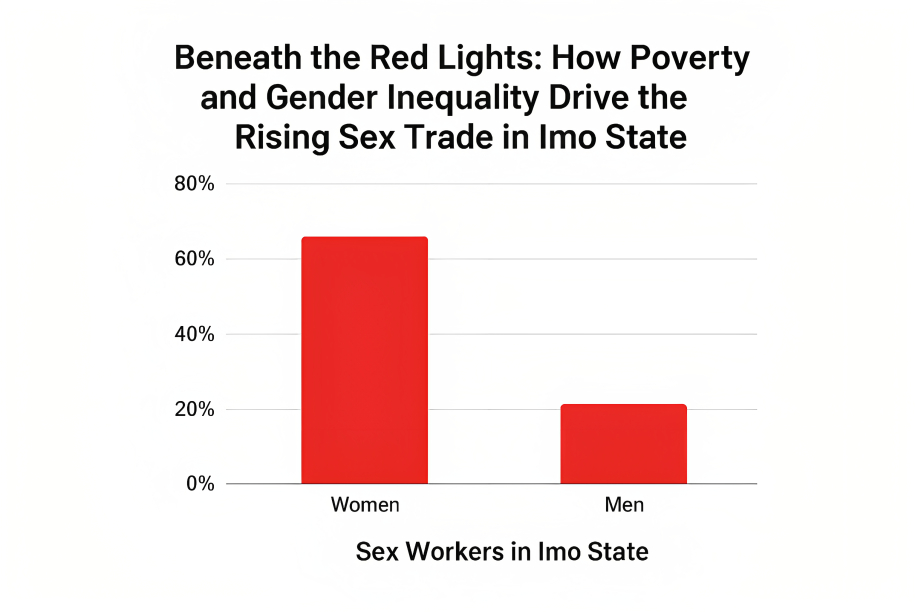
A visual breakdown highlighting gender disparity in Imo State’s growing sex trade — showing how poverty and inequality continue to push more women into the flesh economy.
“I didn’t choose this life. I was pushed into it,” said Grace (not her real name), a 33-year-old mother of two from Ohaji/Egbema. She left an abusive marriage, but with no education or job skills, prostitution became her only source of income. “My children depend on me. I have no other way to feed them,” she said.
Her story, like many others, reflects a broader failure of social support systems. No government programme offers meaningful rehabilitation or economic alternatives for women trapped in the flesh economy. The result: a growing population of invisible workers fueling a shadow market that thrives on exploitation.
Another woman, Ijeoma, aged 25, told investigators she joined sex work after her father’s death. “I wanted to go to school,” she said quietly, “but when he died, everything stopped. I came to Owerri after I was lured by a friend and because I didn’t want my people to know what I do.” She dreams of starting a small hair business someday, if she can ever save enough.
For women like Grace and Ijeoma, prostitution is not a choice—it is an indictment of a system that has failed to protect the vulnerable. Rising unemployment, inflation, and gender-based violence are pushing more women into what experts now describe as “the poverty-sex nexus.”
Data from the PTJI Economic Resilience Study (2025) estimates that over 1,000 women in Imo State depend wholly or partially on transactional sex for survival. Many are single mothers, displaced persons, or school dropouts. A growing number are teenagers.
In interviews, several women confirmed using hard drugs to cope with the physical and psychological strain of their work. “Without it, you can’t face some men,” said one woman, showing painkillers and sedatives she uses daily. “You just do what you must to forget.”
Experts say the rising visibility of sex work is symptomatic of broader governance decay. “When social safety nets collapse, people sell what they have left—their bodies,” said Dr. Ifeoma Njoku, a gender policy researcher at the Centre for Social and Human Development. “The state’s silence is complicity.”
As Imo State Government continues to focus on infrastructure and politics, a silent humanitarian crisis brews beneath the surface. Thousands of women, stripped of dignity and ignored by policy, are building an informal economy that thrives where governance has failed.
The business of prostitution in Imo State, though unregulated, operates with surprising order and hierarchy. There are madams who control entire brothels, sub-managers who collect daily levies, and “enforcers” who settle disputes or punish defaulters. It mirrors the structure of a legitimate enterprise—except that it thrives on human vulnerability.
Inside one of the brothels at a popular location in Owerri, the leader of the women, known simply as Franca, acts like a chief executive. She mediates conflicts, relays management directives, and ensures compliance with house rules. “I am responsible for peace here,” she said with authority. “If you break the rule, you leave immediately.”
But Franca’s story is also one of tragedy and resilience. A native of Anambra State, she entered the trade in Port Harcourt, where she suffered a mysterious illness she attributed to jealousy from a fellow prostitute. “A priestess told me it was spiritual attack,” she said. “Since then, I protect myself with charms. In this business, without charm, you can die.”
Franca’s belief in charms underscores the blend of superstition, fear, and survival that defines the underworld of prostitution. Many of the women believe in spiritual protection against ritualists—men who visit brothels allegedly for occult purposes rather than pleasure.
Beyond superstition lies the harsh physical toll. Many of the women suffer untreated infections, chronic back pain, and psychological trauma. Painkillers, antibiotics, and hard drugs are part of their daily survival kits. One woman pulled out a sachet of Diclofenac Plus from her purse and said, “Without this, I can’t work.”
Public health experts warn that the proliferation of unregulated sex work in Imo State poses a silent epidemic.
“These women have limited access to healthcare, and stigma prevents them from seeking help,” said Dr. Ogechi Nwosu, a public health physician in Owerri. “The risk of HIV and other sexually transmitted infections is rising.”
Yet, the women are not the only victims. Married men form a large percentage of the clientele, bringing diseases back to unsuspecting spouses. According to PTJI’s interviews, many men prefer prostitutes because, as one man put it, “They are cleaner and more discreet than some girls at home.”
The contradiction is chilling: while men stigmatize sex workers in public, they sustain them in private. “We keep the city running,” one prostitute said with a sardonic smile. “Politicians, lecturers, businessmen—all of them come here. Some even have their regular rooms.”
In fact, the PTJI investigation revealed that some brothels are owned or protected by influential figures, including security agents and politicians. These connections shield the trade from raids and ensure uninterrupted operations. “Once you settle them, nobody disturbs you,” a brothel manager confessed.
Law enforcement, instead of curbing the practice, often exploits it. Several women narrated how policemen visit brothels for free sex, or extort money under threat of arrest. “They take our money, take our girls, and go,” Franca said bitterly. “When they come, we just pay. It’s the cost of peace.”
The complicity of the system means that prostitution in Imo State is not just a social issue—it is an institutional one. It thrives because those who should suppress it benefit from it. And so, the cycle continues.
Economically, the sex trade represents a shadow market that generates millions of naira weekly. PTJI estimates that an average brothel in Owerri makes over ₦2 million per month from room rentals and levies alone. Yet, none of this revenue is taxed or reinvested into the community.
The human cost, however, outweighs the financial gain. Many of the women interviewed spoke of depression, suicidal thoughts, and a haunting sense of emptiness. “I smile with men at night, but I cry every morning,” said a 27-year-old from Mbano. “Sometimes I wish to die, but my mother depends on me.”
For many, prostitution is not an identity—it’s a sentence. They live in rooms with no windows, share toilets, and risk violence daily. Some have been beaten, robbed, or sexually assaulted by clients. “We don’t go to police,” one said. “Who will believe us?”
Despite the grim realities, there are faint sparks of hope. A few NGOs and faith-based organizations have begun outreach programmes, offering counselling, vocational training, and small grants to women willing to quit the trade. However, the reach is minimal, and the stigma remains a huge barrier.
PTJI’s research also found that many of the sex workers expressed willingness to leave prostitution if given real opportunities—training, microloans, or jobs. “If I can get ₦200,000 to start a small business, I will leave this life today,” one said with tears.
The failure to address this crisis, experts warn, will have lasting generational consequences. “When children grow up around brothels, they normalize immorality,” said sociologist Dr. Henry Okeke. “We are breeding a moral vacuum that will haunt our society for decades.”
To change the narrative, PTJI calls for a comprehensive, multi-sectoral intervention—combining economic empowerment, public health, and social reorientation. “We cannot shame people out of poverty,” said PTJI Program Coordinator, Mrs. Onyedika Onyeukwu. “We must create alternatives that restore dignity.”
The organization also urges the Imo State Government to launch a Women’s Economic Recovery and Rehabilitation Fund, targeting at-risk women, widows, and survivors of gender-based violence. Such a fund, PTJI argues, would directly reduce the drivers of prostitution.
Beneath the red lights of Owerri, life continues. The music blares, the deals are struck, and the night economy thrives. But beyond the lights and laughter lies a cry for help—one that echoes from the dark rooms of survival. Until Imo confronts its poverty, patriarchy, and policy failures, the business of the flesh will remain its most profitable shame.
Editor’s Note:
This investigation was produced by Project Truth Journalism Initiative (PTJI), a non profit investigative arm of INNONEWS Media Network Limited, publishers of innonews.com.ng.