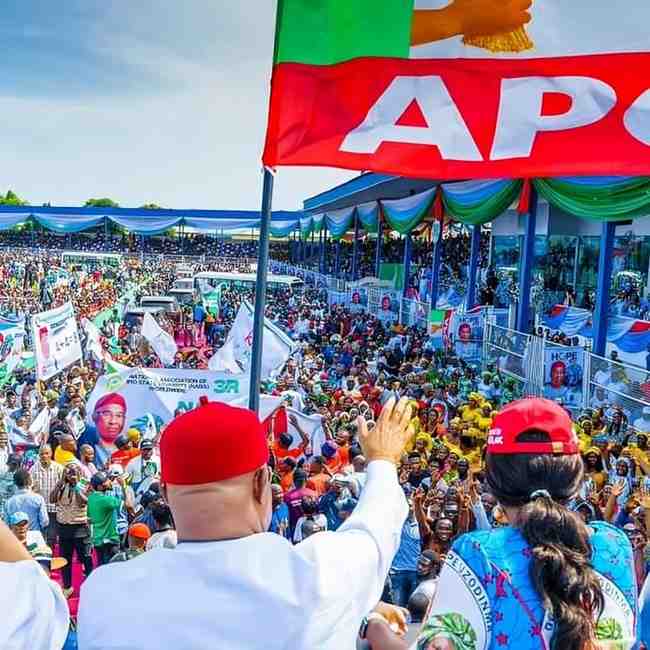
Political allies, friends and close associates of Governor Hope Uzodimma of Imo State are increasingly unsettled as the governor maintains sealed lips over who will succeed him when his tenure ends in January 2028.
With a little over a year to the next governorship election—scheduled for November 2027 as an off-cycle poll—there are no clear signs, signals or body language from the governor indicating a preferred successor within the ruling All Progressives Congress (APC).
Multiple party insiders told INNONEWS that the silence has triggered intense speculation within APC ranks, with many leaders privately admitting they are operating in the dark over the governor’s succession plans.
While some political analysts argue that it is still early to expect a definitive anointed candidate, another school of thought insists that no astute politician of Mr Uzodimma’s stature would approach the final stretch of his administration without a succession roadmap firmly in mind.
According to this view, the governor may already have a preferred option but has chosen to keep it under wraps for strategic reasons, including maintaining party cohesion and preventing early fractures within the APC.
The uncertainty, however, has had practical political consequences. Several of the governor’s allies and party loyalists—some of them very close to him—are now pursuing what insiders describe as “safe options” by positioning themselves for Senate and House of Representatives seats ahead of the 2027 elections.
This newspaper can authoritatively report that although there is a growing list of governorship aspirants from Owerri zone, a significant number of them have begun redirecting their ambitions towards the National Assembly, largely because they are unable to read the governor’s mind on succession.
Party sources say the fear of backing the wrong horse—or being caught unprepared if the governor eventually throws his weight behind an unexpected candidate—has forced many aspirants to hedge their bets.
Even a top politician from Okigwe zone, who was previously believed to be warming up for a governorship contest, is said to have slowed down his ambition. His associates told this newspaper that the lack of clarity from the incumbent has made it difficult to assess the political terrain.
With APC congresses and the party’s national convention approaching, many politicians in the state consider it more prudent to contest elective positions they believe are within reach, especially as Senate and House of Representatives primaries are expected to hold around September or October 2026.
Despite the growing anxiety, Governor Uzodimma has remained publicly noncommittal. Those close to him say he is deliberately avoiding succession politics, choosing instead to focus on governance, infrastructure and development programmes in the state.
According to them, the governor believes premature succession battles could distract his administration and weaken the support base he needs to complete his agenda effectively.
Meanwhile, agitation for the governorship ticket has intensified within the APC, particularly from Owerri zone. Several pressure groups and political blocs from the zone argue that equity and fairness demand that the next governor should emerge from Owerri.
They hinge their argument on historical imbalance, noting that since 1999 Owerri zone governed the state for only about seven months under Emeka Ihedioha, while Okigwe zone held power for four years and Orlu zone would have governed for 24 years by the time Mr Uzodimma completes his tenure in 2028.
Despite repeated visits by Owerri zone leaders and stakeholders to Government House, Owerri, the governor has not openly declared which zone should produce his successor.
Okigwe zone is also firmly in the race, with former governor Ikedi Ohakim widely regarded as the leading figure championing the zone’s renewed push for the governorship, setting the stage for an intense and unresolved succession contest within the ruling party.