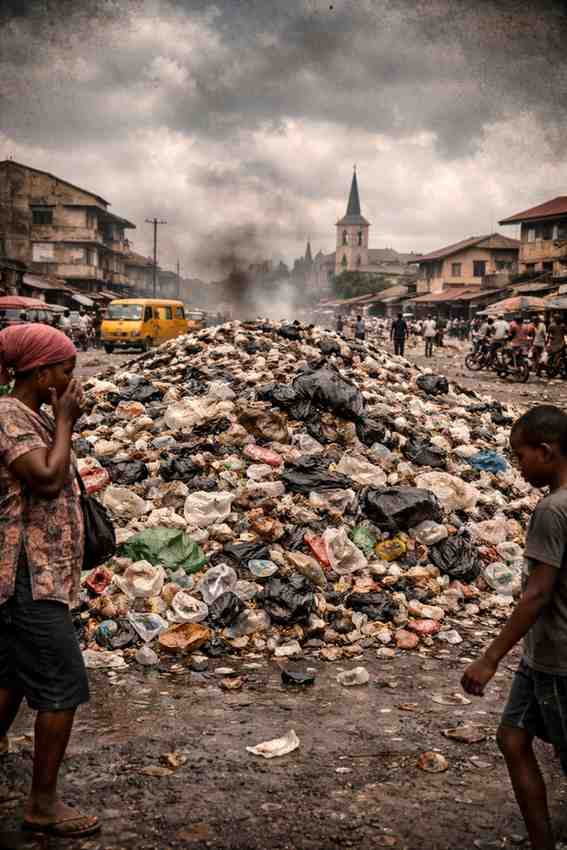
There is something deeply unsettling — almost tragic — about the current state of Owerri. A city once celebrated, even envied, as one of the cleanest state capitals in Nigeria is now choking under the weight of uncollected refuse. Across its major roads, inner streets, and residential corridors, heaps of decomposing waste have become the new, ugly signature of the Imo State capital. This is not just an environmental lapse; it is a civic emergency.
From Douglas Road to World Bank Roundabout, from Orji to Amakohia, from Egbu Road to Umuguma, the story is the same: refuse piles rising unchecked, spilling into roads, choking movement, and assaulting public sensibilities. In some areas, one lane of traffic has effectively been surrendered to garbage. What should be a functioning urban space is fast degenerating into a landfill disguised as a city.
More troubling is the timing. The rains have begun. And with rain comes a dangerous alchemy: decomposing waste, stagnant water, and airborne toxins. Public health experts have repeatedly warned that such conditions create breeding grounds for disease vectors — rats, mosquitoes, and cockroaches — the very agents responsible for outbreaks of Lassa fever, malaria, and other infectious diseases.
Refuse is not just an eyesore. It is a biological weapon when left unmanaged. Rotting organic waste releases harmful gases such as methane and hydrogen sulfide, contaminates soil and groundwater, and exposes residents — especially children — to respiratory infections and toxic environments. The longer these heaps remain, the higher the probability of an epidemic silently incubating within the city.
What makes this situation even more baffling — and frankly inexcusable — is that the Hope Uzodimma administration had, until now, maintained a commendable record in waste management. For years, Owerri stood out as relatively clean, organised, and environmentally conscious. There was visible effort, structured evacuation, and a sense that the government understood the optics and necessity of urban sanitation.
Which is why this sudden relapse is not just a failure of logistics; it is a breakdown of systems. Something has clearly gone wrong — whether in coordination, funding, supervision, or contractor performance. And when systems fail in a sector as sensitive as waste management, the consequences are immediate, visible, and dangerous.
History offers a sobering reminder. Owerri was not always like this. It earned, repeatedly, the reputation of being among Nigeria’s cleanest capitals — a city that reflected order, pride, and civic discipline. That reputation is now under direct assault. What was once a badge of honour is fast becoming a memory.
Urban sanitation is not cosmetic governance; it is foundational governance. Studies have consistently shown that indiscriminate waste disposal leads to blocked drainages, flooding, environmental pollution, and increased risk of disease outbreaks. When refuse blocks waterways, even moderate rainfall can trigger flooding. When waste accumulates near homes, disease transmission becomes a matter of time, not possibility.
There is also an economic dimension that cannot be ignored. A dirty city repels investment, discourages tourism, and erodes the confidence of residents. Owerri, known for its hospitality and vibrant urban life, risks losing its appeal if this environmental decline is not urgently reversed. Cities compete — not just in infrastructure, but in livability.
The government must act — and act decisively. Waste evacuation must be immediate, sustained, and visible. Contractors, if any are involved, must be held accountable. Regulatory agencies must wake from whatever inertia has gripped them. Environmental sanitation cannot be seasonal or reactive; it must be systemic and relentless.
But responsibility does not lie with the government alone. Residents must also confront their own complicity. Indiscriminate dumping, poor waste culture, and disregard for sanitation laws contribute significantly to this crisis. A clean city is a shared responsibility — enforced by the government, sustained by citizens.
Still, leadership sets the tone. And at this moment, Owerri needs urgent, visible, and effective leadership intervention in waste management. Not statements. Not assurances. Action.
Because if the current trajectory continues, the consequences will not be limited to aesthetics. They will be measured in hospital admissions, disease outbreaks, and avoidable deaths.
Owerri has walked this path before — from clean to chaotic. The difference now is that the stakes are higher, the population denser, and the risks deadlier.
The warning signs are already here. Ignoring them would not just be negligence. It would be dangerous.