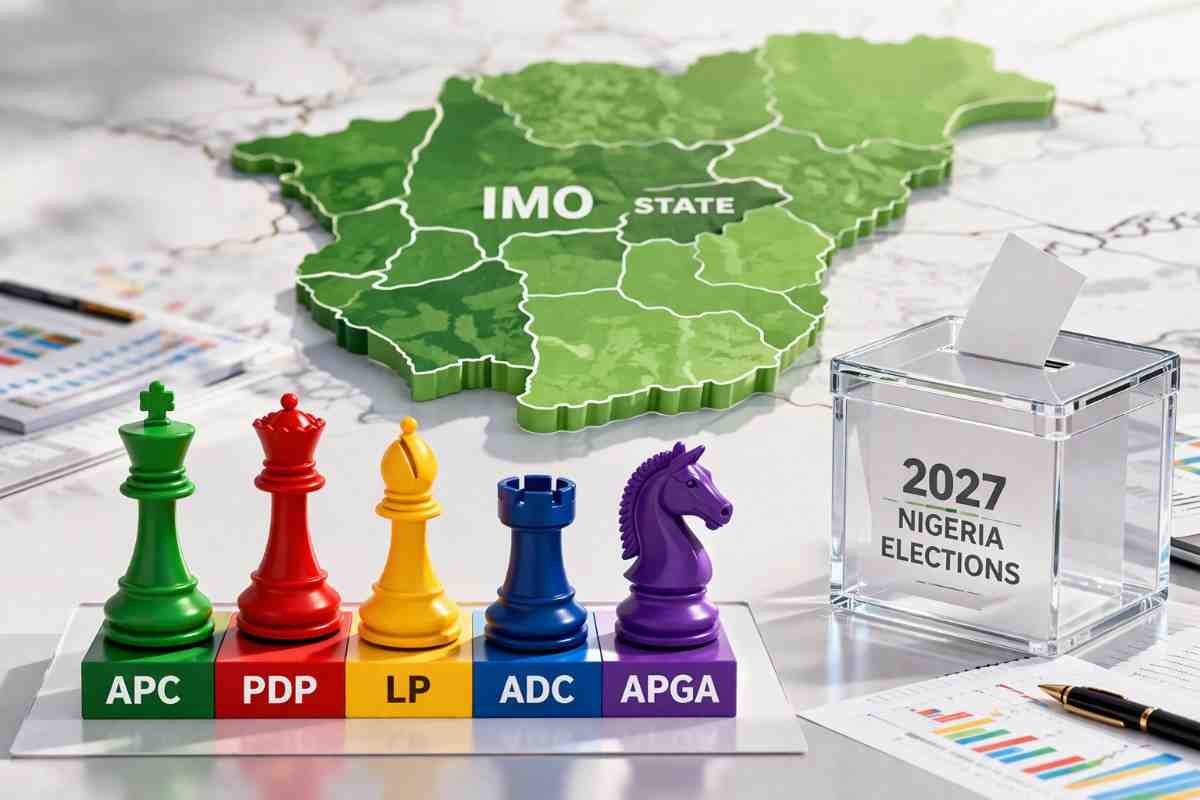
With Nigeria’s next general election cycle approaching, political currents in Imo State are crystallising into a competitive multi-party contest, even as early signals point to a potentially predictable outcome in the presidential race.
The Independent National Electoral Commission (INEC) has fixed the presidential and National Assembly elections for 13 January 2027, while governorship and state assembly elections will follow later in the year. In Imo, the governorship poll is scheduled for November, in line with its off-cycle arrangement—a timeline already shaping political calculations.
Across the state, six parties are prominently in contention: the All Progressives Congress (APC), Peoples Democratic Party (PDP), Labour Party (LP), African Democratic Congress (ADC), All Progressives Grand Alliance (APGA), and the Action Peoples Party (APP). However, analysts say the dynamics effectively narrow into a six-horse race, given the relative alignments and strategic weight of the major blocs.
Unlike earlier assumptions, the ADC has emerged as a formidable force in Imo, buoyed by the entrenched political structure and loyalists of former governor Emeka Ihedioha. Mr Ihedioha, who is widely believed to be eyeing a return to Government House, Owerri, has retained significant grassroots influence since his removal from office by the Supreme Court in January 2020, when Senator Hope Uzodimma of the APC was declared governor.
At the presidential level, early projections suggest a possible consolidation of support around President Bola Tinubu. Beyond the APC’s dominance, political undercurrents indicate that some parties in the state may, directly or indirectly, align with his re-election bid.
The PDP’s internal dynamics, particularly the influence of factions sympathetic to the ruling party at the centre, could shape its eventual stance. In APGA, Anambra State Governor Charles Soludo has been explicit in his support for President Tinubu, signalling a likely alignment that may cascade into Imo’s political calculations.
The Labour Party’s trajectory remains uncertain. Following the exit of its 2023 presidential candidate, Peter Obi, to the ADC, and recent remarks by Abia State Governor Alex Otti indicating support for Tinubu’s re-election, the party’s presidential direction in 2027 remains unclear. Analysts say this ambiguity could weaken its cohesion at the state level.
The Action Peoples Party, APP continues to build visibility in Imo, with its growing local appeal positioning it as a potential disruptor, particularly in legislative races.
Consequently, the real battleground in the state is expected to be the National Assembly elections—both Senate and House of Representatives—as well as the State House of Assembly contests. These races are widely seen as a litmus test for party strength ahead of the governorship election later in November.
Since assuming office in 2020, Governor Hope Uzodimma has led the APC to successive electoral victories, backed by a structured and disciplined political machinery. However, the 2027 elections are shaping up to be more competitive, as opposition parties intensify mobilisation efforts.
APGA has undergone internal recalibration, while the APP has strengthened its ranks with figures such as Mazi Chima Amadi and the alignment of federal lawmakers Ikenga Ugochinyere and Mathew Nwogu. The PDP, under the leadership of Samuel Anyanwu in the state, continues to maintain relevance despite internal strains.
Despite the heightened activity, there is still limited public clarity on aspirants for senatorial and House of Representatives seats, with party primaries imminent. Observers attribute this to ongoing consultations and strategic positioning within party structures.
Johnson Uche, a political analyst, described the unfolding scenario as a “layered contest,” noting that “while the presidential race may tilt in one direction, the legislative elections will be intensely fought and could reshape the political balance in the state.”
Nnamdi Nwosu, another analyst, said the stakes are unusually high. “For parties like the ADC and PDP, strong performances in the National Assembly elections are crucial if they hope to mount a serious governorship challenge later in the year,” he said.
Mary Onye, a public affairs commentator, added that voter perception will be decisive. “Imo voters are politically sophisticated. Any party that wants to dislodge the APC must first prove its electoral strength in January. That is where credibility will be tested,” she said.
As the primaries draw closer, shifting alliances, strategic defections, and subtle endorsements underscore a fluid political environment—one in which the presidential race may be leaning in a particular direction, but the broader electoral contest in Imo remains wide open.