Enough of the soft gloves. Enough of the polite language. Nigeria is bleeding, and the man at the helm has not only failed to stop the hemorrhage—his policies have deepened it. This is no longer a debate about reforms or ideology; it is about consequences. And the consequences of Bola Ahmed Tinubu’s presidency are written plainly across the country: hunger, fear, anger, and a collapsing standard of living.
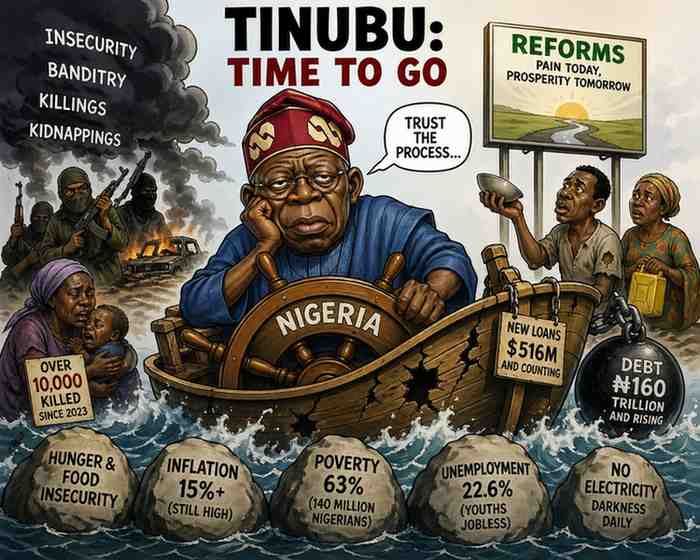
Start with the economy—the administration’s loudest talking point and its most devastating failure. Yes, inflation has eased on paper to around 15% in early 2026. But that is statistical cosmetics. In reality, Nigerians are poorer than ever. The World Bank confirms that poverty has surged to 63%, with roughly 140 million people trapped below the poverty line. That is not a policy transition; it is a humanitarian emergency engineered in slow motion.
This is the brutal paradox of Tinubu’s Nigeria: macroeconomic “improvement,” microeconomic collapse. GDP crawls at about 3–4%—barely above population growth—while real incomes disintegrate. The so-called reforms have created what economists now describe as a “jobless boom,” where growth exists without jobs, without relief, and without dignity. Unemployment is projected to hover around 22.6% in 2026. Growth without people is not growth—it is economic exclusion.
The removal of fuel subsidy—executed with shocking abruptness—triggered one of the worst cost-of-living crises in Nigeria’s modern history. Inflation didn’t just rise; it exploded, peaking above 30% in 2024 after the policy shock. Transportation costs spiraled, food prices followed, and the naira collapse amplified everything. What was sold as reform has become a long, punishing sentence for ordinary Nigerians.
And let’s be clear: the suffering is not easing—it is hardening into permanence. Even as inflation slows, prices remain structurally high. PwC warns that poverty could still climb toward 62% due to weak income growth and persistent cost pressures. In plain terms, Nigerians are not recovering—they are adjusting to hardship as a new normal. That is the real legacy of these reforms.
Then comes the fiscal hypocrisy. Nigerians were told subsidy removal would free up funds. Instead, the country is drowning deeper in debt. Public debt has ballooned to nearly ₦160 trillion. And still, the government continues borrowing—$516 million here, hundreds of millions there—stacking obligations on a nation already gasping for fiscal oxygen. This is not reform. It is reckless accumulation dressed up as strategy.
Meanwhile, the budget itself has become a monument to excess and contradiction. A staggering ₦68.32 trillion 2026 budget, with massive deficits and crushing debt servicing obligations, tells a simple story: government is expanding while citizens are shrinking. The state is feeding itself while the people starve.
And yes, Nigerians are starving. This is no exaggeration. The link between policy and hunger is now undeniable. The spike in fuel costs cascaded directly into food inflation, pushing millions into food insecurity. Households are skipping meals, reducing portions, and surviving on less. Hunger is no longer seasonal—it is systemic.
If the economy is collapsing, security is imploding. The country remains under siege. Despite official claims, violence persists at alarming levels. More than 10,000 people have reportedly been killed since Tinubu took office, according to human rights assessments. Bandits roam freely, kidnappings continue, and entire communities live at the mercy of armed groups. A government that cannot secure lives has forfeited its most basic responsibility.
This insecurity feeds directly into economic ruin. Farmers flee their lands, agricultural output drops, and food scarcity worsens. It is a vicious cycle: insecurity drives hunger, hunger fuels instability, and instability deepens insecurity. Yet, there is no evidence of a decisive, winning strategy to break this loop.
Electricity? Still a national disgrace. Nigerians endure endless blackouts while paying higher tariffs. Businesses spend fortunes on diesel, households grope in darkness, and productivity suffocates. The promise of improved megawatts has not translated into improved lives. Power generation statistics mean nothing when homes remain in darkness.
And then there is the silent crisis: a generation abandoned. Youth unemployment, rising frustration, and economic exclusion are creating a ticking time bomb. A country with vast human capital is systematically wasting it. When young people lose faith in the system, the system itself begins to decay.
What makes this administration particularly troubling is not just failure—but denial. The insistence that things are improving, the constant appeal to patience, the refusal to acknowledge the scale of suffering—these are not signs of leadership. They are signs of detachment. Nigerians are not asking for miracles; they are asking for relief. What they are getting is rhetoric.
Leadership is results. And the results are damning. Poverty at 63%. Debt nearing ₦160 trillion. Inflation shocks that wiped out savings. Persistent insecurity with thousands dead. These are not isolated failures—they are a pattern. A consistent, undeniable pattern.
So let us stop pretending. This is not about 2027 politics; it is about 2026 reality. Nigeria cannot afford another four years of this trajectory. Not with this level of pain. Not with this absence of relief. Not with this scale of failure.
The verdict writes itself: Tinubu should not seek a second term. Not because of sentiment. Not because of opposition politics. But because the evidence is overwhelming, the suffering is undeniable, and the cost of continuation is simply too high.
Ebere writes from UK