Even before a single ballot is cast, the All Progressives Congress (APC) primaries in Imo State may have morphed into a high-stakes political contest, with early manoeuvres exposing deep cracks and uneasy alliances among some of the party’s most powerful figures.
At the centre of the unfolding drama is the fierce scramble for senatorial tickets across key zones, particularly Orlu and Okigwe, where the purchase of Expression of Interest and Nomination Forms has triggered intense calculations among entrenched political actors.
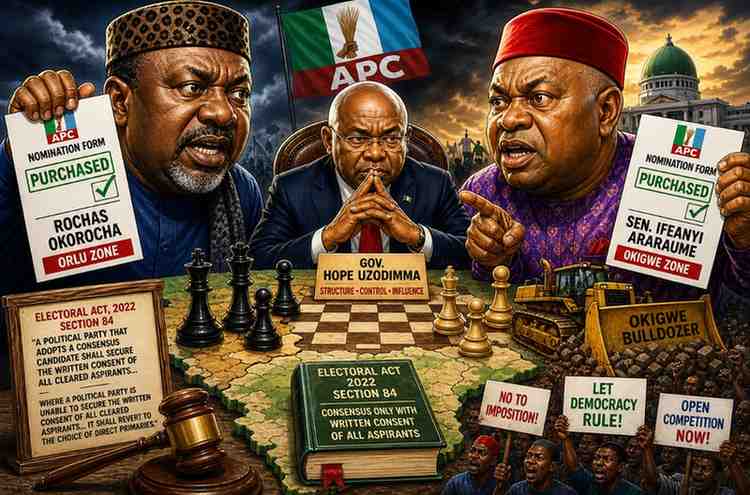
In Orlu zone, the contest is now firmly taking shape as a direct confrontation. Former governor Rochas Okorocha has confirmed his entry into the race after purchasing nomination forms, setting up a potential clash with incumbent governor Hope Uzodimma, who is widely believed to be weighing a bid for the same seat.
Okorocha’s formal entry has effectively ended speculation about his intentions and heightened the stakes, as it signals a willingness to challenge the existing power structure within the party.
In Okigwe zone, Senator Ifeanyi Araraume has also re-entered the race, seeking a return to the Senate years after his last stint.
However, emerging signals within the party shows that both Okorocha and Araraume may be pursuing a deeper strategic objective—forcing the APC into a direct primary, a route that could dilute the influence of entrenched party structures and widen the contest beyond consensus arrangements.
This calculation is anchored on the provisions of Nigeria’s Electoral Act, which has significantly narrowed the pathway for consensus candidacies, making it procedurally difficult to impose a single aspirant without full internal agreement.
Section 84 of the Electoral Act provides that parties may adopt either direct primaries or consensus, but places strict conditions on the latter.
More critically, the law is explicit that consensus can only stand where all aspirants agree in writing. As the Act states: “A political party that adopts a consensus candidate shall secure the written consent of all cleared aspirants… indicating their voluntary withdrawal from the race.”
It further provides that where such unanimity cannot be achieved, the party must revert to a broader contest: “Where a political party is unable to secure the written consent of all cleared aspirants… it shall revert to the choice of direct… primaries.”
For political heavyweights unwilling to step down, this provision effectively blocks any attempt at forced consensus, strengthening the hand of aspirants like Okorocha and Araraume who may prefer a full-scale electoral contest within the party.
The potential convergence of Uzodimma, Okorocha and Araraume in the same political cycle has therefore set the stage for confrontation, with all three men unlikely to cede ground easily despite operating under the same party platform.
Insiders maintain that Uzodimma’s firm grip on the APC structure in Imo gives him a significant advantage, consistent with a broader pattern in Nigerian politics where sitting governors exert decisive influence over party machinery and candidate selection.
That structural edge may prove decisive, particularly if consensus arrangements are attempted—but the legal constraints now surrounding that option could complicate any such move and trigger internal resistance.
The tension is most visible in Orlu, where the Orlu Political Consultative Assembly (OPOCA), led by Rex Anunobi, sparked outrage after announcing a controversial ban on other aspirants, effectively endorsing the governor’s presumed Senate ambition.
The move has drawn sharp criticism for undermining internal democracy, especially in light of the Electoral Act’s clear requirement for inclusivity and consent in any consensus arrangement.
Reacting to the development, the Orluzurumee Youth Assembly rejected the exclusion of aspirants, urging stakeholders to allow open competition and cautioning against dragging the governor into actions that could damage his public image.
With tensions rising, legal constraints tightening, and ambitions colliding, the Imo APC primaries are fast evolving into a full-scale power struggle—one that may ultimately be decided not just by political strength, but by the limits imposed by the law itself.