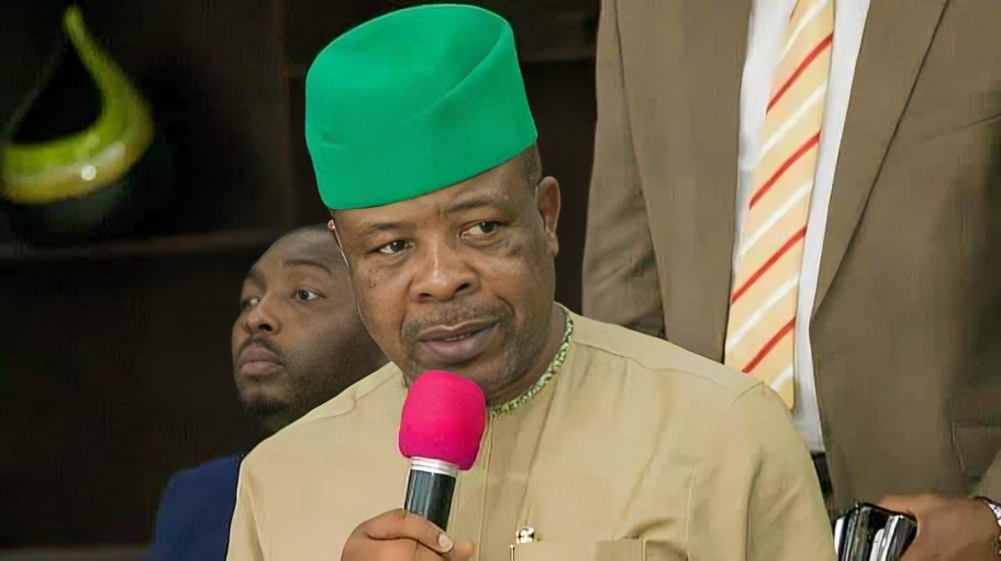
Former Imo State Governor and ex-Deputy Speaker of the House of Representatives, Emeka Ihedioha, has formally declared his decision to remain in the African Democratic Congress (ADC), distancing himself from the latest wave of political realignments triggered by Peter Obi’s defection to the National Democratic Congress (NDC).
In a statement released days after Obi’s move, Ihedioha said he had “consciously and consistently” worked over the past year to build a coalition under the ADC, aimed at delivering accountable governance and national renewal. His declaration effectively positions him as the most prominent Igbo political figure yet to follow Obi into the NDC.
“After due consultation and reflection over the past 72 hours, I have chosen to remain in the African Democratic Congress at this time,” Ihedioha said.
He continued, “I take deliberate political steps, and for now, I find no justification to turn my back on the ADC.”
His decision comes amid a rapid unraveling of alliances within the South-East zone .Senator Enyinnaya Abaribe, who had earlier aligned with Obi under the ADC from APGA, has since returned to the Labour Party, while Senator Victor Umeh, alongside over 17 members of the House of Representatives previously in the ADC, followed Obi into the NDC—moves that have left the ADC structurally weakened in the zone.
Obi’s defection on May 3, 2026, has been widely interpreted as a strategic recalibration ahead of the next elections with the NDC expected to gain momentum from his grassroots appeal. Ihedioha, however, struck a conciliatory tone in his statement, describing Obi as “my brother” while acknowledging his right to pursue political ambition on a different platform.
“While I would have preferred that this ambition was pursued within the ADC, I recognize that in a democracy, every leader has the right to make political choices guided by conviction. I respect his decision and wish him well,” he stated.
Despite the outward neutrality, Ihedioha’s political journey continues to fuel speculation about his enduring alignment with former Vice President, Atiku Abubakar, under whom he served during his formative years in national politics. Some political analysts who spoke to this newspaper note that his longstanding association with Atiku—dating back to when Atiku was Vice President—remains a defining feature of his political identity.
That perception was reinforced during the 2023 election when Ihedioha publicly canvassed support for Atiku at a high-profile gathering in Ghana, even as Obi surged as the Labour Party’s presidential candidate. At the event, Ihedioha was widely reported to have argued that Atiku possessed the requisite experience and national spread to stabilize Nigeria, a remark that drew sharp criticism from Obi’s supporters across the South-East.
The former governor would later attempt to walk back the controversy, insisting that his comments were either taken out of context or misrepresented.
Notably, Ihedioha still commands a measure of public sympathy among sections of Imo voters who remain aggrieved over the manner the Supreme Court removed him from office as governor—an undercurrent that continues to shape his political capital. With time, analysts say, aligning more closely with Obi’s widespread appeal in the South-East could have provided strategic leverage for both the ADC and Ihedioha’s future ambitions.
For many observers, his current stance—remaining in the ADC while key politicians from the South-East disperse—signals both caution and calculation. It also raises fundamental questions about his next political move in an increasingly fragmented opposition landscape.
Imo State itself presents a volatile political configuration. With the ruling All Progressives Congress consolidating power, a resurgent Peoples Democratic Party regaining internal cohesion, and the NDC positioning itself for a breakthrough on the back of Obi’s popularity, the political terrain in the state is rapidly shifting.