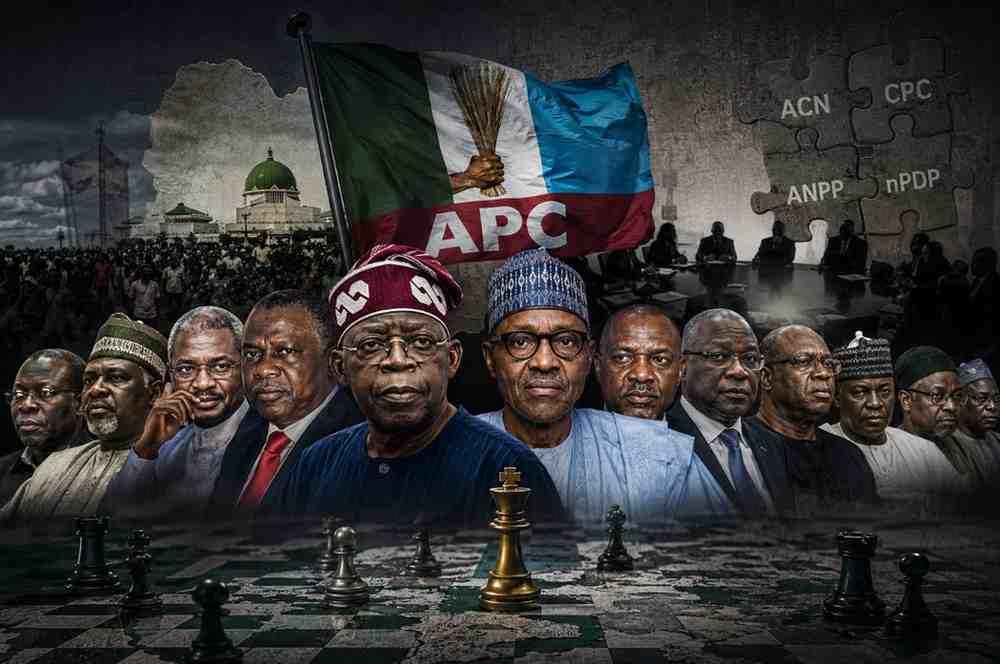
The All Progressives Congress did not emerge as a neat coalition of equals. It was engineered through strong negotiations, strategic defections, and carefully timed political betrayals that fused four fractured opposition blocs or parties into a single electoral machine. What is often simplified as a “merger” was, in reality, a contested consolidation of ambition, structure, and regional bargaining.
At the centre of the architecture stood Bola Ahmed Tinubu, who provided the organisational backbone and negotiation leverage from the Action Congress of Nigeria. Alongside him, Muhammadu Buhari supplied the mass electoral appeal that made the project nationally viable, especially across the North. The alliance between these two poles—southern political engineering and northern electoral weight—became the foundation on which APC was constructed.
The formal structuring of the party was then stabilised by figures such as Bisi Akande, who served as the first interim national chairman, and Nasir El-Rufai, whose technical coordination and negotiation discipline helped translate political intent into party architecture. Around them, ideological actors like Ogbonnaya Onu and Ibrahim Shekarau provided the necessary Northern and minority-party legitimacy required to dilute APC’s original regional perception. Onu and Shekarau came from the APP bloc.
Yet APC’s survival was never guaranteed by negotiation alone. It depended heavily on sitting governors and power brokers who converted state structures into political capital. Figures such as then Governors Kayode Fayemi, Babatunde Fashola, Rauf Aregbesola, and Adams Oshiomhole gave the party administrative credibility and grassroots mobilisation capacity. Without this input, APC would have remained a fragile electoral coalition rather than a governing force.
A second shockwave came from the breakaway faction of the Peoples Democratic Party, commonly referred to as the “new PDP.” This bloc altered the balance of Nigerian politics by injecting sitting governors and legislative heavyweights into the APC structure. The most prominent included Atiku Abubakar, Rotimi Amaechi, Bukola Saraki, Aminu Tambuwal, and Rabiu Musa Kwankwaso. Their defections did not merely strengthen APC; they weakened the PDP from within and accelerated Nigeria’s 2015 political realignment.
It is within this broader wave that figures like then Imo State Governor, Rochas Okorocha of the All Progressives Grand Alliance, APGA should be understood. Okorocha was not part of the original merger negotiation table, nor did he shape APC’s constitutional formation. However, his alignment from the South-East gave the party a symbolic breakthrough in a zone traditionally resistant to its ideology. He functioned more as an early adopter and regional amplifier than a founding architect, but his political utility in broadening APC’s national footprint was significant.
Alongside him, actors such as George Akume, Danjuma Goje, and Aliyu Wamakko helped consolidate APC’s North-Central and North-East presence, ensuring that the party was not dismissed as a purely South-West political project.
The CPC structure itself, driven by figures like Buhari, Buba Galadima, Emeka Nwajiuba and allied operatives such as Farouk Adamu Aliyu, provided the grassroots mobilisation machinery that sustained Buhari’s national electoral appeal. Without this network, APC would have lacked the disciplined voter base that ultimately delivered its 2015 victory.
What emerges from this choreographed history is not a single founding moment, but a collision of interests: ideological opposition to the PDP, personal ambition across multiple governors, and zonal calculations about power rotation. APC was built less as a unified ideological party and more as a strategic electoral coalition that later hardened into a ruling party and structure.
The real lesson of its formation is that Nigerian party politics is rarely about ideology. It is about timing, defections, and the ability of elite blocs to temporarily align interests long enough to seize power. APC is the clearest example of that political reality.
*Emenako, is Political Editor, INNONEWS