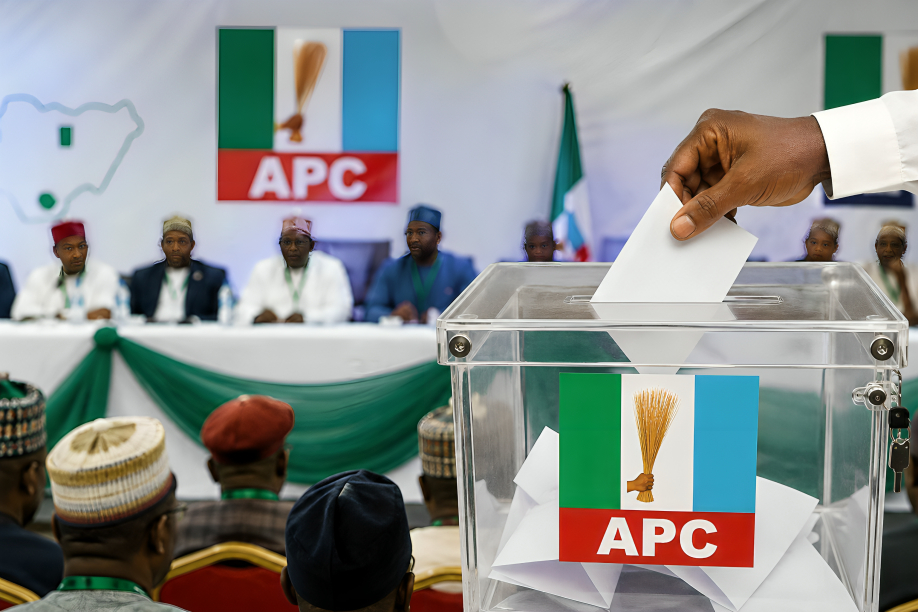
There is something almost revolutionary about what is unfolding in the All Progressives Congress in Imo State. For the first time since Hope Uzodimma assumed power, the ruling party appears ready to abandon the familiar culture of political coronation masquerading as consensus and embrace actual primaries. In a state where candidates had often emerged from smoky backroom negotiations, whispered endorsements, and imperial nods from above, this sudden flirtation with internal democracy feels less like routine party administration and more like a political earthquake. It is the ultimate litmus test for the APC in Imo. And if mishandled, it could become the beginning of implosion for a party that currently enjoys frightening dominance over a weakened opposition.
The irony is impossible to ignore. In 2023, when the opposition still had some oxygen in its lungs, the APC behaved like a besieged fortress. The Peoples Democratic Party was then active, aggressive, and politically alive. There was pressure. There was resistance. There was fear of electoral backlash. But today, most opposition parties in Imo resemble abandoned political warehouses occupied by confused tenants. They are weak, fragmented, and largely incapable of mounting any serious challenge. Yet it is at this moment of overwhelming political supremacy that the APC has chosen to test itself with direct primaries. That decision is either an act of unusual confidence or a dangerous gamble.
For years, what APC leaders in Imo called “consensus” was merely selection perfumed with party grammar. Candidates were practically handpicked. Internal democracy existed only in speeches and party communiqués. Everyone knew where power resided. Aspirants merely queued for blessings from the political throne. The process was less about competition and more about proximity to power. Those who enjoyed the confidence of the governor smiled into office; those who did not were advised to “wait for their time.” It was a system that rewarded loyalty over popularity and obedience over political relevance.
But something appears to have shifted in 2027. At the APC stakeholders’ meeting held at the Banquet Hall of Government House, Owerri, Uzodimma sounded less like a political emperor and more like a cautious manager trying to prevent a civil war within his own party. His tone betrayed a man who understands that the old method has reached its elastic limit. He knows that another cycle of imposition could rupture the fragile thread holding the APC together in Imo. Too many ambitions are colliding. Too many political warlords are watching. Too many expectations have been raised. The governor clearly understands that bruised aspirants can become dangerous enemies overnight.
And this is where the Charter of Equity enters the conversation like a hot knife slicing through butter. Whatever criticisms one may have against zoning arrangements, one fact is undeniable, and that fact is, Uzodimma deserves commendation for attempting to institutionalize it rather than weaponize it selectively. In a political environment where leaders routinely abandon agreements once power is secured, his insistence that aspirants should respect zoning is politically significant. It signals an effort to establish predictability in Imo politics. It is also an admission that unchecked political greed can destabilize the structure of the ruling party he hopes to preserve beyond his tenure.
The governor’s declaration that he would not favour anybody must have landed like thunderbolts inside the camps of many of his allies, loyalists, and longtime associates who had assumed they possessed automatic tickets to political office. Some of them probably believed proximity to Douglas House was enough qualification to be candidates. But Uzodimma’s warning that those seeking to defy zoning should “respect themselves” was not merely a statement; it was a political guillotine wrapped in diplomatic language. It was his way of informing entrenched interests that the era of entitlement may be approaching its expiration date.
Still, nobody should celebrate too early. Most political parties have perfected the art of staging democracy while manipulating outcomes from hidden control rooms. The danger before the APC is not whether direct primaries will hold, but whether they will be genuinely free from remote control. If party leaders begin to subtly intimidate ward executives, coerce delegates, influence Option A4 arrangements, or impose unofficial directives on members, then the entire exercise would become another fraudulent theatre production. Democracy is not validated merely because people lined up behind candidates in public. It is validated when they are free to do so without fear, coercion, or hidden instructions from political landlords.
That is why this primary election matters far beyond candidate selection. It is a referendum on the soul of the APC in Imo State. Can the party survive genuine competition among its own members? Can it tolerate dissent without descending into bitterness and sabotage? Can it allow unpopular incumbents to lose tickets without triggering vengeance politics? These are the questions hanging over the exercise like dark clouds. Political parties in Nigeria often preach democracy only until democracy threatens powerful interests. The moment the people’s choice contradicts elite preferences, the rules suddenly change.
Ironically, Uzodimma’s greatest political challenge today is no longer the opposition. It is managing success. Absolute political dominance can intoxicate a ruling party into self-destruction. When external enemies disappear, internal rivalries become ferocious. The APC in Imo is now crowded with ambitious politicians, returnee defectors, opportunists, entrenched incumbents, and succession gladiators all fighting for shrinking political spaces. The governor understands this reality. He knows that keeping the APC intact ahead of his succession calculations requires political delicacy, not brute force. One reckless imposition could trigger defections, rebellions, and silent sabotage during the general election.
If these primaries are conducted transparently, he may ultimately earn a place in Imo’s political history as the man who reluctantly opened the door to internal democracy inside the APC. But if the process is manipulated from above, if candidates are secretly favoured despite public theatrics, then this entire exercise would collapse into hypocrisy of the highest order. Imo people are watching. Party members are watching. Aspirants are watching. This is more than a primary election. It is a stress test for political sincerity. And for once, the APC in Imo has no opposition to blame if it fails.