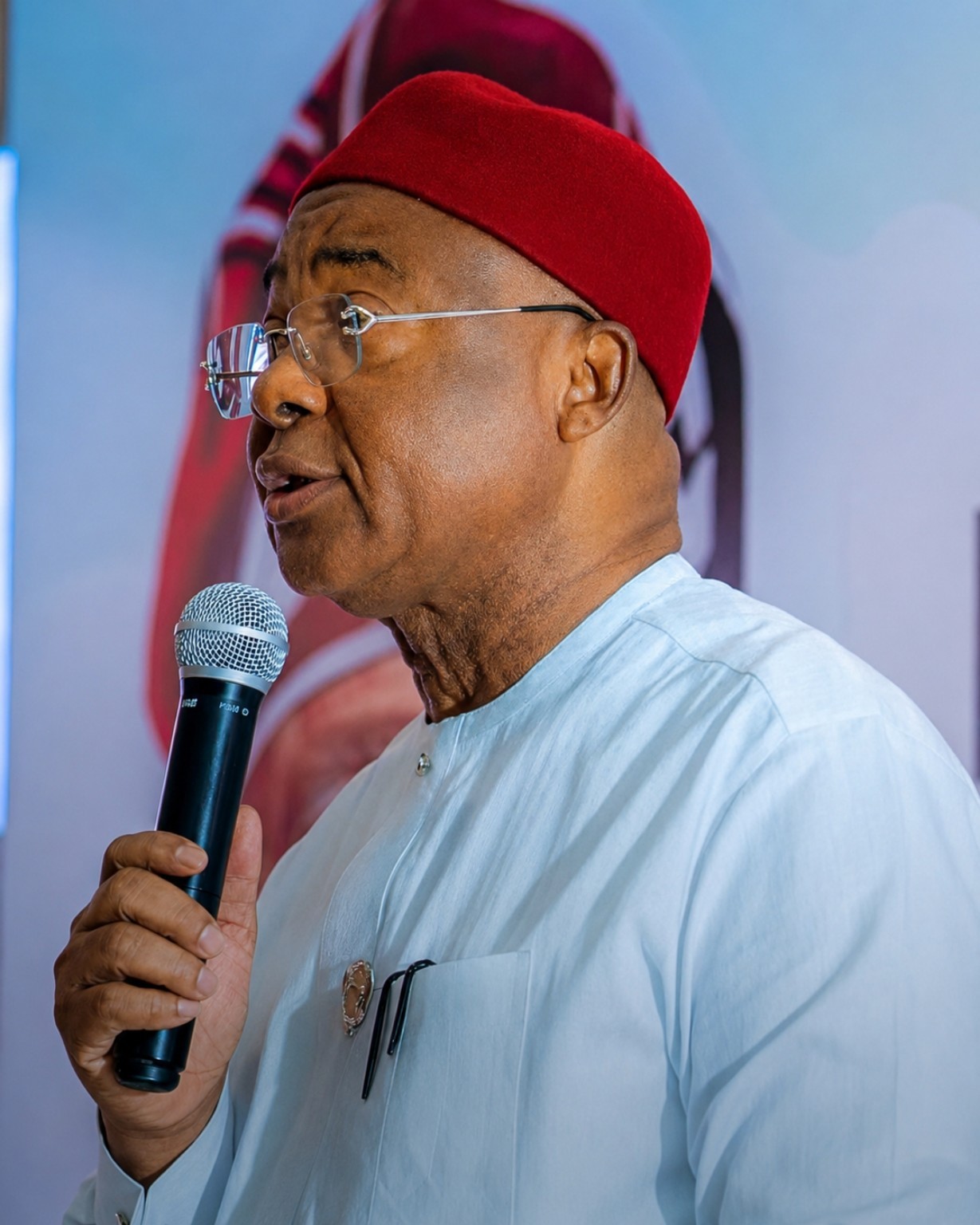
Governor Hope Uzodimma’s declaration that Imo is “unapologetically a one-party state” has reignited debate over the health of democracy in the South-East state, with supporters describing the remark as a reflection of the All Progressives Congress (APC)’s growing political dominance, while critics argue that it highlights the steady erosion of opposition politics and raises concerns about democratic accountability.
The governor made the statement while receiving members of the Renewed Hope Ambassadors Media Team during an inspection of federal and state government projects. He expressed confidence that President Bola Tinubu would secure overwhelming support from Imo voters in the 2027 presidential election, insisting that the state’s political direction had become firmly aligned with the APC.
“Our people have already decided that they want President Tinubu back as president because without him and his policies and programmes, this environment we are enjoying today would have been impossible to achieve,” Mr Uzodimma said. He maintained that the removal of fuel subsidy and the resulting increase in federal allocations had significantly improved the capacity of states to execute critical infrastructure projects.
His remarks immediately triggered mixed reactions. Opposition politicians and civil society groups warned against rhetoric that could be interpreted as diminishing the role of multiparty democracy, while supporters argued that the governor merely acknowledged the prevailing political reality in Imo, where the APC has steadily consolidated its influence since assuming office.
Those defending the governor’s position point to several landmark infrastructure projects executed by his administration, including the reconstruction of the Owerri-Orlu Road, Owerri-Okigwe Road and Owerri-Mbaise-Umuahia Road. They also cite the Assumpta Flyover, the Emmanuel Iwuanyanwu International Conference Centre, expanded urban road networks, healthcare investments, urban renewal initiatives and reforms in electricity generation and distribution as evidence of governance that has resonated with many residents.
An APC chieftain from Okigwe Zone, Ephraim Uche, said the governor’s comments should be viewed within the context of those achievements rather than as a partisan declaration. “The governor spoke from the standpoint of performance. His signature projects, particularly the Owerri-Mbaise-Umuahia Road, the Owerri-Okigwe Road and the Owerri-Orlu Road, have become major landmarks executed under an APC government. These projects have changed transportation across the state and strengthened public confidence in the administration,” he said.
Mr Uche argued that political dominance is often earned through public approval. “Whether one belongs to the APC or not, it is difficult to deny that the government has invested heavily in infrastructure. When people see tangible projects, it naturally translate into political support. That is what is happening in Imo today,” he added.
Political analyst Ben Kalu, however, said the governor’s declaration also reflected the weakened state of opposition politics in Imo. According to him, opposition parties have failed to sustain policy-based engagement, leaving the ruling party largely unchallenged in the public space. “The governor should not be blamed for making such a statement because there is presently no viable and vibrant opposition in Imo. The opposition appears to have gone to sleep and only wakes up whenever elections are around the corner,” he said.
Mr Kalu argued that democracy extends beyond periodic elections. “A credible opposition should consistently interrogate government policies, question public spending, offer alternative ideas and hold those in power accountable. That has been largely absent in Imo. Whether the opposition is overwhelmed by the political strength of the ruling party or has failed to organise itself effectively, the consequence is that public debate has become less robust than it ought to be,” he said.
Another political commentator, Chris Ibe, shared a similar assessment, arguing that stronger opposition politics would ultimately improve governance. “Government would even perform better if there was an active opposition providing constructive criticism. The governor was not entirely wrong to describe Imo as a one-party state because opposition parties have virtually disappeared from public discourse. Democracy benefits when governments are challenged, not when they operate without sustained scrutiny,” he said.
The outcome of the 2023 governorship election remains central to the debate. The APC secured a commanding victory, while the Peoples Democratic Party (PDP), the All Progressives Grand Alliance (APGA) and other opposition parties failed to establish a significant electoral presence across the state’s local government areas. Analysts also point to the relative silence of the Inter-Party Advisory Council (IPAC) in Imo, noting that the umbrella body of political parties has rarely featured prominently in debates on governance or public policy.
Whether Mr Uzodimma’s description of Imo as “unapologetically a one-party state” accurately reflects the state’s political reality or merely underscores the organisational decline of the opposition remains contested. What appears less disputed, however, is that the governor’s remark has brought renewed attention to the quality of political competition in Imo, where the strength of democratic institutions may increasingly depend not only on the popularity of the ruling party but also on the capacity of the opposition to offer credible alternatives as the 2027 elections draw closer.