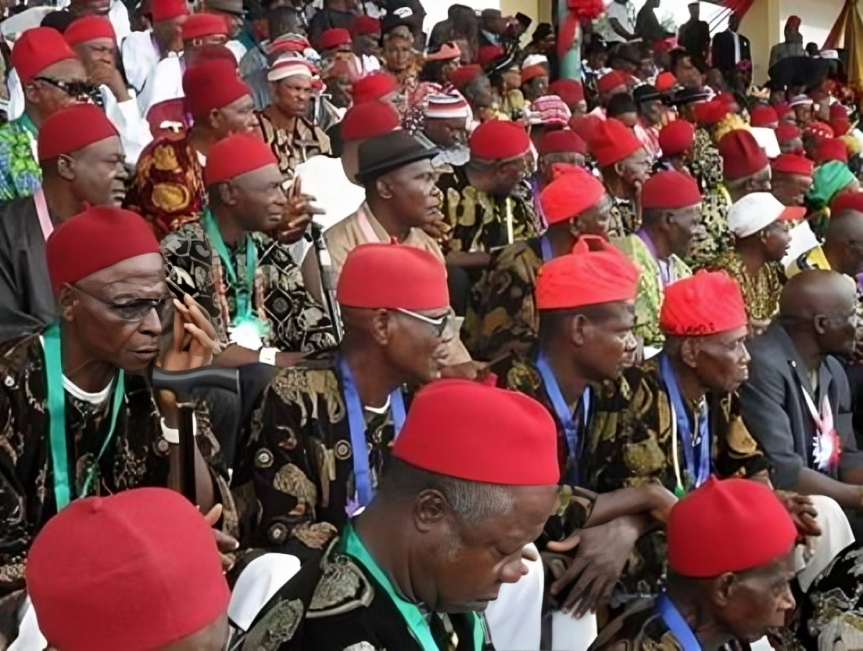
The South East Coalition of Good Governance (SECG) has faulted Imo State Governor Hope Uzodimma for claiming that the five South-East governors have resolved to support President Bola Tinubu’s re-election in the 2027 presidential election, insisting that the governors cannot determine the political choices of millions of Igbos across the region and in the diaspora.
In a statement issued in Enugu and signed by Donatus Ibe, president general and Emeka Offiah, secretary, the group said the five South-East governors had only one vote each and could not speak for the over 20 million Igbos eligible to vote in Nigeria. It said individual governors were free to make their political choices but should not present such positions as the collective decision of Ndigbo.
According to SECG, the 2027 presidential election will ultimately be decided by voters, arguing that no political leader or group of governors can dictate the voting pattern of millions of citizens. The coalition said the people of the South-East would independently assess the candidates and make their choices based on their interests, convictions and the need for fairness in the distribution of political power.
The group also questioned the rationale behind supporting another presidential candidate from the South-West, arguing that the region has already produced two presidents since the return to democratic rule in 1999—Olusegun Obasanjo and Bola Tinubu—as well as a vice-president, Yemi Osinbajo, who served under former President Muhammadu Buhari.
SECG noted that the South-South also produced Goodluck Jonathan, while the North produced Muhammadu Buhari, who governed Nigeria for eight years. It therefore asked why the South-East, which has not produced a president since 1999, should continue to be excluded from the presidency when the country is expected to operate on principles of fairness, equity and national inclusion.
“Any rational-thinking person who believes in fairness and equity should support the emergence of an Igbo president in 2027. Since 1999, every major region has had its opportunity at the presidency, except the South-East. Why should an Igbo man not become president now?” the coalition asked.
The group said the case for an Igbo presidency was even more compelling with the availability of what it described as credible candidates, including Peter Obi, arguing that the 2027 election provides an opportunity to correct what it described as an imbalance in the distribution of the country’s highest political office.
It further accused the South-East governors of “demarketing the Igbo nation” by presenting their individual political preferences as the collective position of Ndigbo. The coalition said the execution of federal projects or the establishment of development agencies should not automatically translate into political endorsement, stressing that citizens retain the right to evaluate governments and candidates independently.
“Governor Uzodimma spoke for himself and for the governors. He did not speak for Ndigbo,” SECG said, adding that the political decision of the Igbo people could not be predetermined by five governors.
The coalition urged voters across the South-East and the Igbo diaspora to carefully assess all presidential candidates ahead of the 2027 election, considering their competence, credibility, record, commitment to national unity and fairness, as well as the longstanding demand for equitable rotation of political power.
SECG maintained that while the governors have a constitutional role in representing their respective states, the final decision on the presidency belongs to the electorate. It urged the people to exercise their democratic rights freely and independently, insisting that no governor, political party or interest group has the authority to determine how millions of Igbos will vote in 2027.
READ ALSO: