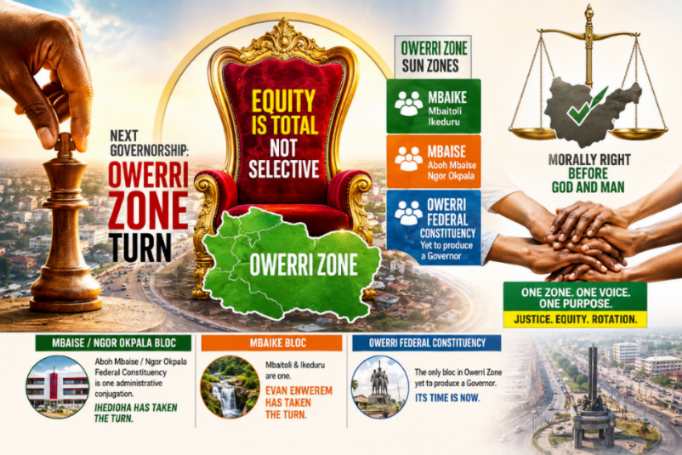
If the next governor of Imo State must come from Owerri zone, then Owerri is already sitting on a win-win proposition. It has the moral argument, the political arithmetic and, if its leaders do not squander the moment, the electoral advantage. Before God and man, there is a compelling case for correcting the prolonged denial of the governorship to the zone. Owerri has waited long enough.
Orlu and Okigwe will naturally protest, and they are entitled to do so. But the larger question is what Owerri does with the opportunity when it finally arrives. Equity is not a favour one zone grants another when convenient. It is a principle of justice. And when justice knocks on Owerri’s door, Owerri cannot open it halfway. It cannot demand equity from outside and suddenly become allergic to equity within.
This is where the argument becomes uncomfortable—and therefore important. Owerri zone is not a homogeneous political unit. Its three broad blocs—Mbaike, Mbaise and Owerri Federal Constituency—must confront the question of internal equity. Those who argue that it does not matter which bloc produces the next governor are, in my view, wrong, hook, line and sinker. If equity matters at the zonal level, it must matter at the sub-zonal level. Equity must trickle down. Otherwise, what we are calling equity is simply political convenience wearing the garment of justice.
Consider Mbaise. What happened to the administrative conjugation of Aboh Mbaise/Ngor Okpala Federal Constituency? Has it suddenly been thrown overboard because it no longer fits the present political arithmetic? Can Ngor Okpala honestly claim that it has no stake in the political share associated with an Ihedioha-Mbaise governorship? I do not find that argument persuasive. To me, it amounts to a political U-turn.
Ngor Okpala’s preferred political description today cannot erase the historical and political relationship that has long bound it to Mbaise. If we are serious about rotating the governorship among the blocs, then Mbaise/Ngor Okpala must be treated as a bloc. Ihedioha took the turn of Mbaise/Ngor Okpala. It is as simple as that. One cannot embrace a federal constituency when it strengthens one’s arithmetic and dismember it when the same arithmetic becomes inconvenient.
The same logic applies to Mbaike. Can Ikeduru divorce itself from the fact that Evan Enwerem’s governorship formed part of the political turn of Mbaike? Enwerem took the turn of Mbaike—Mbaitoli and Ikeduru together. If equity is genuinely the moral foundation upon which Owerri’s claim is being constructed, then the historical application of that principle within the zone cannot suddenly become irrelevant. You cannot invoke the principle when demanding something from others and suspend it when it begins to demand something from you.
That is why the emergence of key sons of Owerri Federal Constituency to contest the 2027 governorship is particularly heart-warming. It is the only broad bloc in Owerri zone that has not produced a governor. Its sons are now stepping forward within the ruling party and across other political parties. That development should be encouraged, not viewed with suspicion. Their emergence is not a threat to Owerri’s cause; it is part of the unfinished business of equity within the zone.
Owerri therefore has a historic opportunity in 2027. But it must be careful not to commit the very injustice it has spent years condemning. The argument cannot be that the next governor must come from Owerri zone while the question of which bloc has had its turn is dismissed as irrelevant. That is not equity. It is equity with conditions. And equity with conditions is merely another name for political convenience.
The next governor should come from Owerri zone. There is a powerful moral and political case for that position. But if equity is the argument, then equity must also determine which bloc within Owerri takes the turn. Otherwise, Owerri may succeed in correcting one historical injustice only to manufacture another. And that would be a remarkably poor definition of justice.