*Unbiased analysis on the personalities, party structures, zoning question, economic mood and political undercurrents shaping the contest*
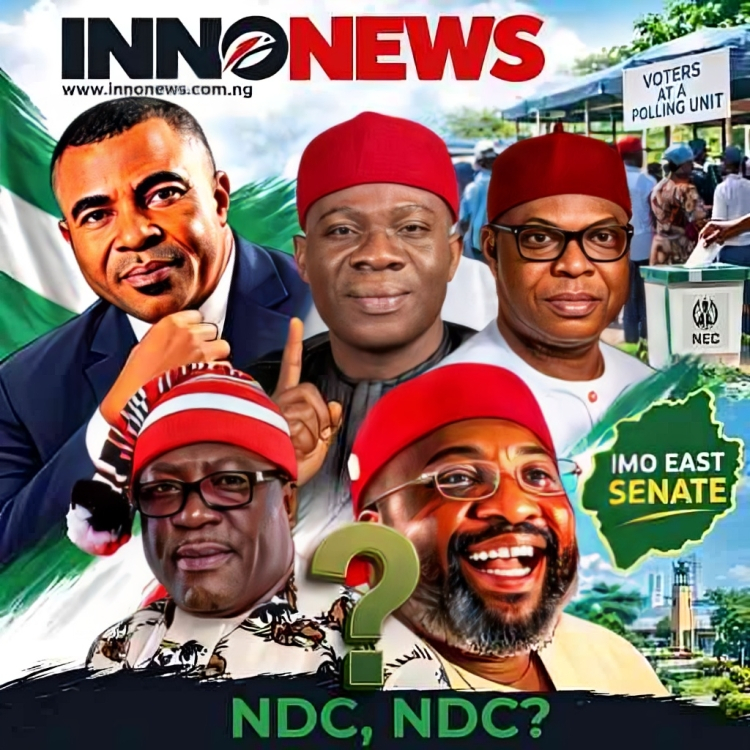
When voters in Imo East Senatorial Zone go to the polls on January 16, 2027, they will choose a senator from a field shaped by more than campaign promises, rallies and party slogans.
The zone comprises nine local government areas — Owerri Municipal, Owerri North, Owerri West, Ngor Okpala, Ikeduru, Mbaitoli, Aboh Mbaise, Ahiazu Mbaise and Ezinihitte Mbaise — with distinct political interests, voting patterns and local alliances.
For the first time, the contest is also presenting an unusually large field of 16 candidates. The major political platforms bring different advantages: the APC has state-government control and an established organisation; the NDC has the Peter Obi factor; the PDP is seeking to rebuild its traditional network; the ADC is drawing on the political network associated with former governor Emeka Ihedioha; while the APP and Labour Party are seeking to strengthen and consolidate their respective bases.
But the central question is how these advantages will translate into votes across the nine LGAs.
NINE LGAs, A HISTORY OF UNPREDICTABLE RESULTS
The electoral history of Imo East shows why the race cannot be understood simply through party structures, geographical claims or the popularity of individual candidates.
Samuel Anyanwu won the Senate seat for the PDP in 2015. In 2019, Ezenwa Onyewuchi retained it for the PDP with 146,647 votes against the APC’s Emmanuel Umunakwe Ojinere, who scored 33,729.
In 2023, Onyewuchi moved to the Labour Party and won again with 100,631 votes, defeating the PDP’s Uche Onyeagocha, who scored 87,229. Labour won five LGAs — Owerri Municipal, Owerri North, Ngor Okpala, Ikeduru and Mbaitoli — while the PDP carried Owerri West, Aboh Mbaise, Ahiazu Mbaise and Ezinihitte Mbaise. The APC did not win a single local government.
The results demonstrate an important feature of the zone. Imo East does not vote as one bloc. A candidate can win several LGAs, still face a close overall contest and possibly lose.
THE ZONING QUESTION: POLITICAL EQUITY VERSUS VOTING REALITY
Few issues have generated as much political argument in Imo East as zoning.
The zone is divided through four political blocs — Mbaike, Owerri, Mbaise and Ngor Okpala — making zoning a recurring feature of negotiations, endorsements and candidates’ calculations.
But there is a difference between zoning as a political organising principle and voters behaviour at the polling unit.
The electoral record in the zone does not show a consistent pattern in which voters simply hand the Senate seat to a particular bloc because it is considered that bloc’s turn. Mbaike has produced Evan Enwerem, Amah Iwuagwu and Samuel Anyanwu; Mbaise produced Chris Anyanwu; while the Owerri bloc produced Eze Ajoku and subsequently Ezenwa Onyewuchi.
Zoning can therefore influence negotiations and mobilisation at a certain level, but does not determine how voters vote in Imo East Senate election.
Ngor Okpala adds another dimension to the debate. It has increasingly asserted a separate political identity in wider and broader zoning discussions, although it remains constitutionally joined with Aboh Mbaise in the Aboh Mbaise/Ngor Okpala Federal Constituency for the House of Representatives.
Ahead of the senate election, Ngor Okpala is making a strong case that it is it’s turn to produce a senator on the basis that it is the only bloc yet to do so. How their demand resonate with other blocs in the zone cannot be ascertained.
However, all the candidates will consequently have to convert claims of political equity into actual support across the nine LGAs.
THE OBI FACTOR AND THE 2023 SHADOW
One of the biggest questions in 2027 is what will happen to the political energy associated with Peter Obi in 2023.
Obi, who was the Labour party presidential candidate won Imo State in the 2023 presidential election, while Labour captured the Imo East Senate seat through Onyewuchi. The senatorial result was particularly significant because Labour won the seat despite the PDP carrying four of the nine LGAs. The APC did not win a single local government area.
The political terrain has since changed. Obi is now the presidential candidate of the Nigeria Democratic Congress (NDC), after leaving the Labour Party.
That makes the NDC presidential ticket a significant variable in the Senate contest, but it does not mean the 2023 Labour result will automatically be reproduced verbatim under a different party platform.
The NDC’s Imo East senatorial ticket is itself facing a legal complication. The Federal High Court in Owerri on September 22 ordered INEC not to accept a candidate presented by the party on the basis of the disputed primary, leaving the senatorial ticket subject to further legal developments.
While some legal analysts say this is a mere academic exercise, the eventual NDC senatorial candidate may eventually benefit from wider and massive influence of the NDC presidential candidate, Obi, whose support not just in Imo East, but across the South East zone remains unwavering.
OWERRI’S URBAN ELECTORATE
The political character of Imo East is also shaped by the urban nature of parts of the zone.
Owerri Municipal, together with significant parts of Owerri West and Owerri North, has a large urban and cosmopolitan population. Non-indigenes living, working and doing business in these areas are therefore part of the wider electoral environment.
But the significance of the urban electorate extends beyond the votes it directly contributes. Political conversations formed in Owerri move like a speed of light through families, businesses, social organisations, religious networks and political contacts into surrounding communities in the zone.
Issues such as the economy, security, infrastructure, business conditions and governance can therefore resonate beyond the urban centres.
MBAISE AXIS: WILL IHEDIOHA’S POLITICAL NETWORK TRAVEL WITH THE ADC?
The Mbaise axis presents another major political variable. It has a unique voting pattern and behaviour.
In the 2019 governorship election, Emeka Ihedioha of the PDP recorded strong support in the three Mbaise LGAs, reinforcing the party’s political strength there at the time.
The PDP also won in Aboh Mbaise, Ahiazu Mbaise and Ezinihitte Mbaise in the 2023 Imo East Senate election.
The political question in 2027 is whether the voting pattern associated with the PDP and Ihedioha in previous elections can travel with the former governor now that he is politically aligned with the ADC.
It would, however, be premature to assume that political allegiance attached to Ihedioha during the PDP era will automatically transfer to the ADC and its senatorial candidate, Uchenna Daniel Ofoegbu.
The Mbaise axis will consequently be one of the areas to watch during the election.
CANDIDATE PERSONALITY: A LIMITED FACTOR
The 2027 race has produced a large and politically active field, with several candidates already known in different parts of the zone.
Yet the electoral history of Imo East provides little evidence that the personality, antecedents or political stature of individual candidates has, by itself, determined the outcome of the Senate election in the past.
Party identity, presidential influence, political structures, geographical support and the prevailing political mood have historically played a larger role in determining who wins the contest.
This does not mean voters ignore individual candidates. Rather, personal reputation of any candidate has rarely been sufficient on its own to overturn a dominant political current in the zone during elections.
APC AND THE SENATE JINX
The APC enters the race with state-government control and an established solid organisational structure. Its candidate, Alexander Mbata, is also familiar to voters after contesting the seat in 2023.
But the party faces a significant historical hurdle: it has never won the Imo East Senate seat since its formation.
The 2027 election therefore presents another opportunity for the APC to possibly break that pattern.
The party is expected to campaign around the record of the Hope Uzodimma administration. But its campaign will also encounter the fierce economic mood of voters.
High food prices, inflation, exorbitant transport costs, electricity and the biting general cost of living have immensely shaped voters perception and attitude. The APC’s challenge is therefore not simply to highlight the state government’s record, but to address how voters assess harsh economic experience under an APC-led federal government. Will this affect or influence voters behaviour on election day?
PDP, ADC AND APP: THE NETWORKS BEHIND THE CANDIDATES
The PDP faces the task of rebuilding a political network that once dominated Imo politics. Its 2027 senatorial candidate, former deputy governor, Eze Madumere, will have to contend with major defections and realignments that have affected the party while attempting to reconnect it with its traditional structures.
The ADC has the political network associated with former governor Emeka Ihedioha, while its candidate, Uchenna Daniel Ofoegbu, must translate that network into votes.
The APP is also seeking political space, with Chima Matthew Amadi making inroads and attempting to turn his grassroots activities and political network into electoral support across the zone.
These parties face the same fundamental test: converting organisation and visibility into votes at polling units.
An endorsement is not a ballot, a rally crowd is not necessarily a polling-unit result, and social-media visibility does not automatically translate into turnout.
THE CHANGING POWER OF POLITICAL ELITES
The 2023 Senatorial election in Imo East also points to a change in the way political influence works in the zone.
Big-name politicians can still mobilise supporters, but their endorsements do not automatically determine how voters cast their ballots. With the exception of political figures who have developed genuine organic followership, traditional political elites increasingly have to persuade voters rather than simply direct them.
The growing presence of younger voters adds another dimension. Their exposure to competing political narratives through social media and other platforms may make them less tied to traditional political structures.
For established political networks, the challenge is therefore increasingly one of persuasion, organisation and turnout rather than relying solely on elite influence.
THE 2027 EQUATION
The 2027 Imo East Senate contest brings together several forces that have previously operated separately: the APC’s organisational advantage and overwhelming strength, the NDC’s Obi factor, the PDP’s historical network, Ihedioha/ADC political influence in the Mbaise axis, the emergence of newer political platforms such as the APP and an electorate confronting difficult economic conditions.
The electoral history of the zone clearly suggests that none of these factors should be treated in isolation.
The nine LGAs have demonstrated different voting patterns, while previous elections have shown that winning several LGAs does not necessarily mean dominating the entire zone. The large number of candidates also creates room for votes to be distributed or divided across multiple political parties.
For the candidates, the central task is to convert political networks, campaign messages and grassroots activity into actual votes across the nine LGAs.