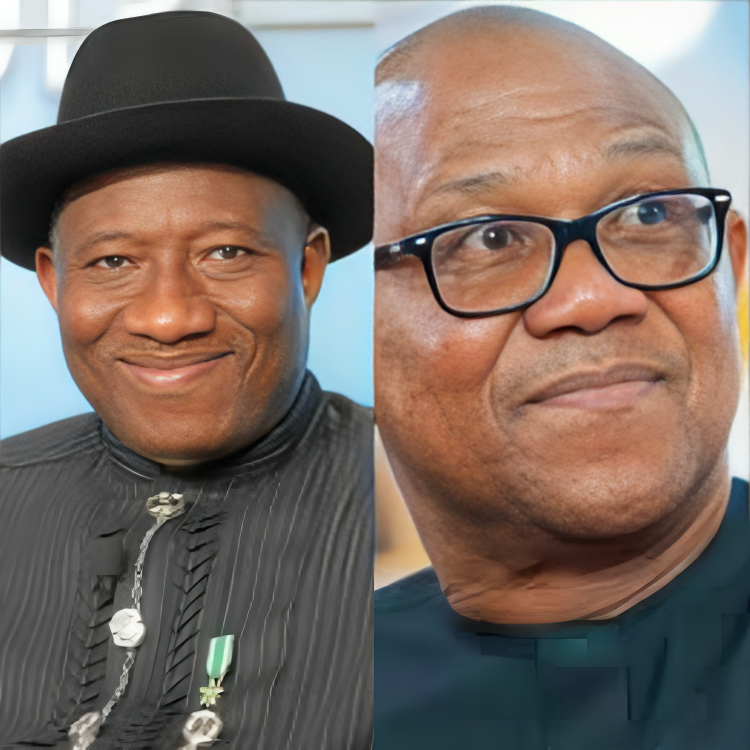
As the 2027 presidential election inches closer, two towering figures dominate the national conversation: former President Goodluck Jonathan and former Anambra State Governor — and 2023 Labour Party presidential candidate — Peter Obi.
The question Nigerians face is not just about policy proposals, but about legacies, memories, and the kind of leadership the nation truly wants moving forward.
Goodluck Jonathan will always be remembered as the first Nigerian president to concede defeat while still in office, handing over power peacefully in 2015. His rise to the presidency in 2010 and his dignified exit are still celebrated as milestones in Nigeria’s democratic journey.
During Jonathan’s tenure, Nigeria was declared Africa’s largest economy after the 2014 GDP rebasing, a development that significantly boosted the nation’s economic image.
At the time, the cost of living was far more affordable — a bag of rice sold for about ₦7,000, petrol hovered around ₦125 per litre, and many Nigerians recall an era when salaries stretched further, jobs were more available, and the middle class thrived.
Political commentator, Mr Uche Mba in his analysis told INNONEWS : “Jonathan’s time was far from perfect, but the economic reality then was a thousand times better than what we are experiencing now.”
Still, Jonathan’s presidency was not without flaws. His administration faced allegations of large-scale corruption, including billions of dollars in missing oil revenues, and a series of high-profile scandals that undermined his anti-corruption credentials. Critics also questioned whether the economic boom of his era could have been sustained with stronger fiscal discipline.
In recent months, rumours have swirled that Jonathan might return as the PDP’s presidential flagbearer to challenge President Bola Tinubu in 2027. He has neither confirmed nor denied the speculation — a silence that fuels political intrigue.
However, skeptics recall how he stepped away from the 2023 race, even when the APC presidential form was controversially purchased for him by some of his political allies. Jonathan’s critics argue that his political will and courage have often been in doubt.
Peter Obi, on the other hand, built a reputation as one of Nigeria’s most reform-minded governors during his tenure in Anambra State. His government transformed the state’s education sector, with Anambra consistently ranking among the best in WAEC and NECO results, and recording the lowest percentage of out-of-school children nationwide. The state also saw significant GDP growth during his time.
Emeka Offonry, a political analyst based in Awka, told this newspaper that : “Obi brought a level of fiscal discipline rarely seen in Nigerian politics. He proved that governance could be done without waste and reckless borrowing.”
Obi’s prudent resource management, reduction of state debts, and investments in health, infrastructure, and education became his calling card. He is remembered for leaving billions of naira in the state’s coffers for his successor — a rarity in Nigerian politics. His governance style won him respect beyond the South East.
In the 2023 presidential race, Obi garnered over six million votes nationwide, sweeping the South East and making strong showings in the North Central. His campaign appealed to a wide spectrum of Nigerians — especially youths — drawn to his message of integrity, transparency, and fiscal responsibility.
An Owerri based political analyst, Paul Egwuatu summed up the contrast: “While Jonathan reminds Nigerians of better days, Obi offers the promise of a cleaner, more accountable government. The question is whether voters want to go back or move forward.”
For many older Nigerians, Jonathan’s presidency brings back memories of relative economic stability, calmer governance, and a less punishing cost of living. For younger, reform-minded voters, Obi represents a decisive break from old politics — a chance to rebuild the system with competence and transparency.
As 2027 draws near, both men offer compelling but starkly different visions. One embodies nostalgia for economic stability, the other embodies a reformist zeal for a new political order. Ultimately, Nigerians will have to decide whether the path forward lies in revisiting the past or forging a new future.
For many older Nigerians, Jonathan’s presidency brings back memories of relative economic stability, calmer governance, and a less punishing cost of living. For younger, reform-minded voters, Obi represents a decisive break from old politics — a chance to rebuild the system with competence and transparency.