Since Nigeria’s return to democracy in 1999, no governor of Imo State has successfully handed the reins of power to a chosen successor.
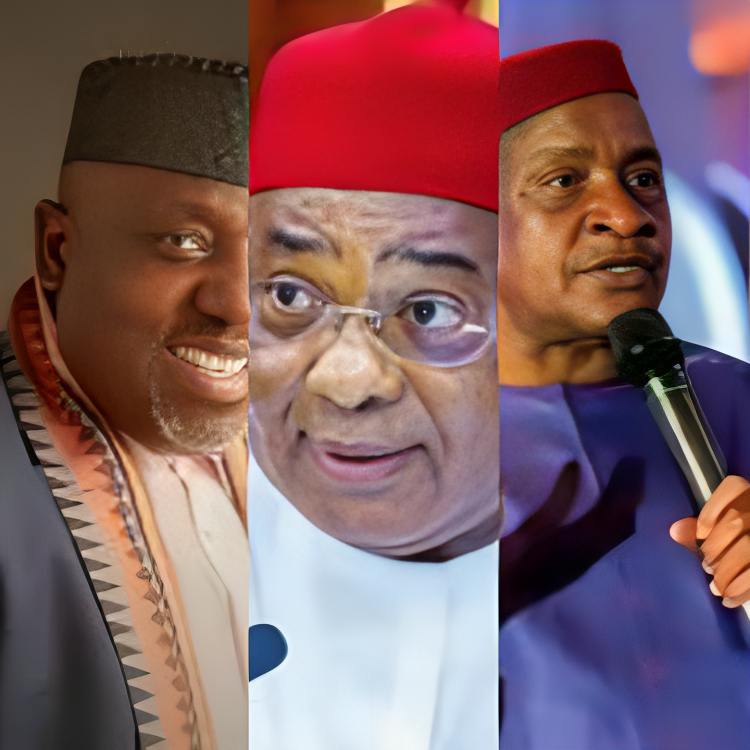
From Achike Udenwa to Rochas Okorocha, every attempt to install a sucessor collapsed under the weight of internal strife, elite conspiracies, or outright rejection by the people.
For Udenwa, the road to succession was destroyed by a fierce political war within the People’s Democratic Party (PDP). His reign ended in open hostility between the Onongono faction, led by his loyalist Alex Obi (of blessed memory), and the Abuja faction anchored by Kema Chikwe, Senator Ifeanyi Araraume, and business mogu,l Tony Ezennna.
The bitter divisions left Udenwa too weakened to impose a successor, paving the way for Ikedi Ohakim’s dramatic rise. Ohakim’s case carried a different coloration but ended in similar humiliation. Despite holding power, he fell victim to conspiracies woven by heavyweight politicians — and even the clergy were implicated in the revolt against him. With the elite against him, his re-election bid crumbled, leaving no room for succession politics.
Rochas Okorocha charted another path but miscalculated fatally.His decision to impose his son-in-law, Uche Nwosu, as successor in 2019 sparked outrage that cut across party lines and the wider Imo populace. The elite rejected it, the people despised it, and the governorship slipped completely from his grip.
What links these failures is a common thread: each governor lost the loyalty of the political elite and, in turn, the people. Their succession dreams perished in factional wars or dynastic arrogance.
Uzodimma, however, has built an entirely different political architecture.Unlike his predecessors, he has thus far successfully courted — and in many cases, neutralized — the state’s most influential players.
From Owerri to Orlu, big names who once held sway now sit in his corner or have chosen silence. Before his re-election in 2023, Uzodimma had already extracted the political fibre of the opposition, luring defectors into his APC fold. By the time he won a second term, the opposition was already a shell of its former self.
Adding to his advantage is the Charter of Equity, which he introduced and has since ignited a frenzy among the political class. The charter, designed to rotate power fairly among zones, has thrown Okigwe and Owerri into heated debates, with both zones aggressively positioning for 2027. This discourse has so preoccupied the elite that it has left little room for a unified opposition front against the governor’s eventual choice.
Meanwhile, Uzodimma has kept his cards close to his chest. Unlike Okorocha, who loudly paraded his son-in-law as heir, Uzodimma has avoided any polarizing hints, leaving the political class guessing. His silence has created suspense and ensured that potential rivals cannot rally a coalition against a visible choice.
Electoral history also tilts in his favour. Every major election under his watch, from governorship to bye-elections, has been a walkover for his camp. His political style, often described as “winner takes all,” leaves little oxygen for challengers. The same machinery that has delivered repeated victories is expected to roll into 2027.
His strategy of distributing appointments and political relevance across zones has further pacified the elite. While Udenwa’s PDP crumbled under factionalism, Uzodimma presides over a relatively united bloc. No powerful faction within the APC in Imo has yet emerged to confront him directly.
However, skeptics argue that Imo’s volatile political history makes nothing certain. Yet, with no towering opposition figure, no clerical revolt, and no unified elite conspiracy, Uzodimma stands in a class apart from his predecessors.His ability to neutralize opposition before it gathers momentum is unmatched.
For the first time in 26 years, Imo may witness a governor produce his own successor. If Uzodimma maintains his grip, leverages the Charter of Equity, and sustains his iron-fisted control of the state’s political landscape, the 2027 governorship election may mark the breaking of Imo’s long, stubborn jinx.
Meanwhile, Uzodimma has kept his cards close to his chest. Unlike Okorocha, who loudly paraded his son-in-law as heir, Uzodimma has avoided any polarizing hints, leaving the political class guessing. His silence has created suspense and ensured that potential rivals cannot rally a coalition against a visible choice.