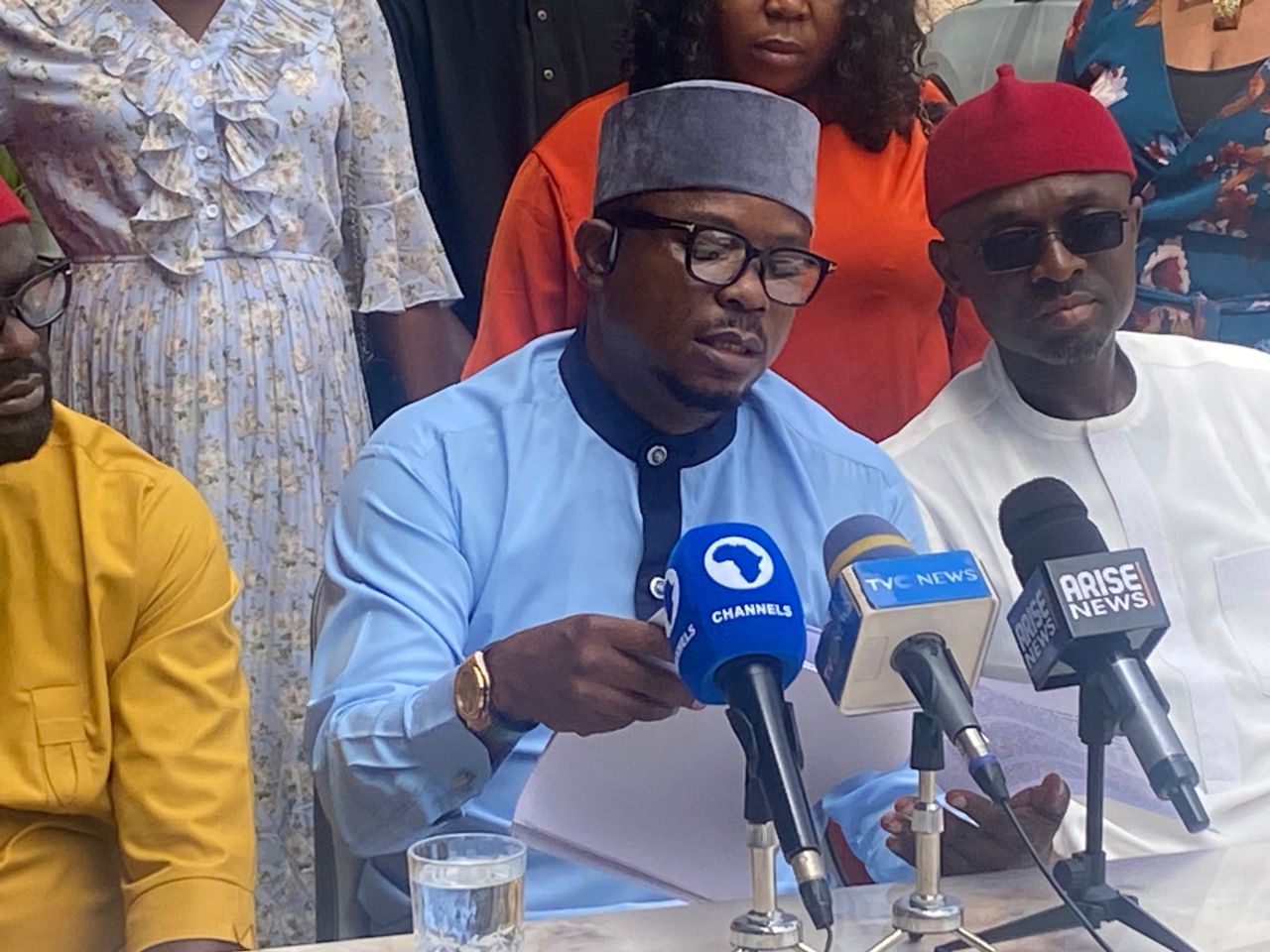
–Says, Legal Battle to Delist APP Fully on Course
CIVIC ACTION FOR DEMOCRACY (CAD)
WORLD PRESS CONFERENCE BY MAZI FRANKLIN NGOFORO, EXECUTIVE DIRECTOR, CIVIC ACTION FOR DEMOCRACY (CAD)
SUBJECT:
UGOCHINYERE’S DESPERATE “AKOKWA WONDER”: HOW PARADE OF IRRELEVANT DOCUMENTS FURTHER EXPOSES FRAUD AND SEALS APP’S FATE AS A DEREGISTERED POLITICAL PARTY
— CAD DEMOLISHES UGOCHINYERE’S CLAIMS OF COURT VICTORY, REAFFIRMS CERTAINTY OF APP DELISTING THROUGH THE COURTS
DATE: APRIL 7, 2026
Good afternoon, distinguished members of the press, fellow citizens, and all friends of democracy. Happy Easter celebrations to all of you. May the resurrection of Christ renew our hope and faith in a Nigeria that is filled with limitless possibilities.
We have convened this emergency world press conference to address the latest desperate propaganda stunt by an ill-trained political charlatan, one Ugochinyere Michael Ikeagwuonu. Let us be clear, this amorphous creature has since abandoned his original name for the “Ikenga Imo” alias. He did so just to prove that he is greater than everyone else in Imo state. Notably, this rebellion to crown himself was ignited in the aftermath of the conferment of the “Ikenga Akokwa” title on his own wealthy, influential and respected elder brother from the same Akokwa.
Gentlemen of the press, you all know this incurable rabble-rouser, in the past few days, has been parading on social media what he terms “court judgments” that purportedly validate his deregistered party’s continued existence. As usual, Ugochinyere and his very few supporters, who believe that politics is only about noise and spectacle rather than substance and law, have begun celebrating and shouting as though they have achieved some great legal victory. Nothing could be more classical in self-deception than this latest charade. Today, we will systematically dismantle every single document Ugochinyere has been flaunting, expose the fundamental legal ignorance or deliberate public deception underlying his claims, and demonstrate conclusively why these documents, far from helping his case, actually constitute additional evidence of the very fraud we are prosecuting before the Federal High Court in Owerri.
Let me begin with what should be obvious to anyone with basic legal literacy: not all court documents are created equal, and the mere fact that a piece of paper bears a court’s letterhead does not mean it addresses the issues relevant to our case or provides the relief Ugochinyere desperately needs. The documents Ugochinyere has been parading fall into distinct categories, none of which remotely affects the pending suit number FHC/CS/03/2026 seeking APP’s delisting from INEC’s register. We will examine each category methodically, applying settled principles of Nigerian law including the doctrines of res judicata, issue estoppel, jurisdiction, and the binding nature of Supreme Court precedent. By the time we are finished with this legal autopsy of Ugochinyere’s propaganda, even his most ardent supporters will understand that he has succeeded only in making mockery of himself and exposing his desperation and the complete indefensibility of his fraudulent enterprise.
THE UYO COURT DOCUMENT: A LEADERSHIP TUSSLE IRRELEVANT TO DEREGISTRATION
The first document Ugochinyere has been flaunting with great fanfare is purportedly from a court in Uyo, Akwa Ibom State. This is perhaps the most useless of all the documents he parades, and the fact that he presents it as somehow relevant to our case reveals either spectacular ignorance of basic legal principles or calculated deception of his followers. The Uyo court document, from its own express terms visible in the very copy Ugochinyere circulated, deals exclusively with an internal leadership dispute within APP. It addresses the question of which faction or set of persons should be recognized as the authentic leadership of the party. This is what lawyers call an intra-party dispute, governed by the party’s own constitution and internal democratic processes.
From the judgment itself, which Ugochinyere apparently did not read carefully before celebrating, the Uyo court explicitly declined to interfere substantively in that internal party leadership tussle, citing the well-established principle articulated by the Supreme Court in cases like Uche v. Elemba (2015) and Ombugadu v. Ucha (2017) that courts are generally reluctant to interfere in the internal affairs of political parties unless constitutional violations or fundamental rights breaches are demonstrated. The court essentially told the warring factions within APP to resolve their leadership issues according to their party constitution. How does this concern our case against APP’s continued illegal retention on INEC’s register? The answer is: it does not, in any way whatsoever.
Our suit does not challenge who leads APP. We are not parties to any internal APP leadership dispute. We do not care whether faction A or faction B controls APP’s structures. Our case is fundamentally different: we are challenging APP’s very existence as a registered political party based on INEC’s lawful deregistration of APP on February 6, 2020, the Supreme Court’s affirmation of that deregistration in March 2022, and INEC’s fraudulent retention of APP on its register through claims of a phantom court order that has never been produced despite six years of requests. These are entirely separate legal issues governed by entirely different legal principles. The Uyo court was not asked to rule on, did not consider, and could not have decided the issues currently pending before the Federal High Court in Owerri.
Under the doctrine of res judicata as articulated in Section 23 of the Supreme Court Act and developed through cases like Eze v. Nwosu (2012) and Saraki v. Kotoye (1992), a previous court decision only bars subsequent litigation if four conditions are met: the parties must be the same, the subject matter must be the same, the cause of action must be the same, and there must have been a final decision on the merits. The Uyo judgment fails on all four counts. The parties are different (we are not parties to that leadership dispute), the subject matter is different (leadership tussle versus deregistration), the cause of action is different (internal party democracy versus constitutional compliance), and the Uyo court did not even render a substantive decision but rather declined jurisdiction. Therefore, the Uyo document has absolutely no bearing, legal or otherwise, on our pending case. Ugochinyere’s parade of this irrelevant document as some kind of victory only exposes his abiding legal illiteracy or his cynical attempt to deceive his gullible supporters.
THE OWERRI COURT DOCUMENT: EVIDENCE OF THE CRIME, NOT DEFENSE AGAINST IT
The second category of documents Ugochinyere has been circulating allegedly emanates from a court in Owerri, Imo State, which he claims has addressed the issue of APP’s registration status. But this matter, upon closer examination, further exposes either his fundamental ignorance of law or his penchant for public deception. First, the suit in question was purportedly filed and judgment obtained in the last quarter of 2025, specifically in October 2025 according to the documents Ugochinyere himself circulated. The subject matter contained in those court papers is entirely different from what we are seeking in our Federal High Court suit. The parties are different. The legal basis is different. The reliefs sought are different. And most critically, the fundamental flaw in Ugochinyere’s position is this: that the Owerri court document is not a defense against our case but rather one of the strongest exhibits supporting our case.
Let me explain the chronology carefully so that even those unfamiliar with legal technicalities can understand the fraud that document exposes. APP was deregistered by INEC on February 6, 2020, pursuant to Sections 225 and 225A of the 1999 Constitution and Section 94 of the Electoral Act then in force, because APP failed to meet the constitutional performance criteria in the 2019 general elections. INEC published formal notice of this deregistration, listing APP among 74 parties removed from the register. In March 2022, the Supreme Court of Nigeria, in a binding judgment that applies to all authorities and persons throughout Nigeria under Section 287 of the Constitution, affirmed the constitutional validity of INEC’s entire 2020 deregistration exercise. From that moment in March 2022, if not from February 2020, APP ceased to have legal existence as a registered political party.
Yet mysteriously, APP remained on INEC’s register. When concerned lawyers wrote to INEC asking why a deregistered party was still listed, INEC claimed that APP had obtained a court order restraining the deregistration. But as we have documented exhaustively in our lawsuit, that court order has never been produced. Not when Barr. Eunice Atuejide requested it in July 2020. Not when Barr. Ukpai Ukairo requested it in 2024. Not in response to our comprehensive suit filed in January 2026. Not when INEC had the opportunity to defend APP at the February 26, 2026 court hearing but chose not to appear. The inescapable conclusion is that the phantom court order does not exist and never existed. INEC’s retention of APP on its register has been, from 2020 to the present day, a fraudulent act lacking any legal foundation.
Now here is where the October 2025 Owerri court documents become devastating evidence against Ugochinyere rather than for him. In 2024, APP participated in local government elections in Jigawa State and purportedly won a councillorship seat. APP also participated in Rivers State local government elections and claimed to have won seats there as well, though those Rivers results were subsequently nullified by court orders declaring that those elections did not validly hold. The October 2025 Owerri court case that Ugochinyere now parades apparently involved APP going to court to argue that because it won a councillorship seat in Jigawa in 2024, it has now met the constitutional performance criteria and therefore should be retained as a registered party.
THE FATAL LEGAL FLAW: PARTICIPATING IN ELECTIONS WHILE DEREGISTERED
But here is the fundamental legal question that destroys Ugochinyere’s entire argument: as at 2024, when APP participated in those Jigawa and Rivers local government elections, was APP supposed to be in legal existence in the first place? The answer, based on INEC’s February 2020 deregistration and the Supreme Court’s March 2022 affirmation, is an emphatic no. APP had no legal capacity to participate in those 2024 elections because APP was a deregistered entity. Under the principle established in Awuse v. Odili (2015) and reaffirmed in numerous subsequent cases, a nullity remains a nullity and cannot be validated by subsequent events or the passage of time. An entity that lacks legal capacity to perform an act cannot acquire legal rights through the performance of that very act.
Let me illustrate with a simple analogy. Imagine a lawyer who was disbarred in 2020 for professional misconduct. The disbarment was affirmed by the highest legal authority in 2022. Yet somehow, through administrative error or corruption, this disbarred lawyer’s name remains on the roll of practicing lawyers. In 2024, this disbarred lawyer appears in court and wins a case. In 2025, he goes to court arguing: “Look, I won a case in 2024, therefore I should be retained as a practicing lawyer.” The absurdity is obvious. The fact that he appeared in court in 2024 does not validate his continued practice because he had no legal capacity to appear in the first place. The 2024 court appearance was itself illegal. Similarly, APP’s participation in 2024 elections was illegal because APP was deregistered and had no legal capacity to field candidates or participate in electoral processes.
This is why the October 2025 Owerri court documents that Ugochinyere parades are not evidence of APP’s legitimacy but rather evidence of ongoing criminal conduct. APP’s participation in 2024 elections despite being deregistered in 2020 is not a basis for retention; it is proof of fraud. It demonstrates that APP knowingly and deliberately participated in electoral processes despite lacking legal capacity to do so. It shows that APP presented candidates, fielded councillorship aspirants, and engaged in electoral activities while aware that the party had been deregistered. This is precisely the kind of fraudulent conduct we are asking the Federal High Court to punish through our reliefs seeking perpetual injunctions, declarations of nullity, and referral to law enforcement for criminal prosecution.
THE PURPORTED INEC LETTER: PROOF OF FRAUD, NOT LEGITIMACY
Ugochinyere has also been parading what he claims is a letter from INEC confirming that APP is in existence and duly registered. Far from helping his case, this purported letter is yet another exhibit that will be used against him in court to prove the very fraud we are prosecuting. Let me be absolutely clear about what we and multiple other concerned citizens requested from INEC over the past six years. We did not ask INEC to confirm whether APP is on its register; we can see for ourselves that APP is erroneously listed. What we specifically requested was for INEC to produce a copy of the court order that INEC claims prevented it from removing APP from the register following the February 2020 deregistration.
Barr. Eunice Atuejide’s letter of July 29, 2020, explicitly requested: “Please provide certified true copies of the court order you claim restrains APP’s deregistration, including the suit number, the court where it was filed, the date it was granted, and the parties to that suit.” INEC never responded to that letter. Barr. Ukpai Ukairo’s 2024 correspondence made similar specific requests for documentation of the alleged court order. Again, INEC did not respond. Our own lawsuit, filed in January 2026, includes specific reliefs compelling INEC to produce the phantom court order or admit under oath that it does not exist. To date, INEC has not produced any such order, and INEC’s failure to defend APP at the February 26 court hearing constitutes a de facto admission that no such order exists.
Now Ugochinyere parades a letter that supposedly confirms APP’s registration status. But notice what that letter conspicuously does not contain: it does not reference any court order. It does not provide the suit number, court file number, date, or any details of the alleged restraining order. It does not explain on what legal basis a deregistered party that failed to meet constitutional criteria, whose deregistration was affirmed by the Supreme Court, should remain on INEC’s register. The letter, if authentic (and we reserve the right to challenge its authenticity through forensic examination), amounts to nothing more than INEC’s administrative acknowledgment that it has erroneously retained APP on its register. But administrative listing does not confer legal legitimacy.
Under the principle established in Okorodudu v. INEC (2014), INEC’s administrative actions must conform to constitutional and statutory requirements. INEC cannot, through mere administrative discretion or issuance of letters, override constitutional provisions, Supreme Court judgments, or its own lawful deregistration decisions. If INEC issues a letter confirming that a deregistered party is still on its register, that letter is evidence of INEC’s ongoing violation of constitutional duty, not evidence that the party is legitimately registered. The letter proves our case rather than disproving it. It demonstrates exactly what we allege: that INEC is fraudulently maintaining a deregistered party on its register in defiance of constitutional requirements and Supreme Court authority.
THE DOCTRINE OF RES JUDICATA AND WHY THESE DOCUMENTS DO NOT BAR OUR CASE
Let me address, from a strictly legal standpoint, why none of the documents Ugochinyere parades can possibly bar or affect our pending suit under the doctrines of res judicata or issue estoppel. These doctrines, codified in Section 23 of the Supreme Court Act and elaborated in cases like Eze v. Nwosu (2012), prevent parties from relitigating issues that have been conclusively determined in previous proceedings between the same parties. But as the Supreme Court held in Adeyemi v. Opeyori (2016), four essential conditions must be satisfied before res judicata applies: identity of parties, identity of subject matter, identity of cause of action, and finality of the previous decision.
The Uyo court judgment fails all four tests. We were not parties to that proceeding; it dealt with internal party leadership, not deregistration; the cause of action was intra-party democracy, not constitutional compliance; and the court did not render a final decision on merits but declined jurisdiction. Therefore, res judicata does not apply. The Imo State court documents similarly fail these tests. Even if the October 2025 judgment addressed registration issues (which we will verify through obtaining certified true copies for forensic examination), we were not parties to that suit. We are raising different legal arguments based on different constitutional provisions and different factual premises. Most importantly, our case is grounded in the Supreme Court’s March 2022 judgment affirming the 2020 deregistration, which is binding on all lower courts under Section 287 of the Constitution and the doctrine of stare decisis.
Under stare decisis, as explained in Adegoke Motors Ltd v. Adesanya (1989), lower courts are bound by Supreme Court precedents and cannot render decisions contrary to Supreme Court holdings. The Supreme Court held in March 2022 that INEC’s 2020 deregistration exercise was constitutional and valid. That holding binds all courts in Nigeria, including whatever Owerri court purportedly rendered in the October 2025 judgment Ugochinyere parades. If that Owerri court suggested that APP’s 2024 electoral participation validates its continued registration despite the 2020 deregistration and 2022 Supreme Court affirmation, then that court exceeded its jurisdiction and rendered a decision contrary to binding Supreme Court precedent. Such a decision would be void for want of jurisdiction and incapable of creating any legal rights or obligations.
Moreover, under the principle in Madukolu v. Nkemdilim (1962), one of the foundational cases in Nigerian jurisprudence on jurisdiction, a court lacks jurisdiction to make an order if the subject matter is outside its competence or if doing so would contradict a superior court’s binding decision. Any Court purporting to validate APP’s registration status in October 2025 would have been acting in direct contradiction of the Supreme Court’s March 2022 judgment. Such an order would be a nullity, as established in Agu v. Ikewibe (1991), and we will seek its setting aside if it becomes necessary to do so.
THE PRINCIPLE OF NULLITY: APP’S FUNDAMENTAL LEGAL NON-EXISTENCE
Central to our entire case is the principle, well-established in Nigerian law, that a nullity remains a nullity and cannot be cured by subsequent events, the passage of time, or the consent of parties. This principle was articulated powerfully by the Supreme Court in Awuse v. Odili (2015) and has been consistently applied in electoral cases. APP’s deregistration on February 6, 2020, created a fundamental nullity: from that date, APP ceased to have legal existence as a registered political party. The Supreme Court’s affirmation in March 2022 removed any possible doubt or ambiguity about this status.
Once an entity has been declared a nullity under law, everything that entity purports to do thereafter is also a nullity. APP’s participation in 2024 elections was a nullity. Any seats purportedly won on APP’s platform are nullities. Any primaries conducted by APP are nullities. Any candidates nominated by APP are nullities. These actions cannot retrospectively validate APP’s existence because they were performed by an entity lacking legal capacity. In Ojukwu v. Yar’Adua (2009), the Court of Appeal held that actions taken by persons or entities lacking legal authority are void ab initio regardless of the form they take or the period they continue unchallenged.
Ugochinyere fundamentally misunderstands this principle. He believes that by participating in elections, winning seats, and obtaining court judgments referencing those electoral victories, he can somehow resurrect APP from legal death. But Nigerian law does not work that way. The nullity of APP’s deregistration cannot be cured by electoral participation any more than a dissolved company can be revived by continuing to conduct business. The proper legal avenue, if APP genuinely wished to participate in elections again, would have been to apply for fresh registration under Sections 222-224 of the Constitution, demonstrating that it meets all constitutional and statutory criteria. Instead, APP chose to maintain a fraudulent pretense of continued registration, and that fraud is now being comprehensively exposed.
THE SUPREME COURT JUDGMENT OF MARCH 2022: THE BINDING PRECEDENT UGOCHINYERE CANNOT ESCAPE
Let me return to the single most important legal document in this entire saga, the one document that Ugochinyere conspicuously does not parade because it destroys his position utterly: the Supreme Court judgment of March 2022 affirming the constitutional validity of INEC’s February 2020 deregistration exercise. This judgment was delivered by the apex court of Nigeria in proceedings where the 2020 deregistration exercise was directly challenged. Multiple parties, including some of the 74 deregistered parties, argued that INEC exceeded its constitutional authority or violated procedural requirements in conducting the deregistration. The Supreme Court examined these arguments thoroughly and rejected them, holding that INEC acted within its constitutional powers and in accordance with law.
Under Section 287(1) of the 1999 Constitution, “The decisions of the Supreme Court shall be binding on all other courts in Nigeria and on all authorities and persons throughout the Federal Republic of Nigeria.” This is not a suggestion or a recommendation; it is a constitutional command. Every court, every government agency, every institution, and every person in Nigeria is bound by Supreme Court decisions. INEC is bound. APP is bound. Whatever Imo State court purportedly rendered judgment in October 2025 is bound. And most certainly, Rt. Hon. Ikenga Ugochinyere is bound.
The Supreme Court held that the 2020 deregistration exercise, which included APP, was constitutional. That holding has the force of law throughout Nigeria. No subsequent court can contradict it. No administrative action can override it. No electoral participation can nullify it. The only way APP’s deregistration could be reversed would be through one of two mechanisms: either INEC conducting a fresh registration process under Sections 222-224 of the Constitution and granting APP registration as a new party, or a subsequent Supreme Court decision overruling the March 2022 judgment. Neither has occurred. Therefore, the legal status established by the March 2022 Supreme Court judgment remains in full force: APP was lawfully deregistered and lacks legal existence as a registered political party.
THE PHANTOM COURT ORDER: THE CENTRAL FRAUD THAT UGOCHINYERE CANNOT ADDRESS
Throughout all of Ugochinyere’s document parade and social media celebrations, he has conspicuously failed to address the central question at the heart of our lawsuit: Where is the court order that INEC claims prevented it from removing APP from the register following the February 2020 deregistration? This is not a peripheral issue or a technical detail. This is the foundational fraud that has enabled APP’s illegal retention for six years. INEC deregistered APP in February 2020. APP should have been removed from the register immediately. Yet APP remained listed. When questioned, INEC claimed a court order restrained the removal. But despite six years of requests from multiple lawyers, despite our comprehensive lawsuit specifically seeking production of that order, despite a court hearing on February 26, 2026 where INEC could have exhibited the order, INEC has never produced any such document.
Under basic principles of evidence law codified in Sections 131-132 of the Evidence Act 2011, the burden of proving the existence of any fact lies on the party asserting that fact. INEC asserts that a court order exists. INEC must prove it by producing the order. The failure to produce documentary evidence that should be readily available if it exists creates a presumption under Section 149 of the Evidence Act that the document does not exist. After six years of non-production despite multiple requests, that presumption has hardened into virtual certainty. The court order is a phantom, a fabrication, a fraud designed to provide legal cover for what is actually corrupt retention of a deregistered party for reasons we can only speculate about but which certainly do not involve legitimate legal process.
Ugochinyere has not addressed this issue because he cannot. He cannot produce the phantom court order because it does not exist. He cannot explain why INEC has never produced it because there is no innocent explanation. He cannot justify APP’s retention on the register following lawful deregistration and Supreme Court affirmation because there is no legal justification. So instead, he parades irrelevant documents about leadership tussles and electoral participation, hoping to distract attention from the central fraud. But we will not be distracted. Our lawsuit focuses laser-like on the fundamental questions: Was APP deregistered? Yes, on February 6, 2020. Was that deregistration constitutional? Yes, as affirmed by the Supreme Court in March 2022. Does any court order validly restrain APP’s removal from the register? No, because no such order has been produced or can be produced. Therefore, must APP be removed from the register? Yes, immediately, as a matter of constitutional obligation.
“THE AKOKWA WONDER”: NAMING AND SHAMING ELECTORAL FRAUD
Given the extraordinary nature of the fraud we are witnessing, the brazen disregard for law and evidence, and the almost magical thinking that seems to animate Ugochinyere’s approach to this matter, we believe it is necessary to properly characterize this phenomenon and give it a name that will enter Nigerian political lexicon as a warning to future would-be manipulators. We hereby christen this species of fraud “Akokwa Wonder,” named after Ugochinyere’s village of Akokwa. Akokwa Wonder refers to the belief that through noise, propaganda, and parade of irrelevant documents, one can resurrect a legally dead political party; that through social media celebrations one can override Supreme Court judgments, and that through sheer audacity one can make the judiciary ignore constitutional provisions and documentary evidence.
Consider the elements of Akokwa Wonder on display in this APP saga. First, the magic that brought back a party deregistered in 2020 to contest councillorship elections in 2024 in Jigawa, as though deregistration is merely a minor administrative inconvenience rather than a legal death sentence. Second, the magic that allows a palm wine tapper from the remotest part of Uli village in Ihiala Local Government Area of Anambra State who died since 2011 (the traced identity of the supposed plaintiff in some of Ugochinyere’s paraded court documents) to suddenly come back to life, become a passionate litigant and pro-democracy advocate, filing lawsuits and obtaining judgments on behalf of a party that was first registered with INEC six years after he had died. Third, the wonder that transforms INEC’s guilty silence about a non-existent court order into supposed validation of APP’s legitimacy. Fourth, the wonder that allows six years to pass without production of a supposedly crucial document, yet expects courts and citizens to believe that document exists.
But here is the problem with Akokwa Wonder: it works only on those who want to be deceived, only in the realm of social media propaganda and political rallies, only among persons who lack basic legal literacy or access to actual court documents. Akokwa Wonder does not work in courtrooms where judges examine evidence, apply constitutional provisions, and follow binding precedents. Akokwa Wonder does not work when confronted with documentary proof like INEC’s own deregistration notice, Supreme Court judgments, and the conspicuous absence of the phantom court order despite six years of requests. Akokwa Wonder cannot overcome the fundamental legal principle that a nullity remains a nullity. And Akokwa Wonder certainly cannot prevent the inevitable judicial delisting of APP when the Federal High Court examines the comprehensive evidence we have placed before it and applies the clear and unambiguous law.
OUR CASE REMAINS WATERTIGHT AND PROCEEDS TO INEVITABLE VICTORY
Let me now reaffirm, with absolute clarity and confidence, the strength of our legal position and the certainty of our ultimate victory in this matter. Our suit seeking APP’s delisting from INEC’s register rests on five unshakeable pillars that none of Ugochinyere’s paraded documents remotely affects. First, INEC lawfully deregistered APP on February 6, 2020, pursuant to constitutional and statutory authority, and published formal notice of that deregistration. This is established by INEC’s own official document exhibited in our court filing. Second, the Supreme Court of Nigeria affirmed the constitutional validity of that deregistration exercise in a March 2022 binding judgment that applies to all authorities and persons in Nigeria under Section 287 of the Constitution.
Third, INEC has claimed for six years that a court order restrains APP’s removal from the register, but INEC has never produced any such order despite multiple written requests and despite opportunity to do so in court. This creates an irrebuttable presumption that the order does not exist and that INEC’s retention of APP is fraudulent. Fourth, even if such an order had once existed, it could not remain operative for six years without underlying substantive litigation, without renewal or extension, and in the face of a Supreme Court judgment affirming the deregistration. Fifth, INEC has a mandatory constitutional duty under Sections 225-225A of the Constitution to maintain an accurate register reflecting only validly registered parties, and courts have both jurisdiction and duty to compel performance of that duty through mandamus.
None of these five pillars has been shaken, much less demolished, by Ugochinyere’s parade of documents. The Uyo leadership tussle judgment does not address registration status. The October 2025 Imo State documents, whatever they may contain, cannot override the Supreme Court’s March 2022 judgment and cannot validate electoral participation by a deregistered entity. The purported INEC letter does not produce the phantom court order or explain the legal basis for retaining a deregistered party. Therefore, our case proceeds exactly as filed, with exactly the same strength it possessed on January 20, 2026 when we filed it, and with exactly the same inevitable trajectory toward judicial victory.
THE TWENTY-ONE RELIEFS: COMPREHENSIVE REMEDY FOR COMPREHENSIVE FRAUD
Our lawsuit seeks twenty-one specific reliefs, each carefully crafted to address a particular aspect of the fraud we are challenging and to ensure comprehensive resolution. I want to remind Nigerians what we are actually asking the Federal High Court to do, because these reliefs expose how comprehensive and devastating our case is compared to Ugochinyere’s irrelevant document parade. We seek declarations that APP was lawfully deregistered on February 6, 2020, that INEC’s claim of a restraining court order is false and constitutes fraud, that APP’s electoral participation since 2020 is illegal and void, and that APP has no legal existence as a registered political party.
We seek perpetual injunctions restraining INEC from recognizing APP, from accepting APP’s nomination forms, from including APP in any electoral materials, and from according APP any status or privileges reserved for registered parties. We seek perpetual injunctions restraining APP itself from holding itself out as a registered party, from conducting primaries, from fielding candidates, from participating in elections, and from engaging in any activities requiring registration. We seek mandatory injunctions compelling INEC to immediately remove APP from its register, to publish formal notice of that removal, to update all electoral materials to reflect APP’s deregistration, and to take all necessary steps to ensure APP does not participate in 2027 elections.
We seek orders compelling INEC to produce the phantom court order or admit under oath that it does not exist, to identify the specific officials who claimed to receive that order or who advised that APP should remain on the register, and to explain why lawful inquiries about the order were ignored for six years. We seek orders referring the entire matter to the Nigeria Police Force, EFCC, and ICPC for investigation and prosecution of potential criminal offenses including fraud, forgery, corruption, and abuse of office. We seek costs and exemplary damages to reflect the seriousness of this institutional fraud and to deter similar misconduct. And we seek any further orders the court deems fit to ensure comprehensive resolution and to protect the integrity of Nigeria’s 2027 elections.
These twenty-one reliefs will be determined by the Federal High Court based on the evidence before it and the applicable constitutional and statutory provisions. Ugochinyere’s social media parade cannot affect that determination. His celebration of irrelevant documents cannot influence judicial decision making. The only things that matter are the documents we have exhibited (INEC’s deregistration notice, Supreme Court judgment, unanswered correspondence), the constitutional provisions we have cited (Sections 225-225A and Section 287), the binding precedents we have referenced, and the conspicuous absence of the phantom court order despite six years of requests and despite INEC’s opportunity to produce it in court.
INEC’S SILENCE AND ABSENCE: THE MOST DAMNING EVIDENCE
I want to return to a point of critical importance that Ugochinyere’s propaganda studiously avoids: INEC’s conduct throughout this litigation. When we filed our comprehensive suit in January 2026, seeking twenty-one reliefs and exhibiting devastating documentary evidence, INEC had every opportunity to file a robust defense. INEC could have produced the alleged court order restraining APP’s deregistration. INEC could have explained the legal basis for retaining a deregistered party. INEC could have challenged our evidence or our legal arguments. INEC did none of these things. Instead, INEC filed minimal processes acknowledging service but conspicuously declined to file any substantive statement of defense supporting APP’s continued registration.
When the matter came up for hearing on February 26, 2026, INEC’s position became even clearer. The electoral commission did not send even a single lawyer to represent its interests or to defend APP. This was not an oversight or scheduling conflict; it was a deliberate institutional decision. INEC, the very body whose retention of APP on the register is the subject of our suit, could not be bothered to defend that retention in court. The message was unmistakable: INEC recognizes that APP’s presence on its register is indefensible, that the phantom court order does not exist, and that the commission will not commit perjury or professional misconduct by making false claims in judicial proceedings.
This institutional abandonment of APP by INEC is worth far more than all of Ugochinyere’s paraded documents combined. When the agency responsible for maintaining the electoral register refuses to defend a party’s presence on that register, when INEC declines to produce the court order it supposedly relied upon for six years, when the electoral commission chooses silence over defense, the inference is overwhelming: APP’s retention on the register is fraudulent, unjustifiable, and indefensible. No amount of social media noise can overcome that damning institutional silence.
THE CERTAINTY OF VICTORY AND THE TIMELINE TO APP’S DELISTING
Based on the strength of our evidence, the clarity of applicable law, the binding nature of Supreme Court precedent, and INEC’s conspicuous refusal to defend APP, I can state with absolute confidence that APP will be delisted from INEC’s register of political parties before the 2027 electoral process begins in earnest. The Federal High Court will examine our twenty-one reliefs, review our comprehensive exhibits, apply Sections 225-225A and Section 287 of the Constitution, and issue orders compelling INEC to remove APP from its register. This is not speculation or optimism; it is legal certainty based on the strength of our case.
The matter is currently adjourned to April 16, 2026, for substantive hearing. On that date or shortly thereafter, we expect the court to grant our reliefs in substantial measure if not entirely. Even if APP or INEC were to appeal (and INEC has shown no inclination to do so), our Motion on Notice for interlocutory injunction, if granted, will restrain APP from participating in any electoral activities pending final determination of appeals. This means that regardless of how long appellate processes might take, APP will be frozen out of the 2027 elections. By the time political parties begin conducting primaries in mid-to-late 2026, APP will be under court injunction or will have been formally delisted. By the time INEC begins accepting nomination forms in late 2026, APP will not be on the register. And when ballot papers are printed for the February 2027 elections, APP’s name will not appear.
This timeline explains Ugochinyere’s desperation and his resort to Akokwa Wonder. He understands that time is running out, that the legal walls are closing in, and that no amount of propaganda can prevent the inevitable judicial reckoning. So he parades irrelevant documents hoping to deceive his supporters, to maintain the illusion of viability long enough to collect more membership fees and political contributions, to string along unsuspecting politicians who might join APP thinking it has a future. But the game is over. The fraud has been exposed. And the Federal High Court will soon formalize what honest observers already know: APP is a deregistered party with no legal existence, and its participation in any aspect of the 2027 elections is prohibited by law.
A FINAL WARNING TO POLITICIANS AND CITIZENS
I want to conclude with a solemn and urgent warning to every politician, every political aspirant, every citizen who may be considering association with APP based on Ugochinyere’s propaganda parade. Do not be deceived. Do not allow Akokwa Wonder to cloud your judgment. Do not sacrifice your political future, your reputation, and your resources on a party that faces certain judicial delisting. Examine the actual evidence rather than social media claims. Read our court filings, which are public documents. Review INEC’s February 2020 deregistration notice. Study the Supreme Court’s March 2022 judgment. Note the conspicuous absence of any court order despite six years of requests. Consider INEC’s refusal to defend APP in court. And then ask yourself: Do I want to associate with this fraud?
Smart and discerning politicians like Hon. Ambassador Uche Ogbuagu and Rt. Hon. Ugonna Ozuruigbo examined these facts and immediately exited APP. They understood that remaining aboard a sinking ship serves no rational political interest. They recognized that APP’s delisting is inevitable and that being associated with the party when that delisting occurs will permanently tarnish their reputations. They made the wise choice to leave while they could still claim ignorance of the full extent of the fraud. Those who remain in APP now, those who join APP knowing what we have exposed, will have no such excuse. They will be permanently identified as persons who knowingly associated with electoral fraud even after being warned by comprehensive legal documentation.
The choice before every politician is clear. You can heed the warnings of legal experts, civil society organizations, and the mounting evidence of APP’s fraudulent status, exit the party now, and preserve your political future. Or you can believe Ugochinyere’s Akokwa Wonder, remain in APP or join it based on irrelevant documents and social media propaganda, and suffer the inevitable consequences when the Federal High Court orders APP’s delisting and when you find yourself without a platform for 2027, with your reputation destroyed and your judgment permanently questioned. Choose wisely. The evidence is before you. The timeline is clear. And the outcome is certain.
CONCLUSION: TRUTH, LAW, AND JUSTICE WILL PREVAIL
We have convened this press conference to systematically demolish Ugochinyere’s latest propaganda offensive, to reaffirm the strength and inevitability of our legal case, and to warn Nigerians against being deceived by Akokwa Wonder masquerading as legal victory. We have examined each document Ugochinyere has paraded and exposed why none of them remotely affects our pending suit. We have explained the binding nature of the Supreme Court’s March 2022 judgment and why no lower court can contradict it. We have highlighted INEC’s damning silence and refusal to defend APP. And we have reaffirmed our twenty-one reliefs and the comprehensive legal framework supporting them.
Let me be clear about what will happen next. Our case proceeds to hearing on April 16, 2026. We will present our evidence, which INEC will not contest and which APP cannot refute. The court will apply clear constitutional provisions and binding Supreme Court precedent. And the court will grant our reliefs, ordering APP’s immediate delisting from INEC’s register and restraining APP from participating in any aspect of the 2027 elections. Ugochinyere can parade a thousand irrelevant documents. He can celebrate on social media until his voice is hoarse. He can deploy all the Akokwa Wonder at his disposal. None of it will change the outcome, because courtrooms deal in evidence and law, not propaganda and noise.
The battle for Nigeria’s electoral integrity continues. APP’s fraudulent retention on INEC’s register for six years represents everything wrong with our electoral system: institutional corruption, contempt for constitutional provisions, disregard for Supreme Court authority, and the belief that powerful politicians can manipulate processes with impunity. Our lawsuit is designed to correct this specific fraud and to send a broader message: constitutional provisions will be enforced, Supreme Court judgments will be respected, and fraudulent enterprises will be dismantled regardless of the political power or financial resources behind them. We fight this battle not for personal gain but for the integrity of Nigerian democracy and for the future of our children who deserve a country where law matters more than manipulation.
We thank the Nigerian press for continued coverage of this historic case. We thank the thirty civil society organizations supporting this lawsuit. We thank the Ideato Youth Alliance and community stakeholders who have stood with us. We thank all Nigerians who have refused to be deceived by propaganda and who insist on truth, evidence, and constitutional governance. And we thank the Federal High Court for providing the forum where this fraud will finally be comprehensively exposed and permanently terminated. Akokwa Wonder has met its match in constitutional law.
Thank you for your attention. May truth prevail. May justice be done. And may God bless the Federal Republic of Nigeria.
Signed:
Mazi Franklin Ngoforo
Executive Director
Civic Action for Democracy (CAD)
April 7, 2026