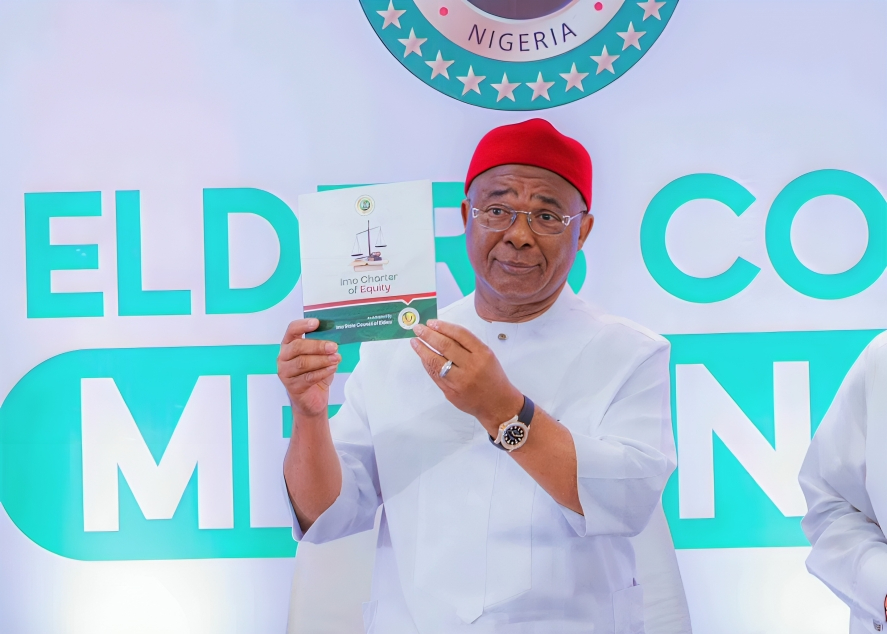
Governor Hope Uzodimma’s formal receipt of the Imo Charter of Equity from the Imo State Council of Elders goes beyond symbolism; it represents the consolidation of a long, often bitter demand for structural fairness in Imo’s power equation. For decades, the governorship question has sat at the centre of elite contestation across the three senatorial zones, shaping alliances, betrayals, and political calculations. That recurring argument has now been distilled into a formal Charter—placing both expectation and responsibility squarely on the governor’s table.

The Charter is arguably the most consequential political document to emerge in Imo State’s recent history. Its force lies not in legal authority but in moral persuasion, the insistence that no zone should be permanently consigned to the margins of power. In a state where political competition has often been shaped by exclusionary victories and wounded constituencies, the Charter attempts to institutionalize rotation as a stabilizing principle rather than an emotional demand.
At the core of the agreement is a clear recommendation that Owerri zone should take the first turn in the proposed rotation of the governorship. This position is anchored on long-standing arguments about political imbalance and perceived marginalization within the state’s power structure. Whether viewed through historical records or contemporary sentiment, the logic advanced is that equity must begin somewhere—and Owerri, by this reasoning, is that starting point.
What stands out in the current political moment is the unusual level of coordination among Owerri zone stakeholders. For once, the zone appears to be speaking with a largely unified voice on the question of succession. This is significant in a political environment where fragmentation has historically undermined its leverage and diluted its bargaining power at critical junctures.
This emerging cohesion reflects a shift in political maturity. It signals a gradual recognition that internal rivalry has often been more damaging than external competition. In practical terms, no political zone advances its interest effectively while divided against itself. The current alignment, therefore, is not just strategic—it is existential for Owerri’s governorship ambition.
With the Charter now formally before him, Uzodimma occupies a decisive position in shaping how this political experiment unfolds. He is not a ceremonial custodian of the document; he is the central actor whose decisions will determine whether it becomes a governing principle or another abandoned political declaration. The weight of that responsibility is unmistakable.
There is a strong argument that political logic and moral consistency both point in the direction of Owerri zone. For the governor, endorsing that trajectory would not only align him with the Charter’s intent but also potentially secure a legacy defined by institutional fairness rather than transactional politics. Few leaders are afforded the opportunity to reshape the rules of succession while still in office.
Yet, caution is necessary. The unity currently displayed by Owerri stakeholders remains fragile and could easily collapse under the pressure of individual ambition. The governorship ambition, by its nature, attracts competing interests, and without disciplined coordination, internal rivalry could once again undermine collective aspirations.
Historical experience reinforces this concern. On multiple occasions, Owerri zone’s governorship prospects have been weakened not by opposition from other zones, but by internal fragmentation. Aspirations have often multiplied faster than agreements, resulting in divisions that outsiders have routinely exploited. Repeating that pattern would amount to political self-sabotage at a defining moment.
This is precisely where Uzodimma’s political calculation becomes critical. Within the architecture of Nigerian party politics, sitting governors wield considerable influence over succession processes. Such influence is neither unusual nor controversial; it is part of the informal mechanics of power transition. The question is how deliberately and constructively that influence is exercised.
If mismanaged, the succession process could descend into internal contestation that weakens Owerri zone’s position before the broader political field even engages. A fragmented front would erase the advantage currently being built. Strategic clarity, therefore, is more important than sentimental entitlement or unchecked ambition.
From a broader political perspective, Uzodimma represents the most immediate and structurally positioned actor capable of making the Owerri governorship possibility realistic in the short term. While other aspirants from.Owerro zone across other parties will inevitably emerge, incumbency remains a decisive force in shaping outcomes in Imo’s political landscape.
There is also a historical pattern that cannot be ignored. Outgoing governors in Imo State have consistently struggled to install successors, often due to shifting alliances, internal party tensions, and voter recalibration. This entrenched pattern of disruption makes succession continuity a complex political task rather than a guaranteed extension of influence.
Still, the present moment presents an unusual alignment of conditions: a formal Charter, a relatively unified Owerri political bloc, and an incumbent governor with significant influence over party dynamics. Such convergence is rare in Imo’s political history. However, political opportunity is never self-executing; it requires deliberate and disciplined action to translate potential into outcome.
Ultimately, the real value of the Imo Charter of Equity will not be measured by its adoption or ceremonial recognition, but by whether it survives the transition from principle to practice. Governor Uzodimma now stands at a defining intersection where his choices could either recalibrate Imo’s political balance or reinforce its familiar cycles of tension and distrust. His decision will shape not only the next succession cycle, but also how history remembers this moment of supposed political correction.