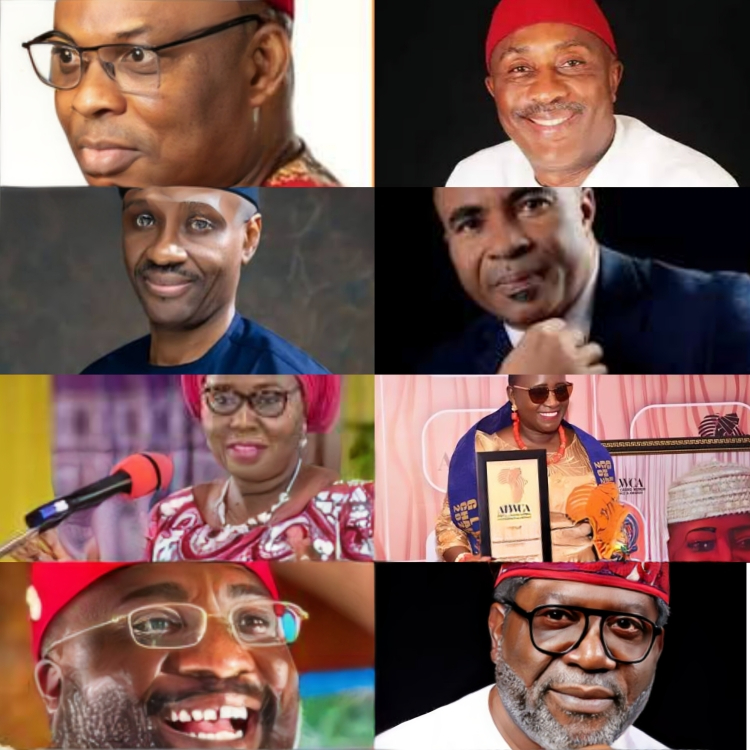
*This report provides an unbiased analysis of how zoning debate, crowded field of aspirants and party stakes set stage for explosive showdown in Imo East senatorial election in January 2027
The battle for the Imo East Senatorial District seat in 2027 is already gathering the weight, intrigue and intensity of a premium political contest. Months before campaigns formally peak, Owerri Zone has become one of the most closely watched theatres in Imo politics. The signs are unmistakable. A crowded field of aspirants, competing party calculations, resurging zoning arguments and the strategic importance of the zone all point to an election that may become the fiercest race in the state.
Unlike previous senatorial elections driven largely by party labels or isolated personalities, the coming contest offers an unusual convergence of top personalities. Former public office holders, seasoned politicians, business magnates, technocrats, professionals and new-generation political entrants are all jostling for relevance. This has elevated the contest beyond routine politics. It is now a test of structure, influence, resources, credibility and grassroots reach across the nine local governments that make up Owerri Zone.
Yet, in the zone, no senate race can be properly understood without confronting the enduring question of zoning. Rotation of the seat among internal blocs in the zone has, over the years, shaped negotiations, endorsements and voter sentiment. Even where political parties deny it publicly, zoning remains one of the hidden engines of the contest. As the 2027 election approaches, that old conversation has returned with fresh urgency.
However, the politics of zoning in Owerri Zone has often been more rhetorical than institutional. While many aspirants deploy it as a persuasive campaign tool to strengthen their ambitions and appeal to certain sentiments, it has rarely been subjected to a formal round-table agreement among the competing blocs. In practical terms, zoning has operated more as moral persuasion than binding political doctrine. Most political parties, especially during primaries, have historically prioritised electability, structure and strategic advantage over rotational or zoning claims.
Even within the ruling APC, which recently embraced the Charter of Equity as a framework for balancing political offices across the state, uncertainty remains over how such a principle would apply in selecting a consensus candidate for Imo East. Whether the party leans on zoning arithmetic, open competition or political pragmatism may become one of the defining subplots of the contest.
Owerri Zone is broadly organised around four principal blocs — Mbaike, Owerri Federal Constituency, Mbaise and Ngor Okpala. Crucially, all four blocs have, at various points, produced senators for the zone. This singular fact has widened the field of legitimate claimants for 2027, because no bloc can convincingly be dismissed as politically excluded. Every bloc can point to history, contribution and entitlement. That reality alone makes consensus difficult and competition inevitable.
Since the return of democracy in 1999, Mbaike bloc has enjoyed the strongest footprint in the zone’s senate history. The bloc produced the late Evan Enwerem, who rose to become Senate President, placing Owerri Zone at the centre of national politics at that time. It also produced Amah Iwuagwu and later Samuel Anyanwu, who chaired the strategic Senate Committee on Ethics and Privileges.
Owerri Federal Constituency has also left a clear imprint on the zone’s political ledger. Eze Ajoku completed the tenure of Amah Iwuagwu after the latter died in office, while the incumbent Ezenwa Onyewuchi has served two terms spanning eight years. In practical terms, Owerri Federal Constituency enters the 2027 race with incumbency factor and a sustained record of representation.
Mbaise, on its part, can point to the emergence of Chris Anyanwu, whose tenure brought visibility, eloquence and national recognition to the zone. Her service remains a reference point in discussions about quality representation. There is also the unresolved debate over Ngor Okpala’s political alignment — whether it should be treated separately or historically grouped within the wider Mbaise bloc. That disagreement has never fully disappeared and may again influence calculations in 2027.
Against this backdrop, the number of aspirants in the contest explains why the race is drawing attention across the state. In the All Progressives Congress, the major contestants include Dr. Alex Mbata, businessman and philanthropist who contested in 2023; Osita Opara, former chairman of Mbaitoli Local Government Area; Chijioke Kaduru; and Chetachi Nwoga, a United States-based trained medical practitioner. There are also speculations that another top politician from Mbaike would also join the line up of APC senatorial aspirants before the primary.
The opposition is no less animated. In the Peoples Democratic Party, former deputy governor Eze Madumere has revived interest in the party’s prospects. In the African Democratic Congress, former House of Representatives member Uche Onyeagocha remains a formidable figure. The Labour Party has former Ondo State First Lady, Mrs. Betty Anyanwu Akeredolu and Basil Maduka in contention, while Chima Amadi of the Action Peoples Party, APP says he is temporarily shelving his governorship ambition to pursue the senate seat first. Based on present indications, Madumere, Onyeagocha and Amadi are widely expected to clinch the tickets of their respective parties, being at the moment the only aspirants vying for tickets of their various parties.
The outcome of party primaries is also expected to significantly shape the colouration of the contest. How candidates emerge, whether through consensus or direct primaries may determine post-primary unity or lingering fractures. In a race projected to be fiercely competitive, any party entering the senatorial election divided would be carrying a self-inflicted handicap.
For the APC, the election carries significance beyond a single legislative seat. Since 2015, the ruling party has repeatedly failed to secure Imo East Senate seat. It’s senatorial candidates lost to the opposition. In 2015, Uche Onyeagocha lost to Samuel Anyanwu of the PDP. In 2019, Emma Ojinere was defeated by Ezenwa Onyewuchi of the All Progressives Grand Alliance. In 2023, Alex Mbata lost to Onyewuchi, this time under the Labour Party. However, with an outgoing governor also expected to focus on producing a successor in the November 2027 governorship election, breaking the jinx of serial defeats in Owerri zone for his party would carry both strategic and symbolic value for the APC.
For the opposition parties, retaining the seat would be equally consequential. It would reinforce the perception that Owerri Zone remains politically competitive and resistant to one-party dominance. The ADC would be banking on the possibility that if Peter Obi emerges as a presidential candidate again, a fresh electoral wave similar to the 2023 momentum that swept many Labour Party candidates across the South East, including Owerri zone, could energise its own fortunes. PDP, meanwhile, would see victory as evidence of revival and renewed grassroots relevance.
The APP cannot be waved aside either, considering the political mileage it has gained across the state in recent years, including notable visibility in Imo East. With Chima Amadi providing structure, visibility and momentum, the party could yet alter established calculations and force bigger parties into uncomfortable arithmetic.
Ultimately, the 2027 race may be decided by three hard variables: who emerges from primaries without deep internal wounds, whose message best balances zoning with competence, and who can convert elite endorsements into grassroots votes. What is already certain is that Owerri Zone is preparing for a bruising, high-stakes and intellectually compelling contest. In keeping with its history, the zone is once again summoning some of its finest to seek a seat that has long carried prestige, influence and expectation.