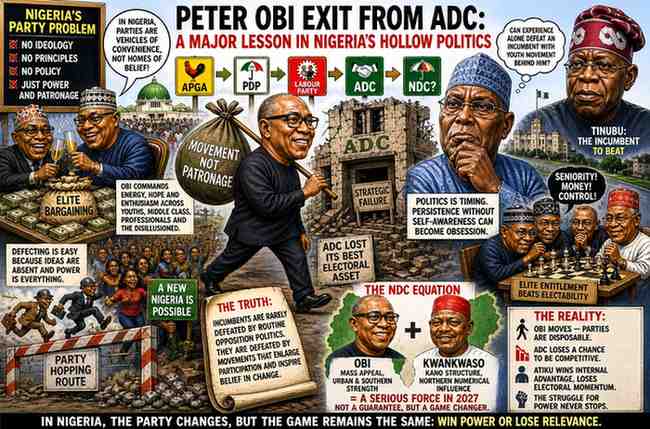
Peter Obi’s exit from the African Democratic Congress (ADC) should surprise no one who understands the fluid, ideology-starved character of Nigerian politics. It is less a political earthquake than another chapter in a familiar national script. Obi’s movement from APGA to PDP, Labour Party, ADC, and now reportedly toward the National Democratic Congress (NDC), reflects a political culture where parties are treated as temporary vehicles rather than enduring institutions of belief.
This is the enduring weakness of Nigeria’s democracy. Political parties are rarely organized around ideas, coherent policy traditions, or philosophical commitments. They are often little more than platforms assembled for convenience and elite bargaining. That is why politicians defect with remarkable ease. In systems where ideology matters, such migration would demand explanation. In Nigeria, it is merely business as usual.
Yet Obi’s departure carries unusual significance because he is not an ordinary defector. Since the 2023 elections, he has built one of the most energetic political followings in the country. He commands enthusiasm among young voters, sections of the middle class, professionals, and citizens disillusioned with the old political order. Whether one admires him or not, he remains one of the few politicians in the country whose appeal extends beyond patronage structures.
That is why ADC’s inability to retain him amounts to strategic failure on its part. Any opposition party serious about defeating an incumbent government should organize itself around its most electable asset. Obi offered ADC a candidate capable of energizing turnout, attracting volunteers, dominating public conversation, and expanding the electoral battlefield. Losing such an asset indicates either poor judgment or internal contradictions too deep to manage in the ADC
Instead, ADC appears to have fallen into a common trap, which is sacrificing electoral appeal for elite entitlement. Many parties know who can best win nationally, yet refuse to rally behind that person because internal power brokers prefer seniority, money, and control. They often win internal contests while losing the larger war before campaigns even begin.
At the center of the matter lies Atiku Abubakar’s continued presidential ambition. No one can dismiss his experience, resilience, or national network. But politics also requires timing and self-awareness. There comes a point when repeated ambition begins to look less like persistence and more like refusal to yield to changing realities. If Atiku believes he can displace Bola Tinubu without Obi’s electoral energy, he may be overestimating himself and the momentum at hand.
The truth is that incumbent Presidents are seldom defeated by routine opposition politics.They are defeated by candidates who create movements, enlarge voter participation, and inspire belief that change is possible. Obi has shown some capacity for that type of politics. Atiku represents a more traditional opposition model—experienced, formidable, but less capable of generating insurgent enthusiasm moreso against a strong Bola Tinubu.
Obi’s reported move to NDC therefore alters the political map. NDC may lack nationwide structure today, but structure in Nigerian politics is often overstated. It can be built, rented, negotiated, or inherited through alliances. What cannot be quickly created is genuine voter enthusiasm. Obi already possesses that currency, and with time he could convert it into organizational strength and power to win elections.
If Rabiu Musa Kwankwaso eventually joins the NDC, the equation becomes even more interesting. Kwankwaso’s enduring influence in Kano gives him strategic relevance. A coalition combining Obi’s southern and urban support with Kwankwaso’s northern numerical base especially in Kano would become a serious factor in 2027. It may not guarantee victory, but it would certainly reshape the contest.
Ultimately, Obi’s exit from ADC is another reminder that Nigerian parties remain weak containers for strong personal ambitions. ADC may have lost its best chance at national competitiveness, to defeat Tinubu. Atiku may have secured internal advantage but he has weakened the prospects of the opposition in the coming. elections. And Obi, by moving again, has shown that in Nigeria’s politics, parties are often disposable—but the struggle for power never is.