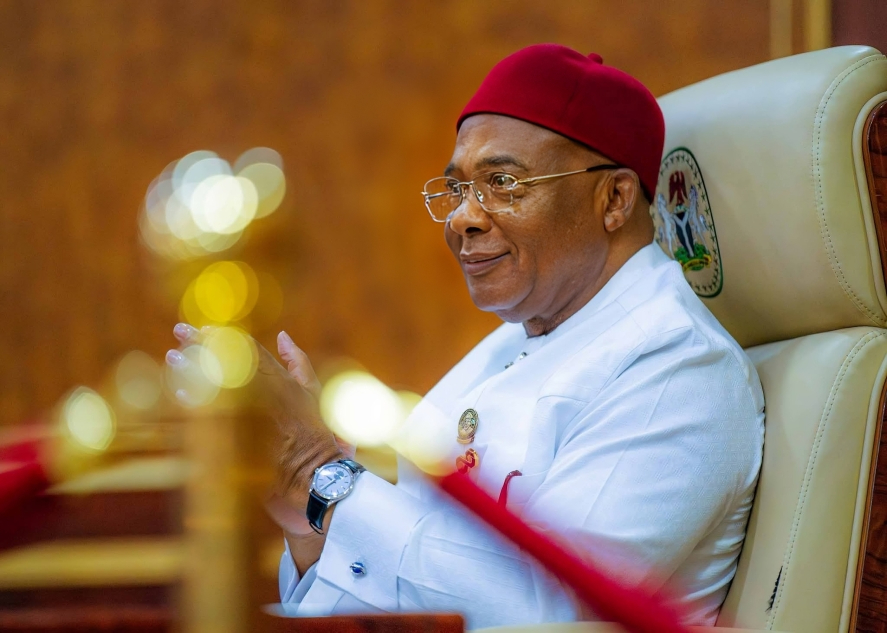
Governor Hope Uzodimma is increasingly operating in what can best be described as a tightening political vise, where elite rivalry—not opposition politics—is defining the contours of his current challenges. The pressures around him are not random; they are coordinated, measured, and reflective of a deliberate effort to contain his expanding influence within Nigeria’s ruling power circle. In effect, his proximity to power has become both his greatest asset and a source of discomfort for entrenched interests.

The latest trigger is the Nigerian Senate, led by Godswill Akpabio, which recently adjusted its internal rules after a closed-door session to guide how principal officers of the next National Assembly will emerge. The revised framework reportedly strengthens party control, zoning arrangements, and legislative ranking—effectively tightening the eligibility space and limiting opportunistic bids for leadership positions.
Although framed as procedural House rules, the implications are unmistakably political. The changes appear designed to block perceived external contenders, especially those without deep legislative roots or those suspected of planning a strategic entry into the Senate with leadership ambitions. In that context, Uzodimma’s alleged interest in the Senate Presidency becomes the thorny issue —and, arguably, the core logic—behind the amendments.
Yet, the move is laced with irony. Those shaping these rules are themselves subject to electoral uncertainty. There is no guarantee they will return to the Senate to enforce what they have designed. This underscores a familiar paradox in Nigerian politics—where power is exercised with immediacy, but its continuity is never assured.
Even so, within political circles, the Senate’s action is widely interpreted as a preemptive strike against Uzodimma. Whether or not he has formally declared any ambition is secondary; in Nigeria’s political ecosystem, perception often triggers defensive maneuvers. The mere suspicion of intent is enough to activate countermeasures.
Beyond the Senate, Uzodimma’s travails reflect a broader, largely subterranean cold war within the ruling APC. His role as chairman of the governors’ forum and his closeness to Bola Tinubu have significantly elevated his national relevance. But in a system where access to presidential power is fiercely contested, such visibility inevitably breeds resistance from competing blocs.
Tensions with Nyesom Wike further complicate the equation. At the heart of this friction, according to political insiders, is Uzodimma’s perceived role in facilitating the political repositioning of Siminalayi Fubara toward the APC—effectively insulating him from Wike’s sphere of control. This move is believed to have deepened Wike’s grievances, as it not only diluted his influence in Rivers State but also signaled Uzodimma’s capacity to intervene decisively in high-stakes political alignments.
Compounding this is Uzodimma’s broader reputation as a political mobilizer who has, in recent times, played a visible role in encouraging defections of opposition governors into the APC. While such moves strengthen the ruling party on paper, they also unsettle internal power balances, particularly among actors who interpret his growing reach as overextension. To such interests, Uzodimma increasingly appears as a political blade—sharp, strategic, and potentially disruptive—necessitating containment.
Crucially, the pressure is not only external. There are indications of internal dissent from actors within Uzodimma’s political environment at home. These fractures, when combined with external hostilities, create a dual-front challenge that is both complex and destabilizing. Ultimately, what is unfolding is a calculated effort to check a rising power broker. Whether Uzodimma weathers this storm will depend on his ability to recalibrate alliances, neutralize internal threats, and navigate a power structure where influence is as contested as it is transient.